
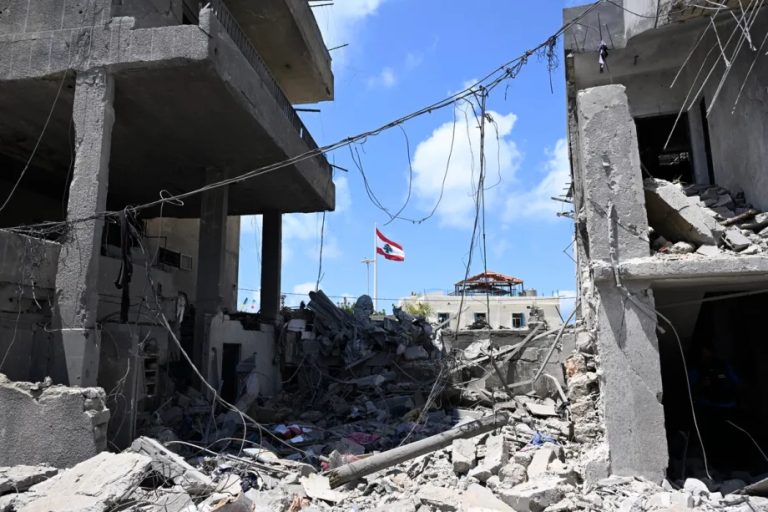
Nearly five decades after Israeli tanks first crossed into southern Lebanon, the same military rationale is being deployed to justify the same kind of operation, producing the same pattern of mass civilian displacement, infrastructure destruction, and strategic ambiguity. Operation Litani in 1978 killed an estimated 1,100 people and displaced roughly 285,000 civilians. The 1982 invasion, which deployed approximately 76,000 troops and produced a three-month siege of Beirut, contributed to death tolls estimated between 17,000 and 19,000 — followed by the Sabra and Shatila massacre that claimed between 1,300 and 3,500 more lives. The 2006 war killed over 1,100 Lebanese civilians and displaced approximately one million. The 2026 campaign has already produced more than 3,400 deaths, over 10,000 injuries, and the displacement of roughly 1.05 million people — close to one-fifth of Lebanon’s entire population. The arithmetic of each successive campaign is larger. The strategic outcome has been identical every time.
The question that no Israeli military briefing has answered in fifty years is the one that matters most: if repeated invasions, prolonged occupations, and comprehensive air campaigns have failed to eliminate Hezbollah across nearly five decades, what specific condition exists in 2026 that makes the outcome different this time? The question is not rhetorical. It has a history. Israel’s 1982 invasion was explicitly designed to destroy the PLO’s military infrastructure in Lebanon and establish a stable security environment in the north. What it produced instead was the political and social conditions from which Hezbollah emerged as a far more durable and deeply rooted force than anything it replaced. The organization’s legitimacy among Lebanon’s Shia community was built not despite Israeli occupation but because of it. Military campaigns designed to eliminate threats repeatedly generated the next generation of threats.
The Limits That History Has Already Established
The broader pattern extends well beyond Lebanon. Russia discovered in Afghanistan and Chechnya that overwhelming conventional force cannot extinguish political identity or sustain occupations against populations with deep grievances. The United States confronted the same ceiling in Vietnam and Iraq, where military dominance failed to translate into durable political orders. Israel itself withdrew from its self-declared security zone in southern Lebanon in 2000 after eighteen years of occupation that strengthened rather than weakened the organization it had tried to contain. The 2006 war, launched with the explicit aim of destroying Hezbollah’s military capacity, produced an eighteen-month ceasefire during which Hezbollah rebuilt more capable systems than those it lost. The lesson repeats with remarkable consistency: force can destroy infrastructure but cannot extinguish identity, organizational capacity, or the political grievances that sustain resistance movements over generations.
The recapture of Beaufort Castle last week was heralded in Jerusalem as a moment of national symbolism. The medieval hilltop fortress overlooking southern Lebanon served as an Israeli military outpost from 1982 until the withdrawal of 2000, when its abandonment became one of the defining images of strategic retreat. Its recapture in 2026 carries historical resonance that Israeli commentators themselves found troubling rather than reassuring — a monument not to progress but to a strategic time loop the region cannot exit.
Diplomacy and Destruction Running in Parallel
What makes the current moment particularly acute is the widening gap between what is being negotiated in Washington and what is happening on Lebanese ground. Ceasefire discussions continue while mass evacuation orders expand beyond the Zahrani River. Statements supporting de-escalation coexist with intensifying airstrikes on Beirut’s southern suburbs. International institutions issue warnings while struggling to enforce compliance with UN Security Council Resolution 1701, which has never been fully implemented despite having been on the books since 2006. The result is a multilateral system that retains the vocabulary of rules-based order while losing its practical capacity to enforce it.
The humanitarian consequences of that gap are accumulating in ways that are beginning to attract institutional attention that military operations cannot entirely deflect. Reports of strikes affecting hospitals and residential districts, combined with displacement figures that now represent nearly a fifth of Lebanon’s population, raise questions about proportionality that go beyond partisan disagreement over the conflict’s origins. The historical precedents for this scale of displacement and infrastructure damage in Lebanon suggest a reconstruction burden that an already economically shattered state cannot possibly carry without sustained international support — support that is significantly harder to mobilize when the destruction is still ongoing.
Nobody in this conflict is positioned to achieve outright victory. Israel cannot bomb away the political conditions that sustain Hezbollah across four decades of organizational resilience. Hezbollah cannot defeat Israel militarily regardless of its tactical gains. Lebanon lacks the institutional capacity to absorb another generation of war. The international community remains divided over enforcement mechanisms, political accountability, and whose interests any settlement should primarily serve. What diplomacy offers is not an ideal outcome but the only one that has not already been definitively tried and failed. Every military alternative has a fifty-year track record. The results are documented in the casualty figures of 1978, 1982, 2006, and now 2026 — each war larger than the last, each withdrawal more complicated, each rebuilt threat more capable than the one before.
Original analysis inspired by Kurniawan Arif Maspul from Middle East Monitor. Additional research and verification conducted through multiple sources.


