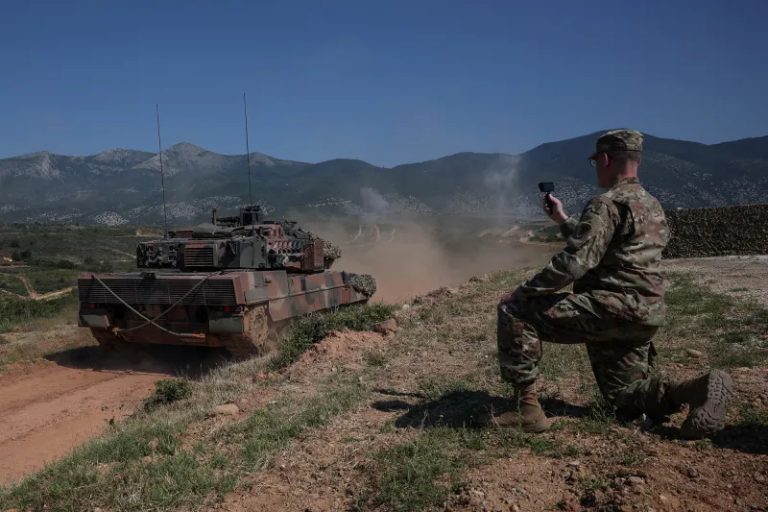
European governments have sharply raised their military budgets as Russian pressure on Ukraine continues and Washington shifts attention toward China. Germany expanded its defense allocation by 24 percent in 2025, reaching 2.3 percent of GDP for the first time in decades, while many NATO members now meet or exceed earlier benchmarks. This momentum follows commitments made at the 2025 Hague Summit, where allies set ambitious new spending paths. Yet these funds mainly target troops, tanks, and ammunition. They do not automatically close deeper gaps in the specialized systems that allow modern forces to coordinate, strike precisely, and survive sophisticated attacks.
Europe has made genuine progress on conventional strength. Initiatives such as the EU’s ReArm Europe plan aim to mobilize hundreds of billions through joint procurement and flexible financing. Countries like Poland have expanded forces rapidly, and joint projects seek to reduce fragmentation. France and Britain already provide nuclear capabilities that could anchor broader deterrence if integrated more deeply. These steps matter because Russia maintains substantial conventional forces along NATO’s eastern flank and shows no sign of abandoning its revisionist goals.
The persistent enabler shortfall remains the harder problem. American forces supply unmatched support in areas from real time battlefield data and secure command networks to logistics, cyber defense, and advanced targeting. European nations depend on these systems, as demonstrated when US intelligence, supply chains, and training helped Ukraine blunt a larger invading army. Without comparable assets, any European defense effort would face reduced precision, slower decision making, and higher casualties.
Studies show the scale of the challenge. The United States operates far more military satellites than all European NATO members combined, and many enabling technologies require nearly a decade to develop, integrate, and master. Political hurdles compound the technical ones. European states maintain different strategic cultures, industrial priorities, and threat perceptions, which slows unified planning and procurement. Even promising innovations in drones, commercial imagery, and artificial intelligence offer only partial substitutes in the near term. Full replication of American scale and seamless integration lies years away.
A structured cofinancing arrangement offers a practical bridge. European allies could commit phased payments directly tied to continued American provision of these critical enablers, perhaps held initially in escrow to guarantee performance. Such a deal would raise the real cost to Washington of sudden withdrawal while giving Europe budget certainty and opportunities for joint training at US facilities. A modest American presence would remain to manage integration and share operational lessons, helping European forces climb the learning curve faster.
This approach serves both sides. Europe could concentrate resources on building mass in combat units and reserves rather than diverting funds into duplicative satellite constellations or command infrastructures it cannot quickly perfect. Washington would gain direct financial contributions to maintain and expand its global enablers, resources that also support competition with China. The arrangement would also create leverage for wider negotiations, including steps toward tariff relief on European exports that could ease domestic political resistance in capitals from Berlin to Rome.
Critics may call the idea transactional. Yet alliances have always mixed shared values with hard calculations of cost and capability. Past European purchases of American equipment formed part of the original NATO bargain. Today’s version simply updates that logic for an era when the United States must stretch limited high end assets across multiple theaters while Europe assumes primary responsibility for its own territorial defense.
A realistic path forward strengthens deterrence. By locking in access to essential American enablers through financial incentives, Europe buys time to mature its own capacities without weakening immediate readiness against Russian aggression. Leaders should frame the proposal as mutual investment in a stronger alliance rather than concession or capitulation. In a world of simultaneous threats across Europe, the Indo Pacific, and the Middle East, pragmatic cooperation that preserves NATO’s operational edge offers the surest route to credible security. Over time, deeper European integration and innovation can reduce dependence, but pretending that moment has already arrived risks undermining the very deterrence the continent needs most.
Original analysis inspired by Luis Simón and Stephen G. Brooks from Foreign Affairs. Additional research and verification conducted through multiple sources.