Tag: Donald Trump

Indian Prime Minister Narendra Modi and President Donald Trump shaking hands while seated in the Oval Office, with aides and a fireplace in the background.

Trump’s Transactional Shift in US-India Relations

The US-India partnership is entering a pragmatic new phase characterized by a focus on tangible outcomes in trade, technology, and defense. While shared concerns regarding China’s influence sustain the alliance, the relationship now navigates a transactional landscape where immediate mutual benefits and market access take center stage.

Read More »
Secret Service agents and tactical law enforcement officers securing a stage during an emergency incident at a political rally, with an officer in tactical gear holding a rifle in the foreground.

US Sees Uptick in Left-Wing Political Violence

Recent high-profile attacks indicate a troubling uptick in left-wing political violence across the United States. Driven by deep societal polarization and digital radicalization, these incidents reflect a shifting extremist landscape where personal grievances blend with political rage, posing a significant challenge to democratic stability and public safety.

Read More »
A crowded anti-war protest in Times Square, New York City, with demonstrators holding yellow signs that read "HANDS OFF IRAN!" and "NO NEW US WAR IN THE MIDDLE EAST!" while photographers capture the scene.

Hormuz Blockade Tests Iran’s Resilience and US Resolve

The ongoing U.S. naval blockade of Iranian ports has turned the Strait of Hormuz into a volatile arena. While Washington aims to squeeze Tehran’s economy to force nuclear concessions, Iran is leveraging its geographic control over global oil supplies, shifting the economic burden onto international markets and testing American endurance.

Read More »
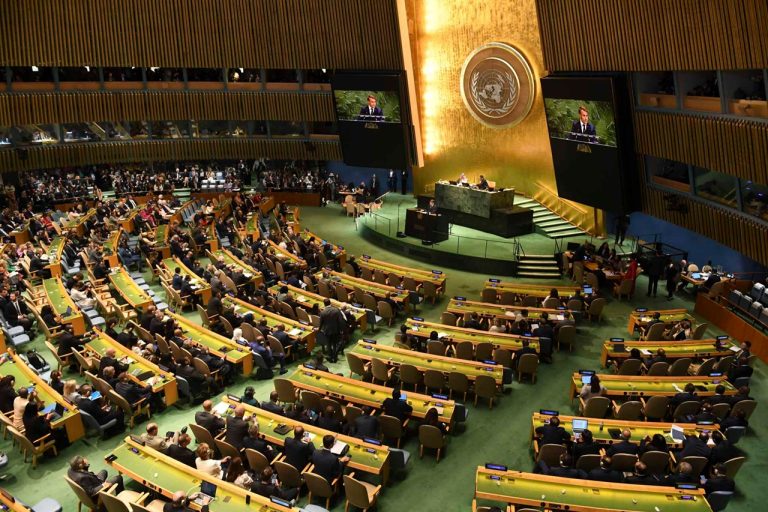
Wide-angle view of the empty United Nations General Assembly hall in New York with the UN emblem on the golden front wall.

The NPT’s Last Chance: Can New York Save Nuclear Diplomacy?

As the 2026 NPT Review Conference opens in New York, the global non-proliferation regime faces its most existential threat since the Cold War. Against a backdrop of active strikes on nuclear sites and the total collapse of U.S.-Russia arms control, diplomats must navigate a perfect storm of regional warfare and systemic mistrust. With Article VI commitments stalled and China’s arsenal surging to 600 warheads, the next four weeks will determine if the NPT remains a pillar of security or becomes a relic of a bypassed era.

Read More »
A U.S. military official speaking at a Pentagon press briefing with a screen showing a large container ship emitting smoke at sea.

Extended Iran Ceasefire Leaves US Facing Tough Choices

President Trump’s indefinite extension of the Iran ceasefire marks a strategic pause in the 2026 war, yet the path to peace remains blocked by a “triumvirate” of IRGC hardliners in Tehran and a rigid U.S. naval blockade. With oil prices surging to $107 and direct talks in Islamabad stalled, the administration faces a critical choice: can diplomacy survive a “military council” that has effectively sidelined Iran’s civilian government?

Read More »
Indian Prime Minister Narendra Modi standing between two European leaders, holding their hands up in a gesture of unity.

India’s Balancing Act: Surviving Trump 2.0 Without Picking a Side

The second Trump presidency has stress-tested India’s foreign policy like never before. Faced with tariff shocks and diplomatic friction over Russian oil, New Delhi has doubled down on its doctrine of multi-alignment. From finalizing a landmark EU trade deal to joining the US-led “Pax Silica” initiative while maintaining ties with Moscow and Beijing, India is navigating a fragmented global order by transforming economic pressure into strategic resilience.

Read More »
A silhouette of a US Navy aircraft carrier at sea during sunset with a fighter jet taking off.

US Iran Blockade Highlights Timing Challenges

The U.S. naval blockade of Iran, while intended to force concessions, has become a strategic bottleneck. Implemented after open hostilities had already commenced, the measure has inadvertently narrowed the space for diplomacy, prompting Iran to decentralize its operations and use the Strait of Hormuz as a counter-lever. This report examines the high cost of delayed coercive sequencing in a rapidly escalating regional conflict.

Read More »
A raised clenched fist wrapped in the Iranian flag against a dark, blurred background with bokeh lights.

Iran’s History of Defiance Challenges US Pressure

The current U.S.-Iran conflict is the latest chapter in a century-long struggle for Iranian sovereignty. By analyzing historical milestones from the 1953 coup to the recent 2026 escalations, this report explores why coercive diplomacy and tactical strikes often backfire. In a region where collective memory shapes modern policy, the pursuit of “domination” continues to underestimate the enduring power of national dignity.

Read More »
A large mural on a building in Tehran featuring historical figures and naval ships, with birds flying in the foreground.

Hormuz Standoff Tests Limits of International Law

The extension of the US-Iran ceasefire has shifted the battlefield to the legal and maritime domain. In the Strait of Hormuz, competing interpretations of international law—specifically the tension between UNCLOS transit rights and the laws of naval warfare—have created a volatile equilibrium. With 20% of global oil at stake, this managed confrontation tests the limits of international oversight and the resilience of global supply chains.

Read More »
A conceptual illustration of hands assembling a missile like a puzzle against a blue background with a North Korean flag piece.

Cold Peace Offers Realistic Path on North Korea

After thirty years of unsuccessful attempts at total denuclearization, North Korea’s nuclear program has evolved into a formidable, permanent threat. As Pyongyang accelerates missile testing and expands its nuclear facilities, the window for traditional diplomacy has closed. A new pragmatic strategy—a “Cold Peace”—focused on immediate risk reduction and crisis management, may now be the only realistic path to ensuring regional stability.

Read More »
A portrait of Donald Trump looking directly at the camera with a serious expression, wearing a blue suit and purple tie.

US-Backed Figures Risk Familiar Fate in Iran Crisis

A recurring pattern in American foreign policy—the cultivation of local proxies for regime change—is once again playing out in the Iran conflict. From exiled figures to ambitious local politicians, those seeking power through external sponsorship often ignore the cautionary tales of the past. History suggests that such collaborations are inherently fragile, frequently ending in isolation or abandonment once Washington’s strategic priorities shift.

Read More »
Two chess kings, one silver and one black, standing on a chessboard with the blurred flags of the United States and Iran in the background.

Iran War Erodes US Appetite for Middle East Role

As the conflict enters its third month, domestic opposition to U.S. military engagement in the Middle East has reached a critical tipping point. Driven by rising energy costs and economic anxiety, a majority of Americans now disapprove of the ongoing campaign. With the 60-day War Powers Resolution deadline approaching, the administration faces a defiant Congress and a public increasingly weary of open-ended regional commitments.

Read More »