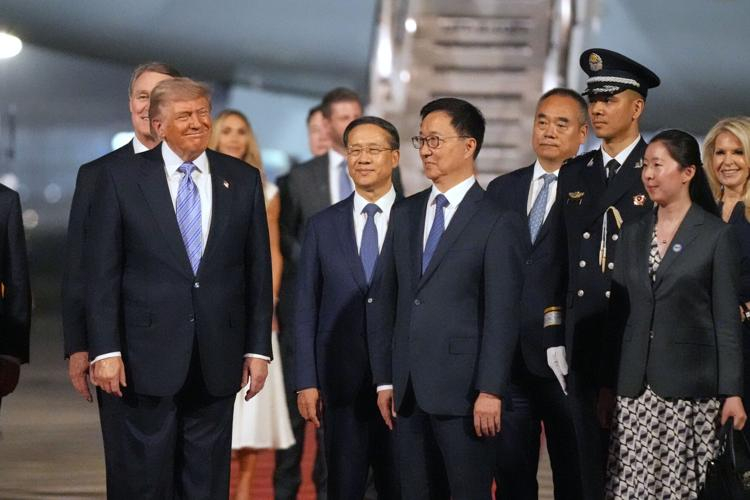
Donald Trump’s latest comments on Taiwan have reopened one of the most sensitive questions in U.S.-China relations: how far Washington is willing to go in backing Taipei. After his Beijing summit with Xi Jinping, Trump told Fox News that he was not seeking to see Taiwan “go independent.” For Beijing, the remark was useful confirmation that Taiwan remains the central red line in dealings with Washington. For Taipei, it was a reminder that U.S. support is strong, but not unconditional.
The timing matters. China’s official account of the Xi-Trump talks placed Taiwan at the top of the bilateral risk list, warning that mishandling the issue could push the two powers toward confrontation. The message was not new, but it carried extra weight after a high-profile summit built around stabilizing ties. Beijing sees any formal move toward independence as a direct challenge to sovereignty. Washington, meanwhile, is trying to preserve deterrence without being pulled into a conflict neither side can easily control.
For Taiwan’s leadership, the difficulty lies in reading Washington’s ambiguity correctly. A Reuters report said Trump’s remarks caused concern in Taipei, even as Taiwan’s officials insisted U.S. policy had not changed. That distinction is crucial. The United States still operates under a one-China policy shaped by the Taiwan Relations Act, the Three Communiqués, and the Six Assurances. Yet those frameworks were designed to deter force and preserve the status quo, not to give Taipei a blank check for moves that could trigger a war.
Taiwan’s security relationship with the United States remains real. Under the Taiwan Relations Act, Washington is committed to helping the island maintain sufficient self-defense capacity. President Lai Ching-te has defended U.S. arms purchases as a deterrent against instability, arguing that Taiwan will not provoke conflict but will not surrender its democratic system or sovereignty under pressure. That is Taipei’s balancing act: strengthening deterrence while avoiding steps that Washington or Beijing could interpret as unilateral escalation.
Trump’s transactional language adds another layer of uncertainty. His suggestion that a future arms package could depend on China feeds anxiety in Taipei that Taiwan may be treated as leverage in a broader U.S.-China bargain. The White House’s post-summit fact sheet focused heavily on trade, investment, agriculture, and strategic stability, leaving Taiwan outside the public list of summit outcomes. That omission may have been intentional, but it also shows how carefully Washington is managing the issue.
Beijing is likely to see Trump’s words as a diplomatic opening. China’s Foreign Ministry has already framed opposition to Taiwan independence as the foundation for cross-Strait peace and has urged Washington to take concrete actions consistent with that view. The risk is that each side defines “peace” differently. Beijing links peace to blocking independence; Taipei links it to resisting coercion; Washington links it to preventing unilateral changes by either side.
The result is a narrower space for political symbolism and a higher price for miscalculation. Taiwan cannot assume that American support will automatically translate into military intervention under every scenario. China cannot assume that U.S. caution equals acceptance of coercion. Washington cannot rely forever on ambiguity if both Beijing and Taipei keep testing its limits.
Trump’s remark should not be read as a full policy reversal. It should be read as a warning about the boundaries of U.S. backing. For Taiwan, the safest course is not passivity, but disciplined deterrence: stronger defense, deeper international partnerships, and careful avoidance of moves that could isolate the island diplomatically. In the Taiwan Strait, confidence is useful only when it is matched by restraint.
Original analysis inspired by Hai Feng from Global Times. Additional research and verification conducted through multiple sources.