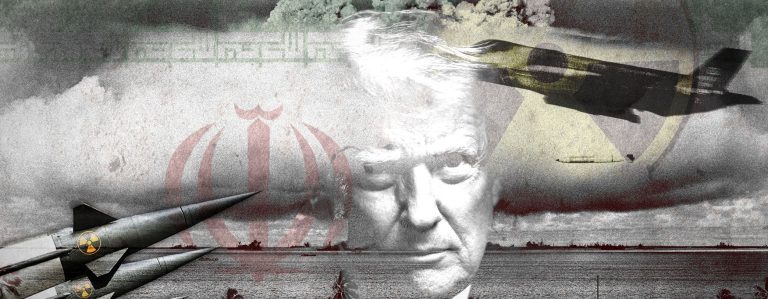
The question circulating in certain strategic circles — whether the United States or Israel would use a nuclear weapon against Iran — deserves serious analytical treatment rather than dismissal as too extreme for consideration. It is no longer a question of capability. Both countries possess the means. The relevant question is what the world looks like on the other side of that threshold, and whether any conceivable military objective would survive contact with the consequences.
The nuclear taboo — the unwritten but behaviorally powerful restraint against wartime nuclear use that has held since 1945 — is not a legal prohibition. It is a political and psychological architecture built over eight decades of accumulated state behavior, near-miss experiences, and institutional norm-building. Once broken, it cannot be rebuilt by the country that broke it. The United States is the only nation to have used nuclear weapons in war — twice. It therefore bears a particular burden of credibility as a custodian of restraint. A second instance of wartime nuclear use, regardless of target or yield, would confirm for every government in the world that the taboo is contingent rather than categorical, and that only nuclear-armed states enjoy reliable protection against nuclear coercion.
The Tactical Illusion
The concept of a “limited” nuclear option — sometimes framed as a demonstration strike on Iranian desert territory or a tactical warhead targeting underground nuclear facilities — rests on a fundamental misreading of how nuclear weapons function politically. A nuclear detonation in an uninhabited desert is still a nuclear detonation. Its blast and radiation effects would be localized. Its political and strategic effects would be global and permanent. Every government watching would draw an identical lesson: the restraint that has governed nuclear-armed states since 1945 is contingent on the interests of the most powerful actors, and can be abandoned whenever those interests are sufficiently engaged.
For Iran specifically, a nuclear demonstration strike — even one causing no immediate mass casualties — would end any remaining internal debate about whether to pursue nuclear weapons. The Iranian leadership would face a domestic political environment in which acquiring a deterrent became an absolute national priority, backed by a population that had just experienced the reality of nuclear coercion. The strategy would guarantee the proliferation outcome it was ostensibly designed to prevent, while simultaneously destroying the international credibility required to manage that outcome diplomatically.
Geography and the Fantasy of Destruction
The most extreme version of the nuclear argument — that Iran could be decisively defeated or forced to capitulate through nuclear strikes — collapses under basic geographic and demographic scrutiny. Iran covers approximately 1.6 million square kilometers, with mountainous terrain stretching across much of its territory. Tehran’s metropolitan area alone is enormous — comprehensively devastating it through blast effects would require multiple coordinated strikes, producing civilian casualties that would shock global conscience and still leave the Iranian state institutionally functional in ways that Trump’s rhetoric about returning Iran to the “Stone Ages” does not acknowledge.
The historical evidence against the premise that overwhelming violence produces rapid political submission is extensive. Sustained bombing campaigns across the twentieth century — from Dresden to Hanoi to Baghdad — repeatedly failed to break civilian morale or force political capitulation. A nuclear strike on Iranian territory would be more likely to generate national rage, mass mobilization, and a permanent civilizational commitment to deterrence than to produce the surrender its advocates assume. The strategy risks failing before its stated objectives are achieved, while guaranteeing the consequences that make success irrelevant.
The International System After Threshold Crossing
The systemic consequences extend well beyond Iran. NATO’s cohesion would face an immediate and potentially fatal test if the United States were directly involved in, or openly supported, a wartime nuclear strike. European governments whose populations would regard such an action as indefensible would confront an impossible choice between alliance solidarity and domestic political survival. The fractures that the Iran war has already opened within the Western alliance — Spain denying base access, Italy refusing landing rights, France blocking weapons transit — would deepen into something potentially permanent.
The proliferation cascade would follow predictably. North Korea would conclude that the taboo’s collapse validated its decision to develop and retain nuclear weapons. Countries currently under American extended deterrence — South Korea, Japan, Poland — would accelerate their own internal debates about independent deterrents. Saudi Arabia’s ongoing exploration of nuclear arrangements with Pakistan would acquire new urgency. Pakistan itself — a nuclear-armed Muslim-majority country sharing civilizational ties with Iran — would face enormous domestic pressure to respond in ways its government might not be able to control.
The world that exists on the other side of the nuclear threshold is not a world in which American or Israeli security problems have been resolved. It is a world in which the single most important restraint on the worst imaginable conflict has been deliberately discarded, with no mechanism for restoration. The question is not whether Washington or Tel Aviv possesses the technical capability to cross that line. The question is whether anyone inside either government has thought seriously about what they would be building in its place.
Original analysis inspired by Hadi Zaarour from The Cradle. Additional research and verification conducted through multiple sources.