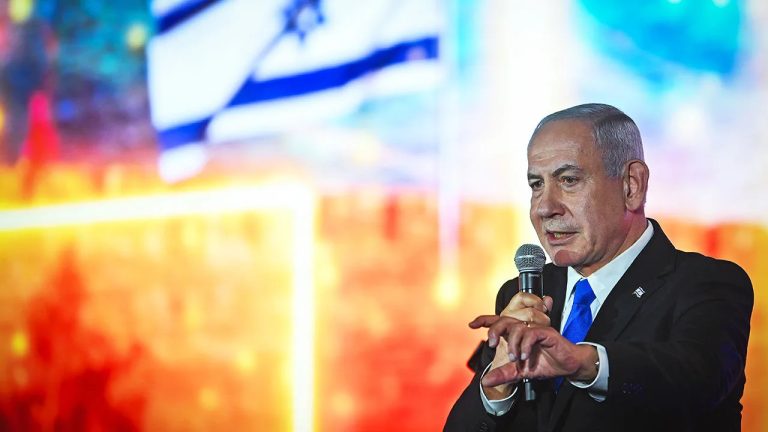
Benjamin Netanyahu may be heading for the exit. A government-backed Knesset dissolution bill passed its preliminary reading on May 20, 2026, by a vote of 110 in favor, and former Prime Ministers Naftali Bennett and Yair Lapid have announced a merger of their parties specifically aimed at uniting a fragmented opposition against him. Polls have successively predicted Netanyahu will lose the next election, due by the end of October. But the shape of what comes after him is already being determined by decisions made during his tenure — and none of them will be easy to undo. Whatever government succeeds his will inherit three crises in various stages of combustion.
The War’s Moral Ledger
The first crisis is legal and international. In November 2024, the International Criminal Court issued arrest warrants for Netanyahu and former Defense Minister Yoav Gallant, alleging responsibility for the war crime of starvation as a method of warfare and crimes against humanity during the Gaza war. The warrant against Netanyahu is the first ever issued against the leader of a Western-backed democratic country for war crimes. Since then, the scope of Israel’s legal exposure has only grown. In 2026, Haaretz reported that the ICC Office of the Prosecutor had secretly requested arrest warrants for National Security Minister Itamar Ben-Gvir, Finance Minister Bezalel Smotrich, and two unnamed IDF officers.
Any successor government that hopes to restore Israel’s international standing will face immediate pressure to distance itself from Netanyahu’s wartime conduct. The obvious temptation is to cooperate with The Hague, hand over Netanyahu and his allies, and argue that Israel under new management is a different country. But that road runs through deep political minefields. Naftali Bennett, a top contender in the election, has pledged only to establish a commission of inquiry into October 7 — not to address the ongoing international prosecutions directly. The question of whether a change coalition could or would actually cooperate with ICC arrest warrants has no clean answer.
The West Bank Time Bomb
The second crisis is territorial and structural. Some 700,000 settlers now live in the West Bank and East Jerusalem, alongside 3.8 million Palestinians who are hoping to establish a future state there. The Netanyahu years have not simply expanded settlement construction — they have cultivated a paramilitary culture within parts of the settler movement that now operates with effective impunity. The term “Hilltop Youth” may no longer accurately describe these groups, whose structure, tactics, and growing confidence suggest they now function more as a paramilitary organization than as an informal collection of radicalized young settlers.
The legal record confirms it. Data collected by Yesh Din shows that between 2005 and 2025, 93.6% of investigation files opened by Israeli police into ideologically motivated crimes by Israelis against Palestinians in the West Bank were closed without an indictment, and only 3% of such cases resulted in full or partial convictions. Since the war with Iran intensified, more than 10 incidents of settler violence have been documented daily in the West Bank, including large-scale attacks involving hundreds of participants.
The political dilemma for any incoming government is acute. Under Finance Minister Smotrich’s leadership, many of the outpost farms that once existed in legal gray zones are now being formally legalized. Reversing that process would require dismantling infrastructure, withdrawing army protection, and confronting settlers who have been told for years that the state stands behind them. An opposition leader who built his career as head of the settler umbrella movement would find that reversal politically treacherous, yet internationally unavoidable. The 150 outpost farms Netanyahu leaves behind are not just a land dispute — they are a security apparatus embedded in the occupied territory that no successor can simply ignore.
The Tribunal That Cannot Be Undone
The third crisis may be the most consequential for Israel’s long-term identity. On May 11, 2026, the Knesset approved the “Prosecution law for the October 7 Massacre” (officially the Prosecution of Participants in the October 7 Massacre Events Bill), creating a dedicated military tribunal to handle the prosecution of roughly 300 to 400 Hamas Nukhba Force operatives held in Israel since the attack. The law includes a legal framework that will allow the death penalty for those convicted of genocide, marking a profound shift for a country that has not carried out an execution since 1962. The bill was approved after 93 out of 120 Knesset members voted in favor, with none opposed, reflecting a rare moment of near-total cross-party consensus.
The international legal concerns are serious. Civil rights organizations, including the Legal Center for Arab Minority Rights in Israel (Adalah), have explained that the law lacks the baseline standards of a fair trial and fails to meet international legal requirements. Legal scholars note that it allows for collective indictments, mass trials, and broad judicial discretion to deviate from standard rules of evidence—potentially admitting statements obtained under coercive conditions that may amount to torture or ill-treatment. The law also permits the filming and public broadcasting of key moments in the trials, including opening hearings, verdicts, and sentencing, via a dedicated website.
Analysts, human rights campaigners, and international organizations including the United Nations have all questioned whether real justice will be delivered by the tribunal, with many considering it an institutionalized mechanism for state retribution. The security implications are equally pressing. If mass executions follow a series of televised verdicts — in a country simultaneously managing fragile ceasefires and high-stakes regional tensions — the risk of retaliatory hostage-taking against Israelis and Jewish communities abroad is not hypothetical. Israeli security services have warned of exactly this scenario for years.
The coming election debate will likely focus on Haredi conscription, coalition arithmetic, and who controls the domestic October 7 inquiry. The election will be a crucial factor in determining Israel’s immediate political future, the stability of fragile border ceasefires, and whether a broader diplomatic track can ever be revived. But the three structural problems Netanyahu has embedded into Israeli reality — international criminal exposure, a legally fortified settler presence in the West Bank, and a capital punishment tribunal with no precedent in modern Israeli history — are not merely electoral issues. They are the fixed terrain on which every future Israeli government will be forced to operate, regardless of who wins in October.
Original analysis inspired by Aluf Benn from Haaretz. Additional research and verification conducted through multiple sources.