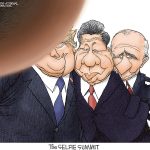
Three warm summits in six months between Donald Trump and Xi Jinping have sparked talk of a lasting thaw between Washington and Beijing. Yet Chinese strategists harbor few illusions about how long this diplomatic truce will survive once Trump leaves office. Rather than treating the current calm as a permanent settlement, Beijing is racing to lock in tangible economic and strategic advantages before a hawkish backlash returns to Washington. Every trade pledge, diplomatic gesture, and regional pressure campaign serves a single goal of raising the baseline before competition resumes.
Chinese officials publicly attribute the easing of bilateral tensions to a balance of economic pain. Beijing responded to sweeping American tariffs in April 2025 with matching duties and later restricted shipments of critical rare earths, compelling Washington to negotiate the Busan truce in October 2025. Data from the Center for Strategic and International Studies shows American imports of controlled Chinese rare earth compounds still dropped nearly 75 percent over the eleven months after that agreement. Promoting this narrative of mutual deterrence projects Chinese strength at home and validates Xi Jinping’s hardline economic posture.
That structural explanation, however, ignores how much of the thaw stems from Trump’s own choices rather than Chinese leverage. Even before tariff hostilities peaked, the White House abandoned the Biden administration’s framing of democracy against authoritarianism and adopted a cooler tone on Taiwan. Washington still commands immense technological and financial leverage, yet Trump has largely left those tools unused in favor of personal dealmaking. When Nvidia chief Jensen Huang resigned over an espionage scandal in November 2026, Trump personally intervened with the company’s board to secure his reinstatement within days.
Consolidating Leverage Across Trade and Security
Aware that a future president may not share Trump’s transactional instincts, Beijing is using the next two years to institutionalize cooperation. During Trump’s May 2026 visit to Beijing, both governments chartered new boards of trade and investment alongside Chinese pledges to buy 200 Boeing jets and billions in American farm goods. For Chinese leaders, full execution matters less than creating visible commercial stakes that future American policymakers will hesitate to dismantle. Even if bilateral ties deteriorate sharply after 2028, Beijing calculates that a higher starting floor will leave China in a stronger position.
Economic engagement runs parallel to a sharper push on regional security and technology chokepoints. At the November 2026 Shenzhen summit, Xi pressed Trump over Taiwan while a $14 billion American arms package for Taipei remained stalled following Democratic midterm gains in Congress. Meanwhile, Chinese export controls continue squeezing Japanese manufacturers even as lawmakers in Washington draft stricter semiconductor bills after the Nvidia controversy. By pairing commercial carrots for Washington with steady pressure on Japan and the Philippines, Beijing aims to normalize limits on American regional backing.
The Fragile Bet on American Public Opinion
Beijing is also investing heavily in grassroots diplomacy to soften American skepticism from the bottom up. During his September state visit to Washington, Xi invited 100,000 young Americans to study and travel in China over the next five years. Recent polling from the Chicago Council on Global Affairs shows that American attitudes toward China have warmed since 2024, with support for deploying troops to defend Taiwan falling to 38 percent. Chinese planners view student exchanges and cultural outreach as insurance against a swift political reversal.
Yet this charm offensive rests on a shaky assumption about how American public opinion actually moves. Voters frequently take their cues from political leaders rather than shaping elite consensus from below, meaning Trump’s pivot likely drove much of the recent moderation. Once a more hawkish administration takes office, public sentiment could harden just as quickly and turn Chinese outreach into a domestic political liability. Beijing knows the current calm is temporary, which is why every concession extracted today is designed to outlast the truce itself.
Original analysis inspired by Yun Sun from Foreign Affairs.
Additional research and verification conducted through multiple sources.