Editorial Note: This article originates from Global Times, a Chinese state media outlet operating under the editorial oversight of the People’s Daily and the Chinese Communist Party. The analysis reflects Beijing’s perspective on US-India relations and should be read accordingly. ThinkTanksMonitor has cross-referenced the core factual claims against independent Western and Indian sources and presents this as one contribution to a broader ongoing debate.
When Modi met Trump at the White House in February 2025 as the fourth world leader to visit after the inauguration, New Delhi was cautiously optimistic. India had a head start in trade negotiations, shared strategic alignment on China, and seemed well positioned to benefit from the new administration’s transactional instincts. Ten months later, Indian exporters were facing the highest effective tariff rate imposed on any major American trading partner — a 50% combined rate comprising a 25% baseline duty plus an additional 25% penalty specifically targeting India’s purchases of Russian crude. That reversal in fortune was swift and striking, and the majority of Indians perceived the full tariffs as “sanction” tariffs reminiscent of the pressure Washington applied in the 1970s and 1990s.
The trade agreement signed on February 6, 2026 restored some equilibrium. The reciprocal tariff on India was reduced from 25% to 18%, and the additional 25% tariff imposed for India’s purchase of Russian crude was removed. In exchange, India committed to buying $500 billion worth of US products over five years and to stop buying Russian oil. But deals signed under duress leave marks. The Modi government concluded a trade agreement, but its relationship with the Trump administration has been scarred by a year of hostility and tariffs. Trump’s reference to India as a “dead economy” will not be forgotten. Neither will Trump’s outreach to Islamabad in the aftermath of the brief India-Pakistan conflict, which has left a permanent scar on the bilateral relationship.
A Symbolic Wound That Cut Deep
If the tariffs were the economic shock, the June 16 renaming of US Indo-Pacific Command back to US Pacific Command was the symbolic one. The renamed US Department of War announced that US Indo-Pacific Command would revert to its older name, US Pacific Command — dropping the word “Indo” that had been added only in 2018. Washington framed the move as honoring historical roots. New Delhi read it differently.
Analysts told This Week in Asia that New Delhi would likely read the reversion as another small but pointed signal that India’s place in Washington’s strategic imagination was shrinking. “Whatever ephemeral morale boost might come from the renaming is entirely outweighed by the symbolic damage done to US ties with the most populous country on the planet,” said Christopher Clary, an associate professor of political science at the University at Albany.
The optics were compounded by an operational detail that made things worse. The “area of responsibility” map on the Pacific Command website, which depicts an inaccurate picture of India’s borders, triggered political reactions in India. The map in question excludes Pakistan-occupied Kashmir and Aksai Chin from India. US Ambassador Sergio Gor attempted to downplay the entire episode, insisting the “name on the letterhead” does not matter. That argument landed poorly in a country where symbolic recognition of sovereignty carries genuine political weight.
In the short term, the renaming may be a rebranding exercise to assuage China. President Trump visited China in May. Beijing, for its part, views the removal of “Indo” from the name as a potential rollback of US multilateral encirclement of China. Whether or not that reading is accurate, it is the reading that matters — and Indian strategic analysts drew their own conclusions from it.
Strategic Autonomy as Policy, Not Slogan
India’s response to the year of turbulence has been consistent: accelerate diversification, reduce dependence on any single partner, and rebuild leverage through a wider network of economic and security relationships. In the months since the downturn in US-India relations, New Delhi doubled down on its commitment to strategic autonomy. On the economic side, India concluded a string of trade negotiations — three in 2025 alone, with Oman, New Zealand, and the United Kingdom — followed by a deal with the European Union in January 2026. It also revived negotiations with Canada, Israel, Qatar, and Peru.
The security dimension followed similar logic. The US remained notably distant in its response to the heightened military escalation between India and Pakistan in May 2025, following a deadly terrorist attack in Kashmir. Its reluctance to intervene or even express clear support created a sense of abandonment in New Delhi. When Washington then credited its own diplomacy for brokering the subsequent ceasefire — a claim Indian officials rejected outright — the grievance deepened.
In one year, Trump’s policy made strategic hedging more crucial than ever as the cornerstone of Indian foreign policy, as India faced a more uncertain geopolitical environment and a less reliable United States. That shift is not ideological — India has never been a formal US ally and has no intention of becoming one. It is pragmatic. The geopolitical and geoeconomic chaos, combined with worries about the future of American global involvement, has strengthened India’s inclination toward multi-alignment. Despite concerns about Beijing’s intentions, New Delhi is increasing engagement with China while maintaining strong ties with Russia, to safeguard against the uncertainties posed by an unpredictable US.
What the Partnership Still Offers — and What It No Longer Guarantees
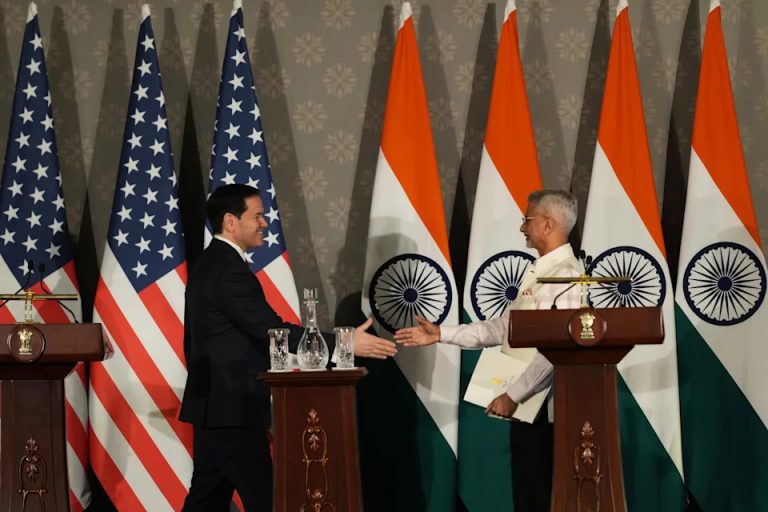
The US-India relationship has genuine depth that a difficult year does not erase. Secretary of State Rubio’s four-day diplomatic visit to India in May 2026 focused on strengthening energy security cooperation and stabilizing bilateral ties. A major highlight was India and the US signing a dedicated pact on critical minerals and rare earths, focusing on securing supply chains for semiconductors, electric vehicles, defense systems, and clean energy technologies. Defense cooperation, military exercises, and technology transfer continue at meaningful levels.
But the terms of engagement have fundamentally changed. The “reciprocal” nature of the trade deal suggests that the US now views India through a purely transactional lens. This could set a precedent where every strategic concession requires a massive economic or political payback. India’s $80 billion in annual exports to the US, its pharmaceutical sector’s exposure to American regulatory standards, and its defense dependency on Russian equipment all create leverage points that Washington has now demonstrated it is willing to use.
Hanging over all of this is the knowledge that there is no guarantee Washington will not reimpose tariffs on India — the US recently threatened to raise tariff levels on South Korea over its failure to meet the terms of a trade deal the countries concluded last year. That precedent is not reassuring to a government that has just committed to $500 billion in American purchases and a reduction in Russian oil imports, two concessions that carry their own domestic and strategic costs.
India’s growing global influence has been largely tied to its role in balancing China’s power in the region, and any shift in US policy toward Beijing could affect New Delhi’s strategic value to Washington. “If the US changes its approach towards China, it will diminish India’s importance,” one analyst noted. That dynamic is what makes the Pacific Command renaming more than symbolic — it is a data point in India’s ongoing assessment of whether the partnership it has been building since 2005 is one Washington intends to sustain.
Original analysis inspired by the Global Times editorial board from Global Times. Additional research and verification conducted through multiple sources.