Tag: BRICS

Indian Prime Minister Narendra Modi standing between two European leaders, holding their hands up in a gesture of unity.

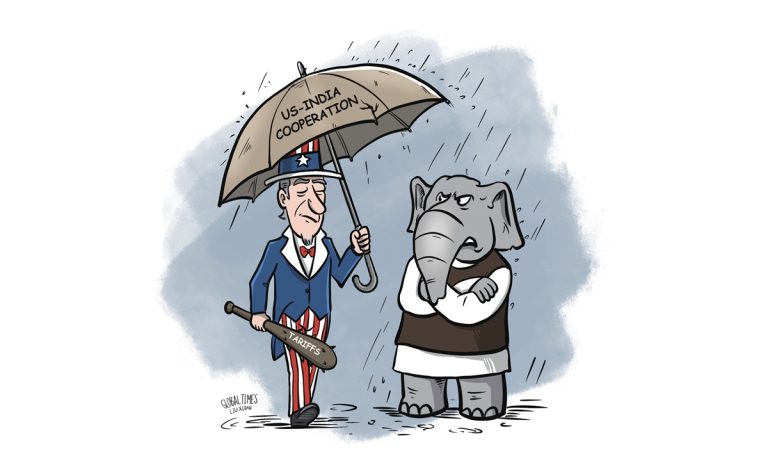
India’s Balancing Act: Surviving Trump 2.0 Without Picking a Side

The second Trump presidency has stress-tested India’s foreign policy like never before. Faced with tariff shocks and diplomatic friction over Russian oil, New Delhi has doubled down on its doctrine of multi-alignment. From finalizing a landmark EU trade deal to joining the US-led “Pax Silica” initiative while maintaining ties with Moscow and Beijing, India is navigating a fragmented global order by transforming economic pressure into strategic resilience.

Read More »
A close-up shot of a high-ranking official smiling while standing next to Vladimir Putin with Iranian and Russian flags in the background.

Iran Conflict Strengthens Authoritarian Networks

The ongoing conflict with Iran has unveiled a sophisticated web of cooperation among authoritarian states. Beyond tactical military aid, China and Russia are helping Tehran build a parallel economic and technological system. From electronic warfare sharing to the normalization of non-dollar trade, this “Authoritarian Collaboration” is actively reshaping global alignments and challenging the resilience of democratic alliances.

Read More »
Two Iranian military speedboats patrolling near a large cargo ship or oil tanker at sea.

Russia’s Influence Fades Across Central Asia

Moscow’s influence across Central Asia is steadily eroding due to the economic strains of war and sanctions. Regional powers are now diversifying their strategic partnerships, prioritizing the Middle Corridor and Chinese investment over traditional Russian ties to secure long-term infrastructure, energy reliability, and economic independence in a multipolar landscape.

Read More »
Dramatic digital art of a coastal conflict with an American flag in the foreground and a damaged globe.

The Gulf Conflict and the Accelerating Shift to Multipolarity

The second month of the 2026 Iran War marks more than just a regional military crisis; it is the catalyst for a fundamental reordering of global power. The conflict has acted as a “stress test” for 20th-century security models, and the results have accelerated a shift toward a multipolar world where American unilateralism is being replaced by regional self-reliance and alternative financial networks.

Read More »
Large oil tankers and cargo ships docked at a major industrial port with storage tanks and green mountains in the background.

Beijing’s Iran Dilemma: Too Big to Ignore, Too Risky to Lead

On March 31, 2026, the diplomatic landscape of the Iran war shifted toward Beijing as Pakistani Deputy Prime Minister Ishaq Dar arrived in China to formally launch a joint five-point initiative for a ceasefire. This move represents China’s first major departure from a month of “muted” detachment, positioning it as a potential guarantor for any future peace deal—a role Tehran has reportedly made a prerequisite for talking to the White House.

Read More »
Close-up portrait of Subrahmanyam Jaishankar, India's Minister of External Affairs, looking thoughtful with his hands clasped.

India’s Iran War Silence Exposes the Limits of “Strategic Autonomy”

The sinking of the IRIS Dena and the subsequent “silence” from New Delhi have ignited a fierce domestic and international debate over the reality of India’s “Strategic Autonomy.” While Pakistan has positioned itself as a central diplomatic intermediary between Washington and Tehran, India finds itself grappling with a “strategic embarrassment” that has paralyzed its traditional role as a regional leader.

Read More »
Stylized graphic of Donald Trump's face superimposed on a waving American flag.

Is Iran the Suez Moment That Ends American Hegemony?

Iran’s retaliation has exposed the limits of U.S. power: Gulf allies were hit despite hosting American bases, the Strait of Hormuz is shut, and global markets are recalibrating around a less reliable Washington. The war’s political and economic fallout accelerates a shift toward multipolarity — a moment many now compare to America’s Suez.

Read More »
Donald Trump pointing forward confidently while speaking at a rally with an American flag background.

The Rules-Based Order Is Dead. Trump Just Buried It.

Trump’s 78‑day cascade of abductions, assassinations, tariffs, and an unauthorized war has shattered what remained of the post‑1945 rules‑based order. With the UN Charter sidelined and sovereignty treated as optional, the Global South bears the brunt — from tariffs to aid cuts to oil shocks — as a multipolar, power‑driven world accelerates into view.

Read More »
A digital collage featuring a central portrait of Ali Khamenei surrounded by scattered United States five, ten, and twenty-dollar bills.

Trump’s Iran War May Leave the Dollar’s Reign Damaged

Trump’s Iran war has triggered oil shocks, inflation pressure, and market turmoil, briefly lifting the dollar while undermining trust in the system behind it. Supply‑chain hits, Fed turmoil, and sanctions whiplash deepen global doubts. China, Russia, and energy importers are accelerating moves away from dollar dependence — a shift the crisis may harden.

Read More »