Millions of Afghan children stand at heightened risk as conflicts in the Middle East ripple across distant supply chains. Humanitarian agencies report that the cost of moving food and nutritional supplies into the country has tripled, with delivery times stretched by several weeks. These pressures arrive on top of years of economic strain, turning what should be routine aid operations into a daily struggle for survival.
United Nations projections show roughly 3.7 million children under five expected to suffer acute malnutrition this year, nearly one million of them severely. UNICEF aims to treat about 1.3 million children for acute cases in 2026, while another 1.2 million pregnant and breastfeeding women also require urgent support. Food prices inside Afghanistan have risen around 20 percent amid the external shocks, pushing already vulnerable households closer to the edge.
Traditional supply lines have fractured under multiple strains. Instability in the Strait of Hormuz has rendered sea routes far more expensive and risky, with insurance costs and detours driving up expenses dramatically. The World Food Programme has been forced to reroute shipments overland through seven countries in some cases. At the same time, repeated border restrictions with Pakistan and limitations from Iran have eliminated much of the predictability that humanitarian operations require.
In place of these southern pathways, attention has turned northward to routes offering greater consistency. The Lapis Lazuli Corridor, which connects Turkey and the South Caucasus across the Caspian Sea to Turkmenistan and onward into Afghanistan, has taken on new importance. Though longer than previous options, its relative insulation from current fighting makes it a practical choice when reliability matters more than speed.
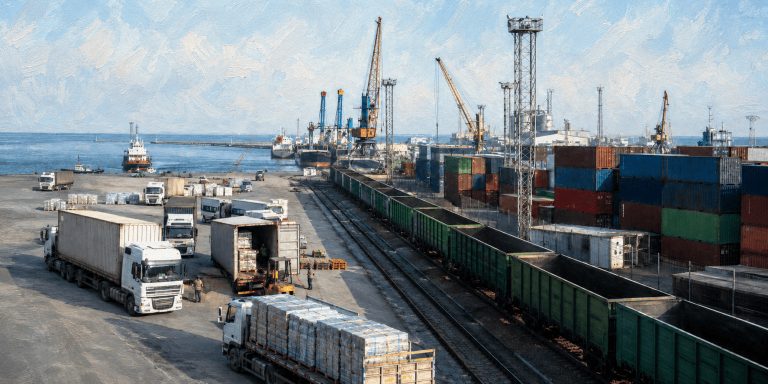
Central Asian states possess many of the building blocks needed to support this transition. Ports on the Caspian Sea in Kazakhstan and Turkmenistan enable efficient multimodal transfers, while rail networks link smoothly to Afghan entry points. Uzbekistan’s city of Termez has served as a logistics hub for years and stands ready to handle greater volumes. Because these countries sit outside the Middle East conflict, they provide neutral ground that international organizations can use with fewer complications.
Central Asia’s Emerging Humanitarian Role
Different states are carving out distinct functions in this new setup. Kazakhstan offers northern connections tied to wider Eurasian networks. Uzbekistan functions as a central distribution point for aid entering northern Afghanistan. Turkmenistan provides the most direct access to the west of the country. Together they reduce the need for entirely new infrastructure, allowing agencies to adapt what already exists.
Obstacles remain significant. High rail tariffs, port fees, and slow customs procedures can quickly erode savings from avoiding sea risks. National strategies for logistics still tend to develop in isolation, limiting the kind of seamless regional cooperation that large-scale humanitarian efforts demand. The lack of a dedicated mechanism to coordinate aid-specific transit rules across borders stands out as a particularly pressing gap.
The recently established UN centre for Sustainable Development Goals in Almaty, Kazakhstan, could help bridge this divide. Located near key transport arteries and already mandated to coordinate across Central Asia and Afghanistan, the facility is well placed to expand its work. It could facilitate dialogue among governments, align donors with the World Food Programme, and help establish unified protocols for humanitarian cargo, building on existing structures rather than creating new ones from scratch.
As long as tensions around the Strait of Hormuz persist, these northern corridors will likely remain central to efforts keeping malnutrition at bay in Afghanistan. Success in strengthening them could save lives today while fostering deeper practical ties across Central Asia tomorrow. The episode underscores how interconnected global crises have become and why flexible regional partnerships matter more than ever in an uncertain world.
Original analysis inspired by Aidar Borangaziyev from The Times of Central Asia. Additional research and verification conducted through multiple sources.