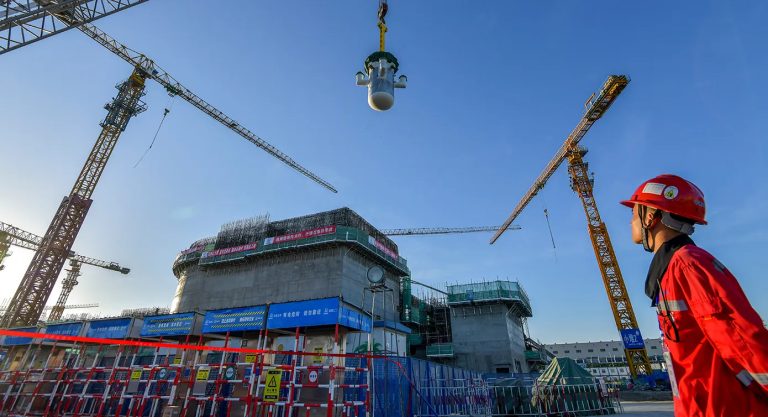
China is approaching an important milestone in its nuclear expansion. Linglong One, a 125 megawatt small modular reactor under construction in Hainan, is expected to begin operation by the end of 2026. The International Atomic Energy Agency describes the project as one of the most advanced commercial SMR developments in the world. Yet proving that China can build a small reactor is different from proving that utilities and industrial customers will want to build dozens of them.
China enters that competition from a position few countries can match. The International Energy Agency reports that China accounts for roughly half of global nuclear capacity currently under construction, while nuclear output is expected to increase rapidly through 2030. Industry data also shows nearly 40 Chinese reactors under construction and a national target of about 110 gigawatts of operating capacity by the end of the decade. This huge conventional nuclear program gives Chinese companies experienced suppliers, skilled workers, and mature manufacturing networks that can support new reactor designs.
The harder problem is finding a market
The commercial challenge begins with economics. Large reactors gain an advantage because their high construction costs are spread across much greater generating capacity. Research presented through the IAEA shows how smaller reactors can begin with substantially higher construction costs per unit of capacity unless serial production, standardization, and learning eventually bring prices down.
That creates a difficult cycle. Manufacturers need many orders to gain the benefits of factory production, but customers need evidence of lower costs before placing those orders. China overcame similar barriers in solar panels and batteries by creating enormous domestic markets and scaling manufacturing aggressively. Small modular reactors may be harder because China already has cheaper alternatives for many of the jobs they are supposed to perform.
Its electricity system illustrates the problem. China has expanded solar, wind, coal, transmission networks, and conventional nuclear power simultaneously. The IEA expects China to add almost 30 gigawatts of nuclear capacity between 2026 and 2030, mostly through large reactors. That reduces the need for small reactors as ordinary grid power sources, especially when large Chinese plants already benefit from established supply chains and financing.
Artificial Intelligence could change the calculation elsewhere. Rising electricity demand from data centers has helped renew interest in smaller nuclear plants in the United States and other advanced economies. The IEA links growing demand from data centers and Artificial Intelligence to renewed investment in firm power sources such as nuclear energy. China, however, can often serve new computing centers with its extensive transmission system and abundant renewable generation, weakening another potential SMR market.
Industry may offer the strongest opening
The better opportunity may lie outside conventional electricity generation. Smaller reactors can potentially supply industrial parks with electricity, steam, heating, hydrogen, or desalinated water without requiring the scale of a traditional nuclear station. China is already experimenting with this approach. The World Nuclear Association records construction of the Xuwei project in Jiangsu, which combines advanced reactors with large nuclear units to provide industrial heat and electricity to a petrochemical base.
Linglong One could therefore matter most if it proves that standardized small reactors can serve specialized industrial customers. CNNC reported completing an important cold functional test in October 2025, moving the project toward fuel loading and operation. Successful operation would establish technical credibility, but commercial replication will depend on construction schedules, financing, safety regulation, and whether future units can be built more cheaply.
China also faces fuel and supply challenges as reactor designs become more diverse. Some advanced SMRs require specialized fuels and new approaches to spent fuel management. Global nuclear fuel production and enrichment remain concentrated among relatively few suppliers, and the IEA warns that expanding nuclear power will require stronger and more diversified supply chains.
The result is an unusual contradiction. China may have one of the strongest industrial foundations in the world for producing small modular reactors, yet its success with large nuclear plants, renewables, and transmission infrastructure reduces the number of places where SMRs clearly offer a better economic solution. Linglong One can demonstrate engineering capability. The more difficult achievement will be turning that capability into repeat orders.
China’s next nuclear breakthrough will therefore depend less on constructing another experimental reactor than on discovering where small reactors provide enough value to justify their higher early costs. Industrial heat, district energy, desalination, and specialized power supply may offer that opening. If those markets expand, China could convert its manufacturing strength into another major energy industry. If they remain limited, its SMRs may stay impressive technological projects without becoming a mass commercial product.
Original analysis inspired by Tong Zhao from Carnegie Endowment. Additional research and verification conducted through multiple sources.