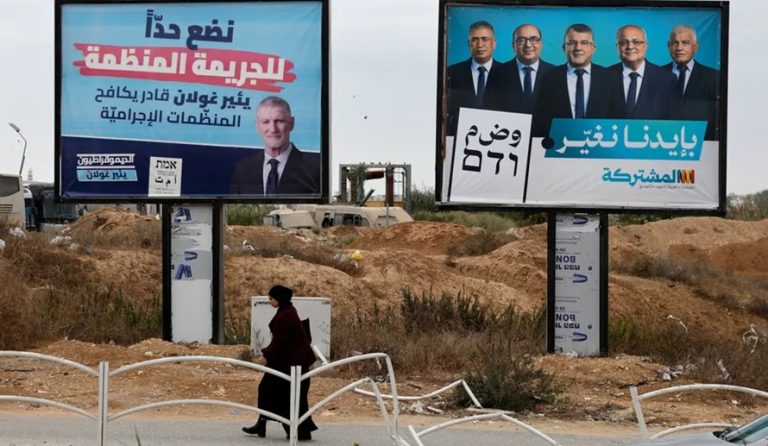
Israel’s October 27 election is shaping up less as a conventional contest between two coherent blocs than as a test of whether Benjamin Netanyahu’s opponents can turn public dissatisfaction into a governing majority. The vote is widely seen as a referendum on Netanyahu’s leadership after the Hamas attack of October 7, 2023 and three years of war and political turmoil. Yet polling suggests that defeating Netanyahu at the ballot box and replacing him in government remain two different tasks. The opposition currently leads in several surveys, but coalition arithmetic could still leave Netanyahu in office.
A Walla poll published on October 20 put Gadi Eisenkot’s Yashar party at 23 seats and Likud at 19. Netanyahu’s declared allies together received 48 seats, while the main Jewish led opposition held 54, potentially rising to 58 with another unaffiliated faction. The remaining 14 seats belonged to the Joint List and Ra’am, two Arab parties that most opposition leaders remain reluctant to include in a government. With 61 seats required for a Knesset majority, that reluctance may determine the election’s outcome as much as the vote totals themselves.
Fragmentation Still Threatens the Opposition
The opposition has taken some steps toward cooperation. Eisenkot, Naftali Bennett, Yair Lapid, Avigdor Lieberman and Yair Golan reached agreements aimed at reducing competition between their parties and maximizing their combined parliamentary representation. But coordination has not eliminated disagreements over leadership, coalition partners or what should happen if Netanyahu’s Likud becomes necessary to break a deadlock.
Benny Gantz’s withdrawal on October 19 removed one possible source of wasted opposition votes. His Blue and White party had repeatedly polled below Israel’s 3.25 percent threshold, meaning votes cast for it could have produced no parliamentary representation. Opposition politicians welcomed his decision, but the episode illustrates how vulnerable a fragmented electoral field can become when several parties compete for similar voters.
More difficult divisions remain. Bennett and Lieberman appeal partly to voters on the political right who oppose Netanyahu, while Golan represents a clearer left wing alternative. Eisenkot has tried to position himself between those camps. That ideological spread gives the opposition access to a wider electorate, but it also makes agreement on a governing program harder once campaigning ends.
Arab Parties Could Decide Who Governs
The largest unresolved issue is cooperation with Arab political parties. Arab citizens represent roughly one fifth of Israel’s population, and Reuters reports that turnout among Arab voters could rise significantly from 2022. Current projections give Ra’am and the Joint List enough seats to influence whether either major bloc can reach a majority.
Eisenkot has so far rejected a formal coalition with Arab parties, even though Mansour Abbas of Ra’am has signaled openness to negotiations. The contradiction is mathematical. If Netanyahu’s bloc remains near 50 seats and the Jewish led opposition remains in the mid fifties, excluding Arab parties may leave no viable alternative government.
Netanyahu has powerful incentives to keep that division alive. His campaign has repeatedly portrayed cooperation with Arab politicians as illegitimate or dangerous, while his alliance with parties further to the right remains intact. Itamar Ben Gvir’s Otzma Yehudit is currently projected to win at least eight seats, showing that Netanyahu can still rely on a substantial nationalist electorate even while Likud itself faces a close contest.
The opposition therefore faces a strategic choice that extends beyond defeating Netanyahu personally. It can continue treating Arab parties as outside the legitimate coalition system, accepting the possibility of another deadlock, or build a broader parliamentary arrangement capable of reaching 61 seats. That decision will determine whether its electoral advantage can become political power.
Israel’s opposition does not lack potential votes. Its deeper problem is converting several different anti Netanyahu constituencies into a government that can survive their ideological differences. If the October 27 result produces another divided Knesset, the campaign’s most consequential failure may not be losing to Netanyahu. It may be winning more seats than his camp and still being unable to replace him.
Original analysis inspired by Ben Kroll from Haaretz. Additional research and verification conducted through multiple sources.