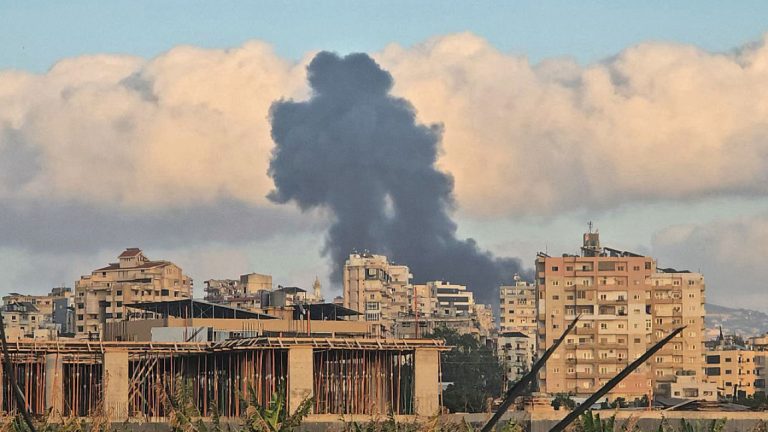
The mid-April ceasefire in Lebanon arrived with the kind of language that Lebanese diplomats and civilians had learned not to trust but could not afford to ignore. Direct talks between Lebanese and Israeli officials were announced under American auspices — the first such formal contact in decades — and for a brief moment, something resembling cautious optimism settled over Beirut. Lebanese author Rana Hanna captured the mood precisely: it seemed, she wrote, that Lebanon “finally had a seat at the table, so perhaps we were no longer the meal.” Within hours, Israeli airstrikes and Hezbollah rocket fire resumed. Over a month later, the ceasefire exists in name only, Israeli forces have crossed the Litani River in a ground advance, and Lebanon’s diplomatic relevance is being steadily consumed by the far weightier US-Iran negotiations happening entirely above it.
Too Weak to Set Its Own Terms
Lebanon’s structural weakness in the current diplomatic environment is not a temporary condition created by this particular conflict. It reflects a decade of state collapse, currency implosion, political deadlock, and sectarian fragmentation that has left Beirut without the institutional capacity or external credibility to shape the behavior of any party fighting across its territory. The Lebanese army, widely described by Western diplomats as a fragile but neutral institution worth preserving, does not possess the operational strength to disarm Hezbollah — a force simultaneously better armed, more financially resourced, and more deeply embedded in the Shia community’s social and economic infrastructure than the national military will be for the foreseeable future.
Attempting to forcibly disarm Hezbollah without its consent would require a direct military confrontation with a well-armed sectarian community — a scenario that would fracture the country along lines it has never fully healed. Washington knows this. Israel knows this. Yet both continue to demand it as a condition of any agreement, making the demand function less as genuine policy and more as a permanent mechanism for ensuring Lebanon remains in violation of its obligations regardless of what its government actually does.
A Country Negotiated Over, Not With
Iran has insisted throughout the negotiations that any memorandum of understanding with the United States must explicitly cover Lebanon, treating the multi-front conflict as a single unified framework. The United States rejects that linkage and insists Lebanon is a separate track. Israel has been escalating its campaign — issuing mass evacuation orders affecting hundreds of thousands, bombing Beirut’s Dahiyeh suburb, and advancing ground forces into territory it has not held since 2000 — in what analysts describe as a deliberate race to reshape facts before any imposed ceasefire takes effect.
The more consequential question is what Iran will actually prioritize when the final tradeoffs arrive. Tehran’s primary objectives — resuming oil exports, accessing frozen assets, and preserving nuclear infrastructure — are all materially more valuable than protecting Hezbollah’s current operational posture in southern Lebanon. Analysts suggest that if Washington offers sufficiently attractive terms on sanctions relief and asset unfreezing, Tehran may quietly accept a formulation that leaves Lebanon’s security arrangements unresolved rather than jeopardize the broader agreement. Lebanon would then face a situation similar to the 2024 ceasefire: formally included in a framework, practically abandoned to Israeli military operations that Washington declines to halt and cannot politically afford to stop.
The fourth round of US-hosted Lebanese-Israeli talks concluded this week without a permanent ceasefire. The Lebanese government will keep pressing for one. But in a diplomatic environment shaped by Iranian nuclear calculations, American domestic politics, and Israeli security imperatives, Lebanon’s voice carries the weight of a state that cannot govern itself. Caught between Hezbollah’s strategic value to Tehran and Israel’s determination to degrade it permanently, Lebanese civilians are absorbing a war they did not choose, cannot end, and may find barely mentioned in the agreement that eventually claims to resolve it.
Original analysis inspired by Alex Martin Astley from The New Arab. Additional research and verification conducted through multiple sources.