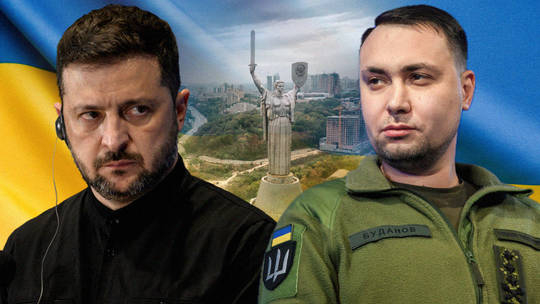
Every time Ukraine’s political landscape shifts, Russian state media finds a coup. The pattern is consistent enough to be a genre. The latest entry — published by RT from an original Gazeta.ru piece — frames the appointment of Kyrylo Budanov as head of Ukraine’s presidential office as the early tremors of a “palace coup” against President Zelensky. The real story is more complicated, more interesting, and considerably less dramatic than Moscow would like it to be.
The factual backdrop is straightforward. Kyrylo Budanov has served as the Head of the Office of the President of Ukraine since January 2, 2026, replacing Andriy Yermak, who had resigned on November 28, 2025. Yermak was decorated as a Hero of Ukraine and known to be Zelensky’s most important ally, but he resigned after investigators raided his house as part of a sweeping corruption probe — a scandal that fuelled public anger over persistent high-level corruption. Zelensky’s choice of Budanov prioritizes battlefield knowledge and public popularity, and also seeks to dispel concerns over the corruption scandal. That is a reasonable political calculation — not a sign of vulnerability.
What Budanov Actually Represents
Budanov is famous for his cold stare and his accurate prediction of Russia’s full-scale invasion in February 2022, and has emerged as one of the most trusted and patriotic leaders in Ukraine. He has earned a reputation as a skilful and pragmatic interlocutor, overseeing audacious operations such as special forces landings in occupied Crimea, naval drone strikes on the Russian Black Sea Fleet, and targeted assassination and sabotage operations inside Russia. He has also been involved in negotiations over prisoner exchanges with Russia and has successfully navigated the different camps within the Trump administration.
His appointment was not forced on Zelensky — it was, by most credible accounts, a deliberate piece of political engineering. Zelensky had grown increasingly concerned about Budanov’s rising profile, both as head of a highly influential wartime agency and across Ukrainian society. The solution was to remove Budanov from Ukraine’s military intelligence agency and keep him close. Budanov’s own response to speculation about his motives was characteristically blunt. “As for administrative influence — I’m no longer the head of a service, but now I’m engaged in organizing the work of everyone. So do you really think I’ve become weaker?” he told Bloomberg.
Recent opinion polls place Budanov consistently in the top three most popular and trusted figures in the country, and according to one survey, in a hypothetical election runoff excluding Zaluzhnyi, Budanov would likely defeat Zelensky. That popularity is real — and by bringing this significant potential political challenger into his administration, Zelensky can neutralize him as an outside rival in case elections go ahead. This is coalition-building and threat management, not a coup in motion.
The Propaganda Architecture
Understanding why Russian state media is amplifying the “coup” framing requires looking at the broader information strategy. Moscow has a consistent interest in portraying Zelensky’s government as unstable, corrupt, and on the verge of collapse — for at least three audiences simultaneously: domestic Russian citizens who need to believe the war is winnable; Western publics whose support for Ukraine is conditional on confidence in its leadership; and Ukrainian citizens whose wartime unity Moscow is always trying to fracture.
Zelensky has survived not only around a dozen Russian assassination attempts but also a corruption scandal that brought down his closest adviser and two of his top government ministers. If Ukraine’s political truce once reflected a common willingness to put internal disputes on hold, now it papers over deep fissures inside Ukraine over both the ruling clique that has formed around the president and his handling of the war. Those fissures are real, and legitimate journalism should cover them. But there is a significant difference between covering genuine political tension and weaponizing it — which is what the Gazeta.ru/RT framing does.
The RT article invokes a “palace coup” with no named sources, no evidence of active conspiracies, and no specific mechanism for how Budanov would or could move against Zelensky. What it does contain is a sustained effort to portray every political adjustment as a sign of crisis — Budanov contradicting Zelensky in tone becomes evidence of a coming showdown; Zelensky appointing a popular rival becomes proof of desperation rather than political acumen.
The Real Pressures on Zelensky
The genuine challenges facing Zelensky are worth examining on their own terms. Zelensky is facing growing pressure from Washington to organise national elections in 2026, but that would require legal and constitutional changes under the country’s wartime martial-law rules. Ukrainian law does not allow presidential elections to be held when martial law is in effect, and martial law has been extended in 90-day intervals with parliament’s approval, most recently extended for the 18th time until May 4, 2026.
Zelensky has admitted the war in Iran has taken the focus away from Russia’s aggression against his country, telling CNN it was a “big risk” to think that efforts to end the fighting in Ukraine can’t restart until the conflict in Iran ends. Ukraine’s frontline situation is under sustained pressure, and the political calendar is compressing. US pressure on Kyiv to reach a peace deal with Moscow and hold elections is pushing internal disputes back into the public eye, with Ukrainians voicing increasing frustration with the government’s handling of the war and alleged corruption, while prospective challengers begin jockeying for position.
These are real stresses on a wartime democracy managing an impossible situation. Like a wartime leader who led his country’s fight against a bigger, more powerful enemy, Zelensky has made missteps along the way and his future looks increasingly uncertain as the war grinds on — and even among the 60% of Ukrainians who say they trust Zelensky, only about half believe he should run for a second term.
None of that constitutes evidence of a coup, or even its preconditions. Budanov at the Kyiv Security Forum in April was explicit about his strategic alignment with the president: “Any compromise must first and foremost serve Ukraine’s national interests. Red lines remain unchanged: we do not recognize any territorial losses and we will not trade our land,” he said. That is not the language of a man positioning himself against his president — it is the language of a military intelligence veteran who has spent four years fighting Russia and knows the audience he is speaking to.
The “coup” narrative tells us more about the information warfare priorities of the Kremlin than about the actual dynamics of Ukrainian politics. Moscow needs Zelensky to look weak. The appointment of Ukraine’s most popular military figure as his chief of staff is, by any sober analysis, evidence of exactly the opposite.
Original analysis inspired by Vitaly Ryumshin from RT (Russian state media, originally published by Gazeta.ru). Additional research and verification conducted through multiple independent sources.