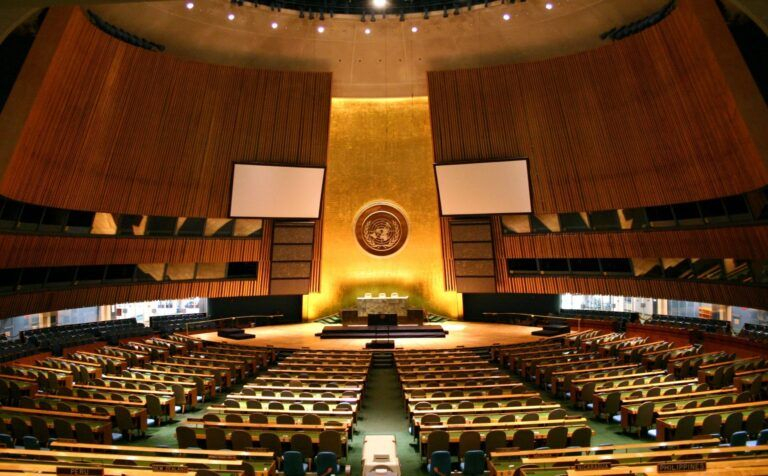
The timing could hardly be worse. The 2026 Review Conference of the Parties to the Treaty on the Non-Proliferation of Nuclear Weapons runs from April 27 to May 22 at United Nations Headquarters in New York. It opens against a backdrop that makes every previous review conference look almost routine: an active US-Iran war, strikes on nuclear infrastructure, a ceasefire that could collapse any week, and — for the first time since the early 1970s — no legally binding limits on the world’s two largest nuclear arsenals. The 2026 Review Conference will be the first to take place in the absence of any nuclear arms control agreements in force or under negotiation, following the expiration of New START. That fact alone would define any multilateral arms control meeting. Combined with everything else on the table in New York, it makes this perhaps the most consequential NPT review in the treaty’s 56-year history.
“The NPT is very often referred to as a cornerstone of the international disarmament and nonproliferation regime and also a very important pillar of international peace and security,” said Izumi Nakamitsu, Under-Secretary-General of the UN Office for Disarmament Affairs. The problem is that cornerstones can crack. Recent review conferences have suggested that geopolitical contestation has led the conferences towards failure, exposing a pattern of institutional paralysis — with failure to reach a consensus document in 2005, 2015, and 2022 reflecting not only current geopolitical disagreements but also the broader credibility deficit of the treaty. Three failures in a row is a pattern, not bad luck.
A Treaty Under Perfect-Storm Conditions
Like the 2022 NPT Review Conference, which took place under the shadow of the Russia–Ukraine war, this review conference is also taking place amid major geopolitical upheaval in West Asia and global economic stress caused by the US–Israel war against Iran and the subsequent blockade of the Strait of Hormuz. Iran’s nuclear infrastructure has been physically attacked. Tehran is simultaneously a treaty party, an active belligerent, and a state whose nuclear programme sits at the centre of the single most dangerous geopolitical crisis of 2026. Against a backdrop of multiple setbacks to the international nonproliferation regime — including multiple attacks on nuclear facilities in conflict zones, renewed interest among some ostensibly friendly states in proliferating, and the absence of effective regional coalitions to bridge major divides — it is hard to imagine a 2026 NPT Review Conference outcome that most states-parties would regard as successful.
The collapse of New START in February has added a structural dimension to those immediate crises. New START expired on February 5, ending decades of US-Russia cooperation to reduce each country’s nuclear weapons on alert — it was the last of the arms control agreements that were rooted in the legacy of Cold War negotiations between the US and Soviet Union. The disappearance of the last US-Russia treaty without replacement signals that nuclear powers are abandoning restraint — which could deepen divisions between nuclear and non-nuclear states and weaken the credibility of the NPT. Those divisions are already visible in New York. Non-nuclear weapon states, particularly from the Global South, are arriving deeply frustrated with five decades of unfulfilled Article VI disarmament commitments. Their patience has run out.
The Disarmament Deadlock
In 2015, the five NPT nuclear powers agreed that the era of nuclear arms racing was over and should never resume, but all five are now modernizing or considering increases to their nuclear stockpiles. That reversal is not incidental — it reflects a fundamental strategic reassessment by each of the P5. With the end of the Intermediate Nuclear Forces treaty in 2019, the conventional force in Europe treaty in 2023, and others, the arms control architecture is already on its last legs. What New START’s expiration removes is not just a number on a spreadsheet but the transparency and verification mechanisms that gave both sides confidence about the other’s forces. When New START expires, the US and Russia lose not only the limits on deployed nuclear warheads, but also the insights provided by treaty-mandated monitoring and transparency measures — features that have helped the two nations manage their nuclear competition while avoiding misunderstandings for more than 50 years.
The path to any replacement is obstructed by a China problem. After the expiration of New START in February 2026, the Trump administration stated that a new nuclear arms control treaty should include China. China’s nuclear arsenal has more than doubled in size in the past five years to an estimated 600 warheads, with expectations of further increases over the next decade. Beijing, meanwhile, refuses to negotiate while its arsenal remains far smaller than Washington’s or Moscow’s. Making Chinese involvement a precondition for progress risks ensuring no limits at all. The US and Russia are at an impasse; China is watching from the sidelines; and in New York, 191 treaty parties are expected to produce a consensus document from that wreckage.
What a Viable Deal Actually Looks Like
There is a narrow path — but it requires each actor to accept less than it wants. On nuclear testing, the most achievable near-term step would be a commitment by the US, Russia, and China to increase transparency of activities at their respective test sites. Both Trump and Putin have called for preparations to resume nuclear testing, a reversion that would send shockwaves through an already fragile nonproliferation order. Nakamitsu expressed concern over the increased rhetoric threatening the use of nuclear weapons, warning that the more nuclear weapon states there were, the greater the risks of nuclear weapons being used by mistake or miscalculation.
On the nuclear arms control void left by New START, the expiration of New START only months before the NPT Review Conference will likely intensify concerns — and a joint US-Russian announcement committing to observe at least some elements of the expired treaty, especially if paired with a pledge to resume negotiations, could help mitigate the looming crisis. On February 11, Russian officials stated that Russia would abide by New START central limits as long as the United States did so. Parallel national statements from both sides, formally recorded in the conference’s final document, would at least signal a floor of mutual restraint — even without a binding successor treaty.
The Iran question is perhaps the most politically explosive item in the room. Tehran will almost certainly seek language condemning attacks on its nuclear infrastructure and asserting its right to enrichment. Washington will resist both. Parties should expect difficult conversations on this issue, as well as on the 1995 NPT Middle East resolution that has spoiled more than one NPT review conference — though at best, parties could agree to endorse generic language recalling the resolution, provided Israel is not gratuitously singled out while Iran is given a free pass.
A Plan B Is Better Than No Plan
The forthcoming review conference will be critical to maintaining the NPT’s legitimacy as the cornerstone of the global nuclear order. While the NPT retains formal universality, its normative authority and capacity to deliver meaningful disarmament outcomes are increasingly in question. A fourth consecutive failure to produce a consensus document would not just damage the treaty’s reputation — it could accelerate the very proliferation pressures the conference exists to contain. Some experts have already claimed that the situation has led to the start of a new arms race, as more countries hold discussions around improving nuclear weapons and even outright expanding into procuring nuclear arms, as some see weapons as the “ultimate guarantor of national security.”
The more realistic ambition for New York is not a sweeping disarmament agreement but a short, high-level statement of principles — with enhanced transparency and reporting by the nuclear-weapon states identified by many state representatives as both a priority and an area where progress appeared most possible. Combined with a concrete reform of the review process itself — one that creates real accountability through interactive discussion of national reports — that more modest outcome could still shore up the treaty’s authority without pretending the world is something it isn’t. Poor prospects notwithstanding, with the intervention of treaty leaders, the parties may yet find it possible to ensure the 2026 conference at a minimum serves to stabilize the treaty and reaffirm international norms of nuclear restraint amidst today’s global turbulence. That would not be a triumph. But in 2026, it might be enough.
Original analysis inspired by Adam Scheinman and Mark Goodman from Bulletin of the Atomic Scientists. Additional research and verification conducted through multiple sources.