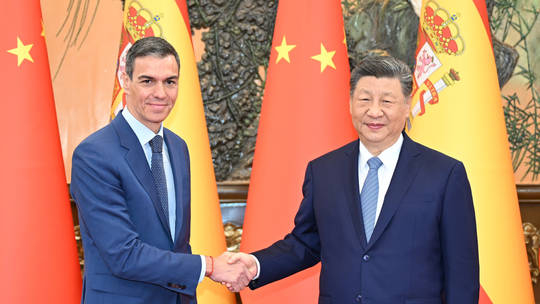
Six weeks after Donald Trump threatened to cut off all US trade with Spain, Prime Minister Pedro Sánchez landed in Beijing and signed cooperation agreements with President Xi Jinping. Trump’s threat came on March 3, 2026, and Sánchez’s response was to deepen ties with the world’s second-largest economy instead. The optics were deliberate. Sánchez’s fourth visit to China in four years was the most substantive yet — and the timing sent a signal that Madrid had no intention of subordinating its economic interests to Washington’s geopolitical preferences.
The visit reached its peak on April 14, when Sánchez and Xi agreed at the Great Hall of the People to establish a Permanent Strategic Dialogue and concluded roughly 19 bilateral agreements spanning investment, education, agrifood, and technology. Led by foreign ministers, the new mechanism gives Spain a similar channel of influence to those already used by major EU powers such as France and Germany. For a country often treated as a second-tier player in EU foreign policy, that upgrade carries real weight.
The Economics Behind the Pivot
Spain’s turn toward Beijing is not an ideological statement — it is a commercial calculation backed by hard numbers. Spain is the eurozone’s fourth-largest economy, with China its largest trading partner outside the EU. Spain generates more than half of its electricity from renewable sources and has an acute need for critical raw materials, solar panels, and green technologies from China to sustain that transition.
Chinese investment in Spain has been accelerating well before the latest visit. Spain attracted one of the largest shares of Chinese foreign direct investment (FDI) in Europe in 2024, driven by major clean-tech and industrial projects, and has adopted a notably softer stance on EU trade defense measures than Germany, France, or Italy.
The industrial footprint of that investment is already visible. In Barcelona, Chinese automaker Chery is establishing a European operations center and R&D institute. In Zaragoza, battery giant CATL is building a lithium battery gigafactory. These are not portfolio investments — they are bets on Spain as a long-term manufacturing hub inside the EU’s single market.
The new High Quality Investment Agreement — reported by Bloomberg ahead of the visit — adds an important condition to this capital flow: Chinese investments in Spain must involve technology transfers to domestic companies, contracts for local suppliers, and job creation in host regions. That conditionality matters. It reframes Chinese FDI not as passive capital absorption, but as an industrial partnership with specific obligations attached.
Spanish exports to China rose by more than 7% over the past year following earlier agreements, but the trade deficit remains significant and correcting it is now a priority. New deals signed during the visit aim to improve access for Spanish products, particularly in the agri-food sector. Sánchez was direct about the imbalance: “There is a clear imbalance that we must correct,” he told reporters in Beijing.
Strategic Positioning Inside the EU
What distinguishes Spain’s approach from other European countries engaging China is its positioning within the EU system. In contrast with European Commission President Ursula von der Leyen’s confrontational rhetoric, Sánchez went to Beijing armed with a more nuanced diplomacy. Spain is pursuing a pragmatic middle ground within the EU, balancing commercial opportunities with growing regulatory and geopolitical risks, as pressure from the European Union and the United States intensifies over supply chains, technology exposure, and trade policy alignment.
Sánchez’s visit was the latest in a wave of high-level European pilgrimages to Beijing. In an era of fragmenting alliances, everyone is racing to secure preferential trade and investment terms. Even German Chancellor Friedrich Merz made a point of visiting earlier this year. The difference is that Sánchez arrived with a rare surplus of geopolitical capital that most of his European peers lack. His vocal opposition to the Iran war has earned him praise across political lines, and by staring down US pressure, Sánchez has cultivated an image of principled firmness that is highly attractive to Beijing.
Xi Jinping explicitly framed Spain as a bridge between China and Europe, declaring both nations to be on the “right side of history.” That framing serves Beijing’s interests as much as Madrid’s — but the commercial substance beneath it is real, and Spain is extracting tangible concessions in exchange for the symbolic validation it provides.
Washington Watches, Warily
The Trump administration has not stayed silent. Treasury Secretary Scott Bessent warned that any country trying to get closer to China would be “cutting their own throat,” arguing that Chinese manufacturers would look to dump goods they can no longer sell in the US into European markets. The warning carried an implicit message: closeness to Beijing in a tariff war brings its own economic costs.
Madrid’s forays into sensitive technology have added to Washington’s unease. A quantum computing agreement with China’s Origin Quantum aims to develop Europe’s largest quantum computer on Spanish soil. Madrid’s separate decision to entrust Huawei with storing judicial wiretaps raised security concerns among allies — though Spain has shown little sign of reversing course.
Alicia Garcia-Herrero, chief economist for Asia Pacific at Natixis, told the Associated Press that the visit gave Sánchez a chance to “get a leadership position in Europe at a time when the transatlantic alliance is not only at risk but in shambles.” That assessment captures the opportunity Spain is trying to seize: as the US-EU relationship deteriorates under Trump’s second term, the country that builds the most credible bridge to Beijing gains leverage inside the EU far beyond its economic size.
Fine Print and Political Risk
The fundamental question for Spain and for Europe is whether Chinese investment is fostering an industrial renaissance or merely paving the way for a new kind of dependence. In sectors like 5G infrastructure, energy grid software, and cloud systems, Chinese involvement carries long-term security implications that a single investment agreement cannot fully address.
There is also a domestic political dimension that Beijing will have noted. Should next year’s election hand power to the conservative Popular Party, Spain’s foreign policy would likely shift from its current pragmatism to a firm Atlanticist stance, which could jeopardize the longevity of any long-term agreements China reaches with the Sánchez administration. When it comes to planning industrial cooperation, political continuity is a baseline condition. News of Sánchez’s wife being charged with corruption also broke during the China trip, and while his bold anti-war stance has sparked a surge in recent polls, the durability of the current government remains unclear.
Spain has carved out a genuinely distinctive position in European foreign policy — pragmatic enough to deal with Beijing, progressive enough to remain credible in Brussels, and independent enough to resist Washington’s pressure. According to Moncloa, the visit seeks to position Spain as a reliable interlocutor between Europe and China in an increasingly fragmented international scenario. Whether that role proves durable depends less on Sánchez’s diplomatic skill than on whether Spain’s domestic political consensus can hold long enough to give Beijing a reason to keep treating Madrid as its preferred European partner.
Original analysis inspired by Ladislav Zemánek from RT. Additional research and verification conducted through multiple sources.