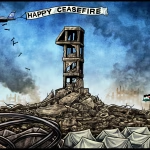
The fragile ceasefire between the United States and Iran has been extended, yet the underlying tensions remain unresolved. In the Strait of Hormuz, a carefully managed confrontation has emerged, where both sides test boundaries without triggering full-scale resumption of hostilities. This uneasy balance carries significant risks, exposing gaps in international legal frameworks and raising questions about how long such controlled escalation can persist without spiraling out of control.
Iran has asserted greater control over the vital waterway, responding to the US naval blockade of its ports by tightening oversight of passing vessels. Washington, for its part, has maintained pressure through selective enforcement, seizing ships and signaling readiness to respond to perceived threats. The result is a tense equilibrium where commerce is restricted but not entirely halted, creating uncertainty that ripples through global energy markets.
Legal Ambiguities Fuel Risks
The situation in the strait defies straightforward legal categorization. Under the United Nations Convention on the Law of the Sea (UNCLOS), it qualifies as an international strait subject to transit passage rights. Yet in practice, it is treated partly as territorial waters, allowing Iran to claim authority over navigation under certain conditions. This dual status creates room for competing interpretations, with no clear mechanism to resolve disputes when security concerns override standard maritime rules.
The broader legal vacuum becomes more pronounced when viewed through the lens of armed conflict. While the law of the sea emphasizes freedom of navigation, the law of naval warfare permits restrictions under specific circumstances. International law offers no definitive guidance on which regime takes precedence when they collide. Without established institutions to enforce rules during crises, enforcement falls to the involved parties themselves, heightening the potential for miscalculation.
Global energy flows depend heavily on stability here. Roughly one-fifth of the world’s oil passes through the strait daily. Disruptions, even partial ones, have already driven up prices and strained supply chains from Asia to Europe. Recent incidents, including vessel seizures and drone deployments, underscore how quickly localized actions can generate wider economic consequences.
Strategic Calculations Shape Responses
For Iran, control over the strait represents a vital leverage point. By signaling its capacity to disrupt traffic, Tehran transforms a defensive posture into a tool that raises costs for its adversaries and draws international attention to its grievances. This approach allows it to externalize pressure, turning a bilateral standoff into a global concern involving energy security and economic stability.
The United States faces its own constraints. Maintaining the blockade serves as a tool to compel concessions, yet prolonged enforcement risks alienating partners and inflating energy prices at home. The Trump administration’s mixed messaging, alternating between threats and hints of progress, has complicated efforts to build broader support for its position. As the ceasefire extension highlights, neither side appears eager for immediate escalation, but the absence of clear rules increases the danger of unintended confrontation.
The coming period will test whether this managed standoff can hold or whether mounting economic and political pressures will force a more decisive shift. A lasting resolution would likely require addressing not only immediate navigation concerns but also the deeper legal ambiguities that allow such situations to arise. For now, the strait remains a focal point where strategic risk and legal uncertainty intersect, shaping the broader trajectory of US-Iran relations and regional stability.
Original analysis inspired by Dr Sania Faisal El-Husseini from Middle East Monitor. Additional research and verification conducted through multiple sources.