Few countries entered Donald Trump’s second presidency with more optimism than India — and few were more quickly disabused of it. Prime Minister Narendra Modi was among the first world leaders to visit Trump after his January 2025 inauguration, betting that the personal chemistry they had developed during Trump’s first term would carry over into trade concessions and strategic partnership. Few governments greeted Trump’s return with as much enthusiasm as Modi’s. And few faced greater disappointment. What followed was a bruising year of tariff shocks, public humiliations, and forced recalibration — one that has ultimately clarified, rather than destroyed, the logic of India’s foreign policy.
That logic is multi-alignment: the doctrine that India can deepen cooperation with the United States and the West without closing doors to Russia, China, or the Global South. India remains firmly committed to its foundational foreign policy principles of strategic autonomy, which allow it to engage with multiple global powers without aligning exclusively with any one bloc — though this approach has occasionally raised concerns in Washington. The second Trump administration has stress-tested that doctrine harder than any US president in recent memory. What the past year has shown is that multi-alignment is not a comfortable hedge — it is a demanding, often painful strategy that requires New Delhi to absorb pressure from all directions simultaneously.
When Washington Became the Problem
The turning point came in August 2025. Trump’s 50% tariffs on India, linked to its purchases of Russian oil, triggered an unprecedented downturn in relations after decades of steady progress. That was followed by a second flashpoint: Trump’s repeated public claims to have mediated a ceasefire between India and Pakistan after the Pahalgam attack — a claim New Delhi flatly rejected as a violation of one of its most sacred diplomatic tenets: that no third party mediates between India and Pakistan on security issues.
Collectively, these moves created one of the most difficult periods in US-India relations in over a decade, prompting New Delhi to ponder the stress it could endure along its borders and to its economy. New Delhi knows it cannot deal with a strained relationship with Washington and a tense frontier with China at the same time, so it reverted to a familiar non-alignment logic aimed at preserving strategic flexibility. The response was not a rupture — India did not abandon its US partnership — but a deliberate, calibrated rebalancing that sent signals in several directions at once.
Modi attended the Shanghai Cooperation Organisation (SCO) summit in Tianjin in September 2025, where he sat alongside Xi Jinping and Vladimir Putin in images that made Western observers uneasy. But that misread India’s intent. With its relationship to Washington deteriorating, New Delhi was instead seeking to muddle through, not to abandon the underlying strategic calculus that led it to turn toward the United States in the first place. Modi’s visit to China was not a reaction to Trump’s tariffs but an effort to repair damaged ties after a year of relative stability along the disputed border.
Russia: The Relationship Washington Hates Most
India’s ties with Russia remain the sharpest point of friction with the Trump administration. In the eyes of the second Trump administration, Russia is a “dead economy,” and India’s purchase of oil and defense equipment is enabling the Ukraine conflict. For India, however, Russia remains critical for strategic reasons. Delhi has been gradually diversifying its defense procurement — purchasing German submarines, deepening cooperation with France and Israel — but cannot rapidly replace decades of Russian hardware dependency.
Russia offers India little in terms of investment capital or cutting-edge technology, two areas critical to the country’s long-term development ambitions. Leaders in New Delhi appreciate the long history behind ties with Moscow but recognize there’s not much room for growth in the relationship. The calculation, then, is one of managed decline rather than strategic embrace: keep Moscow close enough to prevent it from fully aligning with Beijing, while hedging through Western procurement and technology partnerships.
In February 2026, the Trump administration lifted the 25% tariffs imposed on India over its continued imports of Russian oil, ending — at least temporarily — a dispute that had underscored Washington’s willingness to use coercive economic leverage even against close partners. The reprieve was welcome, but Indian policymakers remain clear-eyed about its fragility.
Accelerating Diversification
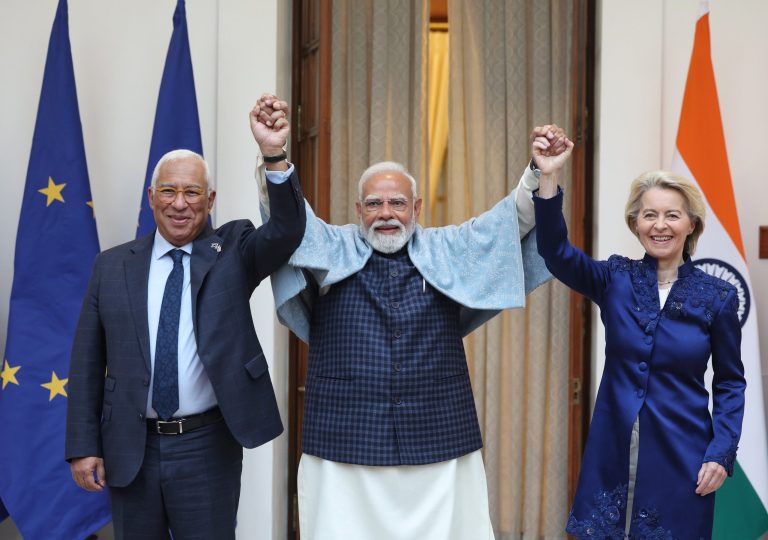
The tariff shock accelerated India’s most consequential economic pivot in years. Faced with tariff shocks in the US market, India accelerated negotiations with Oman, New Zealand, and the United Kingdom before finalising a landmark agreement with the European Union in January 2026. That EU deal — years in the making and repeatedly stalled — is now a cornerstone of India’s trade diversification strategy, reducing dependence on any single market at a moment when Washington has demonstrated it will weaponise commerce without warning.
The tariff shock pushed India to broaden export destinations, fast-track trade talks with Europe, and expand economic links with Russia and other emerging markets. In security policy, India is hedging more deliberately — maintaining the US partnership while easing tensions with China, deepening ties with Russia, and strategically engaging with Europe.
Domestically, the economic pressure has triggered reforms that inward-looking policy had long deferred. India rationalised its goods and services tax (GST) system, enacted pending labour reforms, and accelerated solar energy infrastructure — repositioning economic integration not merely as a commercial interest but as a pillar of strategic resilience. Efforts quickly yielded returns through a trade deal announcement, India’s invitation into the US-led AI and supply chain security initiative “Pax Silica,” and a continuous stream of visits from senior administration officials.
What Comes Next
The high likelihood that the Trump presidency will bring about continuous disruptions in the global order means India is more likely to reinforce its traditional approach of strategic autonomy, rather than shifting closer to the US. The Modi government will assess whether actions by the second Trump administration are merely tactical maneuvers or signal a deeper, more lasting change in US strategic posture. That distinction could determine the limits of India’s engagement.
India is, in essence, running a foreign policy designed for exactly this kind of era: one in which no single power is reliable enough to bet everything on, and where the ability to hold multiple relationships simultaneously is the defining strategic asset. The turbulence of Trump 2.0 has not overturned that logic. If anything, it has validated it. Just like people, countries get used to pain. As Modi learns to manage Trump’s tariffs, he has discovered that standing firm against Washington’s bullying plays well at home and earns respect abroad. Whether that earned respect translates into durable partnerships — or merely useful neutrality — remains the central question of Indian foreign policy for the decade ahead.
Original analysis inspired by Milan Vaishnav et al. from Carnegie Endowment for International Peace. Additional research and verification conducted through multiple sources.