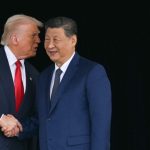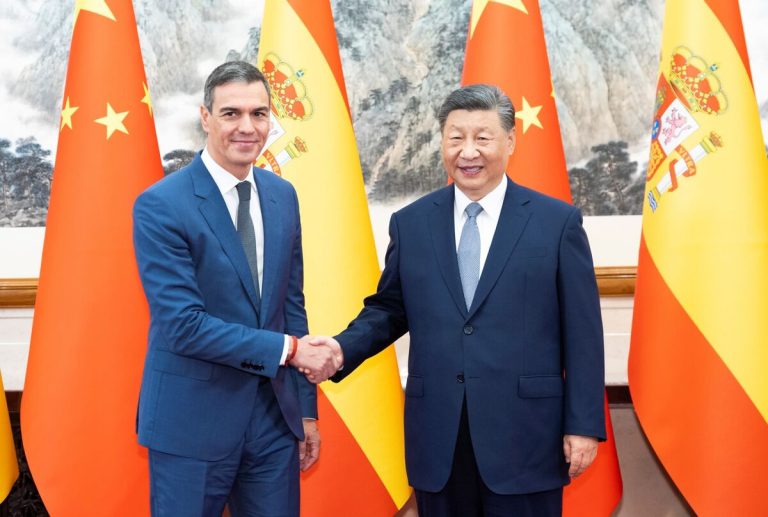
When Trump told reporters on March 3 that the United States would cut off all trade with Spain, he was responding to Madrid’s refusal to allow American aircraft to use jointly operated bases at Rota and Morón in connection with strikes on Iran. Sánchez’s response was to fly to Beijing. On April 11, he arrived for his fourth visit to China in four years, signing cooperation agreements in green development and meeting Xi Jinping, Premier Li Qiang, and the chairman of the National People’s Congress. Natixis Asia Pacific chief economist Alicia Garcia-Herrero told the Associated Press that the visit gave Sánchez a chance to get a leadership position in Europe at a time when the transatlantic alliance is not only at risk but in shambles.
That context — Trump threatening trade war, Spain signing green deals in Beijing — is the lens through which the current state of EU-China relations needs to be read. The historical dimension that Chinese commentators enjoy referencing, the Manila galleons and the missionary letters, is genuine. But it is less interesting than what is happening right now: a significant European economy making a deliberate strategic pivot toward China at the precise moment that its relationship with Washington has become openly confrontational.
A Relationship Built on Specific Interests
Since 2019, Brussels has framed China as a cooperation partner, economic competitor, and systemic rival — an institutionalized hedge that seeks flexibility rather than binary alignment. Spain has operated within that framework, but with a distinctive emphasis. Spain has internalized this logic, but in a manner that reflects its own political economy — supporting the EU’s economic security agenda, yet avoiding steps that could entrench open-ended confrontation or expose key domestic sectors to retaliation.
The commercial stakes are concrete. Spain is a major supplier of pork to China, providing about 20% of its imports. When the EU imposed tariffs on Chinese electric vehicles in October 2024, China responded by slapping 62.4% tariffs on EU pork — a direct response that exposed divisions within the EU, as Spain notably abstained from the vote on the EV tariffs. The abstention was not a moment of weakness. It was a calculated signal that Madrid would not sacrifice its agricultural sector on the altar of Brussels’ technology policy.
The EV dimension runs in the other direction. BYD recently surpassed 40,000 cumulative registrations in Spain — the company sold 25,556 vehicles in the country in 2025, up from 5,393 in 2024. BYD is considering Spain for its third European factory, after Turkey and Hungary. Meanwhile, Chinese electric battery company CATL announced a €4.1 billion joint venture with Stellantis to build a battery factory in northern Spain. China’s green technology investment is not an abstraction in Madrid — it is jobs, factories, and supply chain integration that Spanish policymakers are actively courting.
The Weakest Link Problem for Brussels
From an EU vantage point, Spain’s approach underlines a structural problem: de-risking is only as robust as the least stringent national implementation. Patchwork standards create weakest-link dynamics in a highly integrated digital and security environment and send mixed signals to both Beijing and Washington about the reliability of EU risk-reduction efforts.
That concern is real — but so is the counterargument. Trump’s last administration successfully corralled the EU into adopting a more hawkish stance toward Beijing — Spain being a notable exception — resulting in costly policy U-turns. Ripping out Huawei’s 5G equipment at Washington’s behest cost at least $62 billion by some estimates. Spain’s refusal to follow that model is not naïveté. It is a form of institutional memory about what blind alignment with US preferences costs in practice.
Treasury Secretary Scott Bessent warned that any country getting closer to China would be cutting their own throat because Chinese manufacturers would look to dump goods they can no longer sell in the US into European markets. The warning carries genuine economic logic — but it also reflects Washington’s assumption that it retains the leverage to dictate European commercial relationships. That assumption is looking shakier by the month. If the 2026 midterms or the 2028 presidential race confirm that Trump is more a symptom than the cause of US political instability, Spain and the EU may look to other actors — such as China — to uphold aspects of the international order that benefit them. Spain’s new strategy captures the zeitgeist of the slow decline of US influence worldwide, even from the perspective of one of its traditional allies.
What Spain’s Pivot Actually Signals
Ahead of the visit, Spain and China planned to sign a High Quality Investment Agreement — designed to ensure Chinese investments in Spain involve technology transfers to domestic companies, contracts for local suppliers, and job creation in host regions. A readout from China’s foreign ministry confirmed that the two sides signed a number of cooperation agreements in green development and other fields.
Spain, which generated 56% of its electricity last year from renewable sources, needs Beijing’s critical raw materials, solar panels and green technologies, similar to other European countries transitioning away from fossil fuels. In that context, the visit is not a geopolitical gamble — it is an energy security strategy. The Iran war has just demonstrated, with brutal clarity, what happens to European economies when Middle Eastern fossil fuel supplies are disrupted. Spain’s early and deep investment in the renewable transition, combined with its cultivation of Chinese clean-tech suppliers, has positioned it better than most.
On its own terms, Spain’s approach is coherent: it aligns with EU doctrine, reflects domestic political economy, and rests on a plausible vision of European strategic autonomy that combines resilience with selective engagement. Whether that coherence holds as Washington’s pressure intensifies — and as EU-China trade tensions around semiconductors and rare earths continue to mount — is the question that will define the next phase of European foreign policy. Spain is not abandoning the West. It is redefining what belonging to the West means in a world where Washington no longer sets the terms unilaterally.
Original analysis inspired by Global Times Observer from Global Times. Additional research and verification conducted through multiple sources.