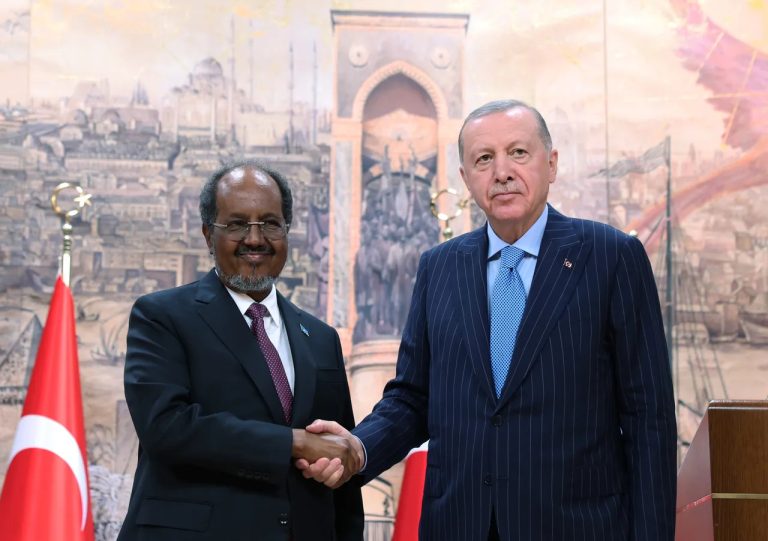
When Erdoğan landed in Mogadishu in 2011, he was the first non-African head of state to visit Somalia in two decades. The country was in the grip of a catastrophic famine, the international community was largely absent, and a functioning central government barely existed. Erdoğan’s visit — he toured refugee camps and hospitals, pledging aid and drawing international attention — was the watershed moment that launched what is now one of Africa’s most consequential bilateral partnerships, warmly received by Somalis who felt abandoned by the global community. What has grown from that moment is real, substantial, and deeply contested — a relationship that is simultaneously a model of South-South cooperation and a case study in the asymmetries of power between a strong middle power and a fragile state.
The numbers that define Turkey’s presence today are striking. Camp TURKSOM in Mogadishu, Turkey’s largest overseas military base, has trained more than 15,000 Somali soldiers. Ankara has claimed over $1 billion in aid and more than 500 humanitarian projects for Somalia. Turkey has integrated deeply into Somali affairs, from its security apparatus to garbage collection, wastewater treatment, and management of seaports and airports. In January 2026, Ankara deployed F-16 fighter jets to be stationed at Mogadishu’s international airport, adding to the arsenal of Turkish-made Bayraktar TB2 drones that Somalia has operated against al-Shabaab. And as of December 2025, Somali and Turkish officials say a new spaceport project is the most advanced collaboration to date — one that could give Turkey an equatorial position in the global space sector.
From Humanitarian Aid to Strategic Extraction
The relationship’s most consequential evolution has occurred in the natural resource and maritime domains — and it is here that the partnership’s asymmetries become hardest to ignore. In February 2024, the two countries signed a new framework agreement deepening cooperation on maritime security, anti-piracy operations, and natural resource protection — establishing a joint naval force to patrol Somali waters for ten years, enabling Turkey’s energy fleet to conduct seismic and drilling operations under military protection. Somali territory is estimated to contain 6 billion cubic meters of proven natural gas reserves and as much as 30 billion barrels of offshore hydrocarbon potential.
The terms of the resulting hydrocarbon deal deserve scrutiny. Somalia’s own share of production is limited through a royalty cap set at just 5%, while Turkey has been granted unrestricted rights to export its share of oil and gas at international market prices — an arrangement that effectively removes Somalia from the financial flow of Turkey’s share. Meanwhile, a newly formed joint venture named SOMTURK has been granted exclusive rights to license, monitor, and enforce regulations within Somalia’s entire Exclusive Economic Zone — led by OYAK, Turkey’s Armed Forces pension and investment fund. OYAK is a massive economic conglomerate with no prior fisheries management experience.
The concentration of control in Turkish hands — particularly those linked to the state and military — combined with Somalia’s institutional tenuousness, raises critical questions about sovereignty, equity, and long-term dependence. A Turkish deputy foreign minister drew a revealing parallel in parliament last year: he compared Turkey’s engagement in Somalia to its approach in Syria, noting that once cooperation with a country advances and security is established, the environment naturally opens up to Turkish business — the field naturally opens up to Turkish businesspeople.
A Geopolitical Contest, Not Just a Bilateral Deal
The Somalia-Turkey relationship does not exist in isolation — it sits at the intersection of several overlapping strategic rivalries. The Horn of Africa has become a focal point for global competition, with China, the UAE, Saudi Arabia, and Turkey jostling for influence alongside each other. Great-power competition over influence in Mogadishu, regional rivalries, security challenges, and a fractured Somali government will all pose significant challenges to Turkey’s agreements and its bid for a greater role in the Horn.
The most acute new pressure point is Israel’s December 2025 recognition of Somaliland. Israel became the first UN member state to formally recognize the breakaway region situated near the strategic Bab al-Mandab Strait, drawing strong objections from Somalia, Turkey, Egypt, and others who view the move as a threat to regional stability. For Israeli leaders, basing in Somaliland is an opportunity to counterbalance encirclement from Turkey — with Jerusalem understanding Turkish force presence in Somalia to be part of a ring of geostrategic pressure points, together with Libya, Syria, and Northern Cyprus. Erdoğan responded by enlisting other Muslim governments against the recognition, issuing a joint declaration with Saudi Crown Prince Mohammed bin Salman in February 2026.
Turkey’s Africa strategy has also expanded well beyond Somalia. In early February 2025, Turkey reportedly entered into a new agreement with the Chadian government to take control of the Abeche military base, vacated by France in late January. As a NATO member with historical enmity toward Russia, Ankara has nonetheless positioned itself as a fairly neutral actor compared to the competition — able to deliver security and economic benefits without the backlash that dealing with Russia or China might generate.
The Partnership’s Real Test
Somalia’s own domestic dynamics complicate everything. Centralizing resource authority under the federal government and SOMTURK has sparked strong opposition from Puntland and other regions with a history of autonomy over coastal waters — regions that have pulled back from supporting Mogadishu’s electoral process. Many contracts bypass parliamentary scrutiny, and federal member states like Puntland and Jubaland — which have their own resource and revenue disputes with Mogadishu — view these centrally negotiated Turkish deals with deep suspicion.
Turkey’s military presence in Somalia now operates an air wing with attack helicopters and drones, F-16s at the international airport, and a naval force with a ten-year mandate to patrol Somali waters. By any measure, that is the footprint of a security guarantor — one whose presence has become structurally indispensable precisely because Somalia has an acute inability to confront threats like al-Shabaab without external support, creating a dependency that intertwines Somalia’s survival with the continued presence of Turkish armed forces.
The difficulties posed by external influences, great-power competition, tumultuous domestic politics, widespread corruption, high costs, and continued conflict in Somalia will make Turkey’s enormous promises extremely difficult to fulfill — meaning the future of these agreements, though built on a strong foundation, remains to be seen. Somalia’s Ambassador to Turkey is correct that this partnership has produced real results. What he did not mention is the price Somalia has paid for them — and whether the terms, negotiated during a period of maximum vulnerability, will look equitable once Mogadishu is stronger. That is the question that will define the relationship’s next chapter.
Original analysis inspired by Fathudin Ali Ospite from TRT World. Additional research and verification conducted through multiple sources.