Before February 28, the Strait of Hormuz carried 34% of the world’s seaborne crude, 20% of its LNG, and 16% of its refined petroleum. One month later, traffic through the strait has plunged by more than 95 percent. The IEA has called it the “largest supply disruption in the history of the global oil market.” A new conversation between Foreign Policy’s Cameron Abadi and Columbia University economist Adam Tooze asks the questions that markets are only beginning to grapple with: Is the Gulf’s economic model broken? Will China emerge stronger? And is this crisis an advertisement for fossil fuels — or the death knell for dependence on them?
The short answer is that the war has scrambled every assumption about who benefits from high oil prices. Unlike prior oil crises, Gulf producer states cannot benefit from rising prices because the Strait of Hormuz closure prevents them from delivering product to market. Saudi Arabia and the UAE retain partial bypass capacity through overland pipelines, but all other GCC states and Iraq have no alternative export routes. This inverts the standard economic model where oil exporters gain from price rises. Oxford Economics has downgraded aggregate GCC real GDP growth for 2026 by 4.6 percentage points to -0.2%, while Goldman Sachs projects Qatar and Kuwait could each see GDP contract by 14% this year if the strait remains closed through April.
The Gulf Model Under Siege
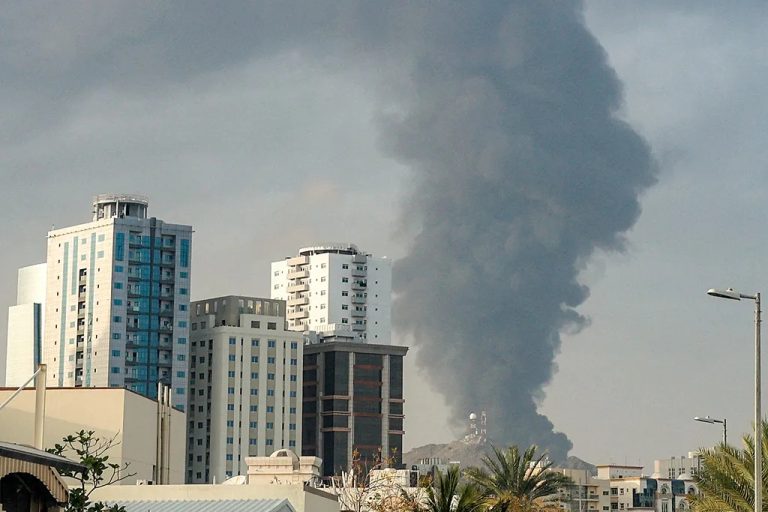
The economic damage runs deeper than stranded oil. Tourism and travel, a growing sector that accounts for about 11% of the GCC’s GDP, has been devastated. All GCC states experienced airspace closures simultaneously, shutting down tourism during Ramadan season and inflicting expected losses of $40 billion. Iranian missiles struck a luxury hotel on Dubai’s Palm Jumeirah, residential towers in Manama, and U.S. diplomatic missions across the region. A “mass exodus” of foreign residents has followed strikes on civilian infrastructure, leading analysts to conclude that the war has destroyed the long-standing “illusion” of cities like Dubai as a secure destination.
Tooze cautions against writing the Gulf off entirely. He argues that hubs like Dubai sit at genuinely nodal points in the global economy and that the demand for Gulf oil and gas will not vanish once a ceasefire arrives. The Middle East Council on Global Affairs, however, warns that the Gulf’s “Vision” strategies — built on the premise that hydrocarbon wealth and geographic centrality could attract global capital and talent — ultimately rest on the perception of stability, which the events of the past days have put under severe, and perhaps lasting, strain.
China’s Quiet Advantage
The conventional wisdom cast Beijing as the war’s biggest loser — after all, roughly half of China’s crude imports and a third of its LNG imports transit the Strait of Hormuz. But that framing misreads China’s energy architecture. China is 85 percent energy self-sufficient. While it imports more than 10 percent of its global oil total from Iran, its energy supply has long been diversified internationally and electrified domestically to avoid critical dependence on any single source. Beijing has built a cushion against a short-term supply shock.
The real prize for China is commercial, not defensive. The greatest benefit to China could come from overseas. As the country has pushed to electrify and generate more of its energy from renewable sources, Chinese companies have become global leaders in these technologies. Already, nations around the globe have been turning to Chinese firms to import or build solar panels, EVs and batteries. Price shocks from the Iran war could accelerate this trend. South Korea’s president has called the crisis “a good opportunity” to shift faster toward renewable energy, while Chinese battery giant CATL has seen tens of billions added to its market capitalization since the war began.
America’s Distributional Gamble
For the United States, the war’s economic impact is not a straightforward loss — it is a redistribution. Tooze frames it as a distributional issue: American oil producers benefit from surging prices, while consumers pay more at the pump. On net, U.S. GDP may actually tick upward because America is both a massive producer and exporter. But the political cost is real. A Financial Times investigation found that $580 million in bets on falling oil prices had been placed just 15 minutes before Trump published a statement on postponing attacks for talks, fueling accusations of insider trading and deepening public cynicism.
The deeper question — one that Tooze and the broader energy debate keep circling — is whether this crisis accelerates or delays the global shift away from fossil fuels. The answer, paradoxically, is both. In the short term, oil and gas dominate every headline and every policy response. But markets are already pricing in the medium-term pivot. As Ember’s Sam Butler-Sloss put it: “The Iran crisis accelerates the shift to renewables and electrification. High fossil prices drive switching, making already cheap electrotech even more competitive. In the old fossil fuel world, energy security meant diversifying fuel supply. With electrotech, nations now have the tools to increasingly eliminate imported fuels altogether.”
The Gulf states themselves understand this. Saudi Arabia and the UAE are racing to build solar capacity with Chinese partners, pivoting from petrostates to what Tooze calls progressive electrostates — competing on price in the oil market while hedging through green electrification at home. The Gulf region produces nearly half the world’s urea and 30% of ammonia, and urea prices have increased by 50% since the war began — a reminder that the disruption extends well beyond crude into fertilizers, chemicals, and global food supply chains. What began as an energy war is becoming an everything shock, and the winners will be those who saw it coming and built alternatives before the strait closed.
Original analysis inspired by Cameron Abadi and Adam Tooze from Foreign Policy. Additional research and verification conducted through multiple sources.