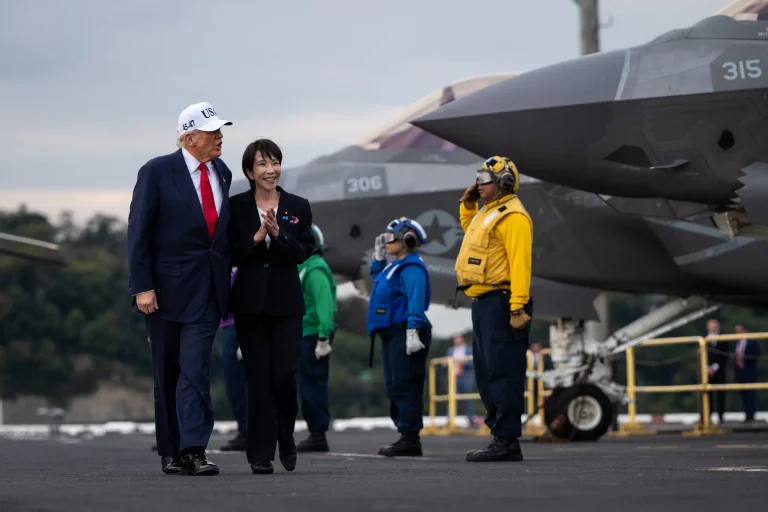
When Sanae Takaichi boarded her flight to Washington on Wednesday, she carried with her a problem that no amount of diplomatic preparation could solve. The first female prime minister in Japan’s history was heading to the White House for her first official visit — a summit that, six weeks ago, was supposed to be about trade, rare earth metals, and a shared concern about China. Instead, it will be dominated by a single demand: send your minesweepers to the Strait of Hormuz.
Trump has been explicit. Japan imports nearly all of its energy, and roughly 95% of its oil transits through the Middle East. Japan gets most of its oil from the Persian Gulf, Trump told reporters last week. They should be there. They should be helping. He has framed the ask not as a request but as an obligation — payback for decades of American security guarantees that have allowed Japan to spend modestly on defense while sheltering under Washington’s nuclear umbrella.
Takaichi’s dilemma is that she cannot say yes without breaking Japanese law, cannot say no without breaking the relationship, and cannot stall indefinitely without watching her economy suffocate as oil prices climb past $100 a barrel. Only 9% of Japanese voters support the US-Israeli war on Iran, according to an Asahi Shimbun poll — making this among the least popular American military operations in the history of the alliance.
A Constitution Written to Prevent Exactly This
Japan’s postwar identity was built on the renunciation of war. Article 9 of the Constitution declares that the Japanese people forever renounce war as a sovereign right of the nation and the threat or use of force as means of settling international disputes. For 80 years, that clause has shaped every decision about deploying Japanese forces abroad — and every attempt to reinterpret it has triggered fierce domestic debate.
In 2015, Prime Minister Shinzo Abe pushed through legislation permitting limited collective self-defense — allowing Japanese forces to fight alongside allies if Japan’s survival is threatened. But Takaichi has said the Iran situation does not yet constitute a survival-threatening scenario under that framework. She told reporters it would be legally difficult for Japan to order its navy to participate in combat operations at sea — while carefully adding that she was considering what we can do.
Japan does possess one of the world’s most advanced minesweeping fleets — a capability developed precisely because of its dependence on Gulf oil routes. It deployed minesweepers to the Persian Gulf in 1991, but only after combat operations had ended. In 2019, during Trump’s first term, Japan sent maritime defense forces to patrol shipping lanes and gather intelligence near the Gulf — but deliberately avoided the Strait of Hormuz itself, to preserve its traditionally friendly relationship with Iran.
That relationship is another constraint. Japan is one of the few Western-aligned nations that has maintained diplomatic ties with Tehran across decades of US-Iran hostility. Japanese leaders have periodically served as intermediaries — most recently in 2019, when Abe visited Tehran in a failed attempt to broker dialogue between Trump and Khamenei. Sending warships to help clear mines laid by Iran would shatter that neutrality in a single gesture.
The Pacific Drain
Takaichi’s deepest concern may not be the strait itself but what the war is doing to the military balance in Asia. The United States has redeployed significant naval and air assets from the Indo-Pacific to the Middle East since February 28 — including carrier strike groups, fighter squadrons, and missile defense batteries that were previously positioned to deter China. The shift has alarmed Japanese defense planners who view those assets as essential to deterring Beijing in the Taiwan Strait and the East China Sea.
A RAND Corporation analyst warned that Takaichi would face the challenge of responding in real time to Trump’s demands. If Takaichi goes there and says, This is a huge concern for us, and Trump turns around and says, So what are you going to do about it? — I don’t know how Japan answers that question. Zack Cooper of the American Enterprise Institute put it more bluntly: This was supposed to be a pretty straightforward, easy summit. Now it’s exactly what the Japanese don’t want: an unpredictable situation with no obvious answers.
Japanese officials had hoped to use Thursday’s meeting to dissuade Trump from making a sweeping deal with Xi Jinping during his planned March 31 visit to Beijing — one that might sacrifice allied interests in exchange for Chinese concessions on trade. Tokyo has also prepared announcements on Japanese investment in the United States and joint initiatives to reduce dependence on Chinese rare earth minerals. Those agenda items now risk being drowned out by the Hormuz question.
The 9% Problem
Domestic politics make Takaichi’s position even more precarious. She took office in September 2025 after a contested leadership race within the Liberal Democratic Party, and her approval ratings have been volatile. The Asahi Shimbun poll showing only 9% support for the US-Israeli campaign reflects a Japanese public that views the war as illegal, reckless, and potentially catastrophic for their energy-dependent economy.
An editorial in the Mainichi Shimbun warned that dispatching Japanese patrol ships would almost certainly be seen as siding with the United States, undermining Japan’s standing in the international community. Opposition lawmakers have demanded that Takaichi take a neutral stance and avoid any commitment that could be interpreted as endorsing the war.
Yet neutrality carries its own costs. If the strait remains closed and oil prices continue climbing, Japan’s economy — already fragile after years of stagnation — could tip into recession. The Bank of Japan has warned that sustained oil prices above $100 would add roughly 1.5 percentage points to inflation and shave an estimated 0.8% off GDP growth. Fuel rationing, last seen during the 1973 oil crisis, is no longer unthinkable if the disruption persists through April.
The Lunch That Decides Everything
Thursday’s summit will include lunch and dinner at the White House — intimate settings where Trump tends to press hardest. Takaichi will likely offer what Japanese diplomats call a contribution package designed to show support without crossing constitutional red lines: expanded intelligence sharing on Gulf maritime activity, financial contributions to escort operations, humanitarian aid for displaced populations, and possibly the deployment of surveillance aircraft to international waters near but not inside the strait.
Whether that will satisfy a president who has publicly demanded warships — and who has framed allied reluctance as ingratitude — is an open question. Trump has already warned that the level of enthusiasm matters to me, a phrase that in his diplomatic lexicon functions as a threat. Japan faces potential retaliation on trade: Trump’s tariffs on Japanese automobiles remain in place, and a pending semiconductor agreement could be held hostage to the Hormuz question.
No other ally faces quite the same squeeze. European nations can afford to distance themselves from the war because their oil comes primarily from non-Gulf sources. Japan cannot. It is simultaneously the country most economically vulnerable to the strait’s closure and the country most constitutionally constrained from doing anything about it. Takaichi must navigate that impossibility over lunch with a president who does not trade in nuance — and who measures loyalty in warships, not words.
Original analysis inspired by Javier C. Hernández from The New York Times. Additional research and verification conducted through multiple sources.