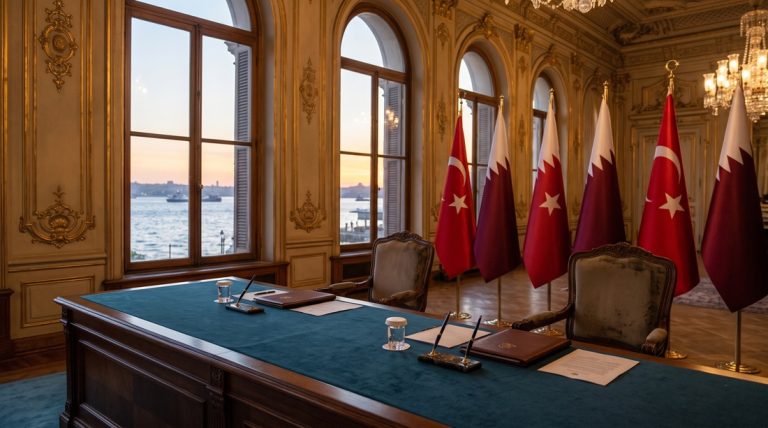
Ankara and Doha have formalized a significant expansion of their strategic partnership at a moment of acute instability across the Persian Gulf. During the latest session of their High Strategic Committee in Istanbul, Turkish President Recep Tayyip Erdogan and Qatari Emir Sheikh Tamim bin Hamad Al Thani signed five bilateral accords, including a new mutual defense agreement. The move reflects growing anxiety among Gulf capitals over regional spillover from ongoing military confrontations involving Israel and Iran. By locking in closer security coordination, both governments aim to deter external threats without relying solely on Western guarantees.
Turkish officials hosted the summit to consolidate more than a decade of expanding military, intelligence, and defense industrial cooperation. Turkey already maintains a permanent military base in Qatar, established after the 2017 Gulf diplomatic crisis to bolster Doha’s deterrence. The newly unveiled pact elevates that relationship by committing both nations to a unified posture against external aggression and expanding joint military exercises.
Strategic Deterrence Without Automatic Triggers
Despite its high profile signing, the text released by officials leaves notable ambiguity regarding automatic military intervention. Regional media noted that while the agreement pledges mutual solidarity and coordinated responses, its public clauses stop short of an explicit collective defense trigger akin to NATO’s Article Five. This careful phrasing gives both Ankara and Doha diplomatic flexibility to calibrate their involvement during fast moving regional crises.
The Istanbul agreement also followed earlier regional security initiatives, including trilateral defense talks linking Turkey, Saudi Arabia, and Pakistan. Observers reported that domestic and regional audiences view the pact as part of Ankara’s broader effort to project influence across the Middle East while hedging against unpredictable shifts in Washington. As Gulf states navigate persistent military volatility, localized defense networks are rapidly emerging as a preferred supplement to traditional American security umbrellas.
Original analysis inspired by Sam Hamad from The New Arab. Additional research and verification conducted through multiple sources.