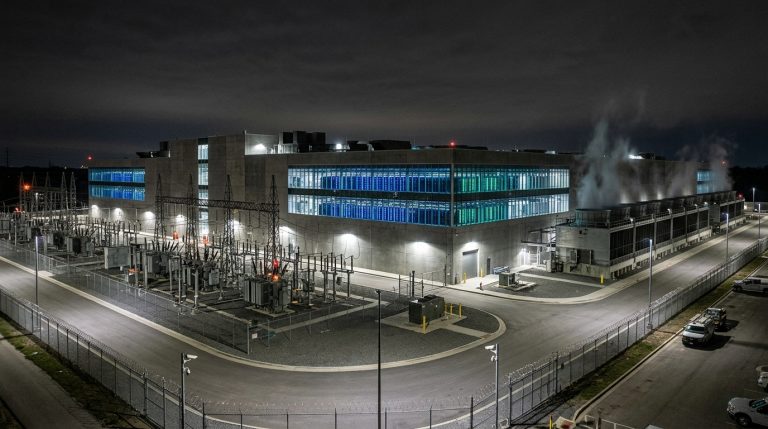
Artificial intelligence is often discussed as a weightless digital phenomenon, yet its operation depends entirely on massive physical complexes of concrete, silicon, and high voltage wiring. Recent military strikes in Eastern Europe and the Persian Gulf have demonstrated that these facilities represent a critical vulnerability in modern warfare. When Ukrainian drones struck data centers operated by the Russian technology conglomerate Yandex and a facility under construction for Sberbank, the blasts disrupted civilian banking, navigation, and cloud services nationwide. Although Russia trails the United States and China in frontier computing due to talent flight and export controls, destroying three Yandex supercomputers powered by restricted American Nvidia A100 chips will set back development across the Russian technology sector for years.
The strategic implications of these attacks extend far beyond the battlefield in Ukraine. Earlier this year, Iranian drone strikes damaged cloud facilities operated by Amazon Web Services in the United Arab Emirates and Bahrain, severing power lines and triggering fire suppression systems that flooded server halls. Months later, Amazon informed regional clients that data stored exclusively at two of those sites remained permanently unrecoverable. That disruption prompted corporate customers to migrate workloads abroad as Iranian security officials threatened future attacks on regional server clusters and undersea cables.
Structural Vulnerabilities and Resiliency Strategies
Three physical characteristics make computing hubs uniquely difficult to defend during armed conflict: their sprawling footprint, their fixed coordinates, and their delicate internal dependencies. Modern hyperscale campuses span hundreds of thousands of square feet above ground, and proposed projects like the Stargate campus in the Gulf were envisioned across ten square miles. Unlike military aircraft that can relocate when threatened, server farms must remain anchored near fiber optic backbones and massive electrical grids, which the International Energy Agency projects will consume surging shares of global power generation. Because these complexes rely on tightly integrated cooling towers and transformers to prevent advanced processors from overheating, a single kinetic hit or insider sabotage incident can paralyze an entire computing node.
Since traditional perimeter guards cannot stop cruise missiles or drone swarms, governments and corporations must prioritize network redundancy and cross border data portability. Strict Russian data localization mandates concentrated digital risk by trapping Yandex workloads inside domestic borders, whereas Ukrainian cloud operators survived similar bombardments by backing up critical digital infrastructure onto servers inside the European Union. Policymakers debating sovereignty rules under the European Commission proposal that governs cloud infrastructure should weigh how strict localization requirements might undermine crisis resilience. Combining geographic dispersion with edge computing offers the most practical defense, ensuring that nations can sustain vital digital services even when physical server halls come under fire.
Original analysis inspired by Connor Martin from Council on Foreign Relations. Additional research and verification conducted through multiple sources.