Under the banner of cleaning up duplicate records, election officials in New Delhi have launched the largest voter removal drive in modern history. Since the government initiated its Special Intensive Revision of the electoral rolls, authorities have stripped between 115 million and 130 million previously registered citizens of their voting rights. While India counts an estimated 1.03 billion adults, the active electorate is shrinking from 995 million down to roughly 880 million, creating a 150 million voter gap that stands more than ten times higher than the disparity recorded during the 2024 national ballot.
For decades, Indian election workers visited homes directly to register residents under a legal presumption of citizenship. The new administrative rules completely reverse that historic burden of proof. Citizens must now submit fresh paperwork within a strict thirty day window or lose their voting status automatically, even if they have cast ballots for fifty years. Because the Indian state has never issued universal citizenship certificates, demanding formal documentation hits migrant laborers, rural women, and impoverished families the hardest.
Engineering the Electorate Through Administrative Rules
Beyond the structural barriers facing poor and female citizens, opposition analysts point to deliberate political targeting inside competitive states. In West Bengal, a longtime opposition stronghold where Muslims make up 27 percent of the population, officials deleted 2.7 million names ahead of the recent state assembly vote. Those removals fell disproportionately on Muslim neighborhoods, allowing the ruling Bharatiya Janata Party to capture a state that had resisted its campaigns for years.
This administrative overhaul follows a controversial legal change that gave Prime Minister Narendra Modi and his cabinet decisive control over appointing the Chief Election Commissioner. International watchdogs have repeatedly classified the country as an electoral autocracy, warning that executive control over independent referees undermines fair competition. By reshaping the voter rolls before ballots are even cast, the ruling party can insulate itself against growing economic frustration and youth unemployment.
A New Generation Crosses Caste and Party Lines
Rather than quieting opposition, the mass deletions have ignited a nationwide protest movement that looks markedly different from past demonstrations. Earlier challenges to the government, including the 2020 rallies against citizenship laws and the 2021 farmer blockades, remained largely confined to specific religious minorities or agricultural unions. Over the past several months, however, a youth group calling itself the Cockroach Janta Party has united students across geographic, caste, and ideological boundaries.
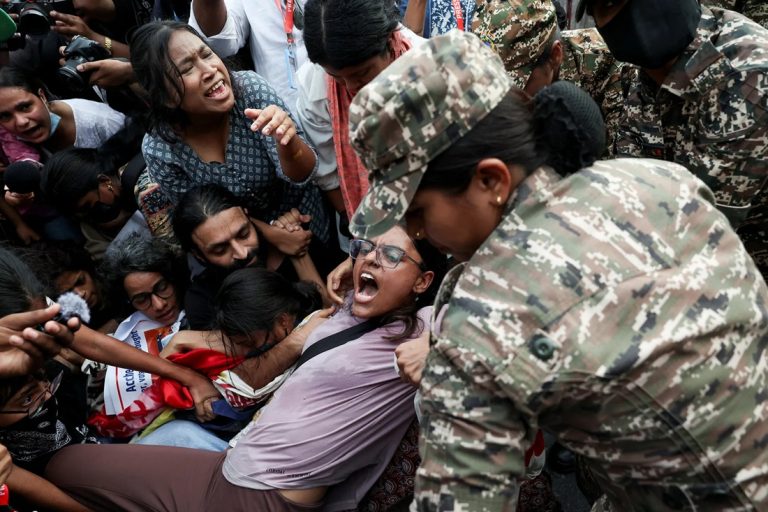
What began in July as student fury over educational failures—an uproar that forced the Education Minister to resign—has evolved into a direct defense of voting rights. Led in part by Dalit organizer Abhijeet Dipke, the demonstrations have drawn heavy participation from both marginalized communities and upper caste, middle class families that traditionally formed the core voting base of the ruling party. When thousands of young demonstrators marched through New Delhi this past weekend alongside civil society figures like Yogendra Yadav and lawyer Prashant Bhushan, the government responded with overwhelming force.
Paramilitary troops flooded the capital in an undeclared curfew, dragging protesters into vans and dumping organizers on the outskirts of the city without formal charges. Human rights monitors documented similar patterns of arbitrary detention during earlier crackdowns, yet the sheer scale of the weekend deployment suggests deep anxiety inside the ruling coalition. Having already ordered cabinet ministers to ramp up social media outreach to counter falling internal poll numbers, party leaders recognize that losing control over the election machinery threatens their grip on power.
Original analysis inspired by Isaac Chotiner from The New Yorker. Additional research and verification conducted through multiple sources.