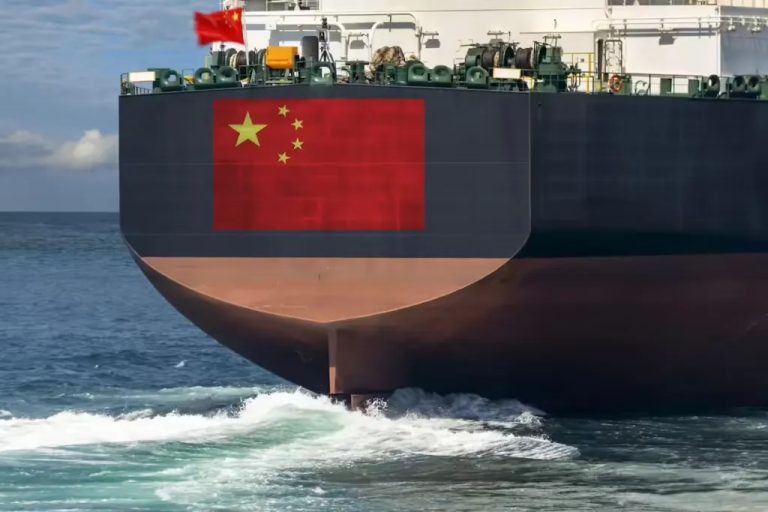
When Chinese Foreign Ministry spokesman Lin Jian welcomed the U.S.-Iran memorandum of understanding, describing it as consistent with “the overwhelming trend of peace and stability in the region,” he was speaking from a position of quiet satisfaction. China did not negotiate the deal. It did not fight in the war. It did not lose a single soldier or expend a single missile. Yet as the Strait of Hormuz gradually reopens, Beijing stands to collect the largest and most durable strategic dividend of any power that touched the conflict.
That outcome was not accidental. It was the product of roughly a decade of deliberate, patient positioning — energy partnerships, Belt and Road infrastructure investments, and diplomatic outreach built precisely to ensure that whatever happened militarily in the Gulf, China’s commercial and strategic interests would survive intact.
The Energy Arithmetic
The numbers explain Beijing’s stake more clearly than any diplomatic statement. According to the International Energy Agency, nearly 15 million barrels of crude oil per day — representing approximately 34 percent of global seaborne crude trade — transited the Strait of Hormuz in 2025. Around one-fifth of global LNG trade moved through the same waterway, with roughly 83 percent of that volume destined for Asian markets. China alone sourced approximately half its crude oil imports through the strait that year. No pipeline network connecting Russia or Central Asia can replace those volumes. When Iran closed the strait, Beijing did not just face higher energy costs — it faced a structural disruption to the supply architecture its entire industrial economy depends on.
The war’s effects moved through Asian economies almost immediately. Tanker traffic slowed, shipping insurance premiums surged, and freight costs climbed across routes that connect Gulf exporters to Chinese, Indian, Japanese, and South Korean ports. Central banks across Asia, already managing the aftershocks of post-pandemic inflation, found themselves confronting another round of imported price pressure driven by a conflict they had no hand in starting. The ceasefire framework did not resolve all of these pressures overnight, but financial markets responded quickly — oil prices retreated as traders priced in the prospect of additional Iranian supply and lower shipping risk.
A Strategy Built Before the Shooting Started
What distinguishes China’s position from that of other beneficiaries is that its gains were earned before the war began. Beijing’s 25-year comprehensive cooperation agreement with Iran, signed in 2021, established a long-term framework for energy and investment flows that sanctions complicated but did not sever. Its deepening energy ties with Saudi Arabia and the UAE created parallel relationships that insulated Chinese commercial interests even as Washington and Riyadh found themselves on the same side of a military confrontation with Tehran. Most consequentially, Beijing brokered the 2023 Saudi-Iran rapprochement — a diplomatic achievement that demonstrated Chinese influence in the Gulf without requiring military deployments or security guarantees.
The ceasefire framework’s most commercially significant element is the $300 billion Reconstruction and Development Fund, structured as a private investment vehicle expected to channel capital into Iran’s energy, logistics, manufacturing, and transport sectors once a final agreement is reached. More than half the proposed investment has reportedly already been committed by companies across the Gulf, Asia, Africa, and South America. Chinese firms with existing infrastructure and energy relationships in Iran are positioned to participate in that reconstruction in ways that American and European companies, still navigating sanctions architecture, are not. The fund creates a commercial incentive to preserve stability during negotiations — and stability is precisely the condition under which China’s Belt and Road investments generate maximum returns.
What Washington Lost, Beijing Gained
The contrast with the American position is stark. The United States expended enormous military capital — burning through nearly half its prewar inventories of key interceptor systems, deploying carrier strike groups, and conducting over 10,000 sorties — to achieve a ceasefire that left Iran’s nuclear program, missile arsenal, and regional proxy network functionally intact. The Pentagon will spend years replenishing what was consumed. China spent nothing and lost nothing, while the conflict validated its argument — made consistently in diplomatic forums — that military solutions to regional disputes produce instability that harms everyone’s economic interests.
China is not the only country to benefit from reopened shipping lanes. India gains from lower crude import costs. Japan and South Korea secure more reliable LNG supplies from Qatar. European manufacturers welcome lower energy costs after years of volatility. Gulf exporters regain full market access. But none of these countries enters the post-war period with China’s combination of embedded infrastructure investments, long-term energy agreements, diplomatic goodwill built on neutrality, and commercial positioning inside the Iranian economy.
The deeper strategic implication is the one that will take longest to fully register. Washington negotiated the deal, took the political risk, and absorbed the domestic criticism — the inflation spike, the depleted arsenals, the erosion of Gulf trust. Beijing watched, maintained its relationships with all parties simultaneously, and will collect the commercial dividends once the strait fully reopens. If the ceasefire holds and Iranian oil returns to global markets at scale, Beijing’s decade of Gulf diplomacy will look less like patient hedging and more like the most cost-effective strategic investment of the past ten years.
Original analysis inspired by Hriday Sarma from Asia Times. Additional research and verification conducted through multiple sources.
By ThinkTanksMonitor