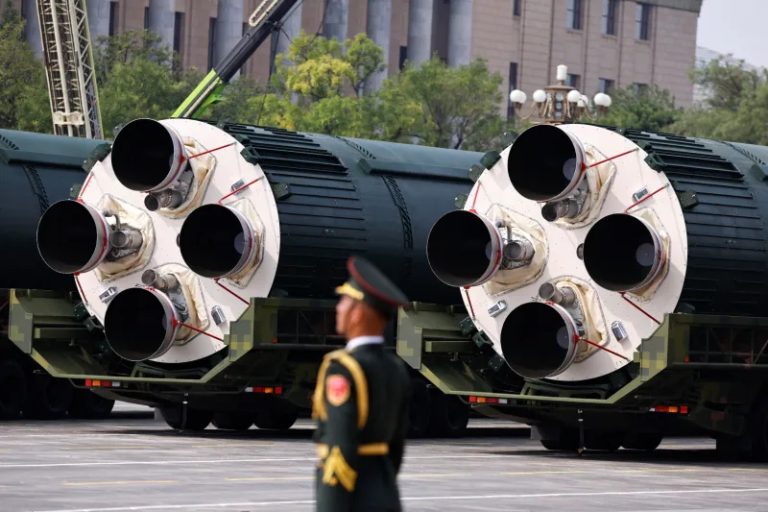
China has nearly tripled its stockpile of nuclear warheads since 2019, reaching around 600 today with projections exceeding 1,000 by 2030. The buildup spans new silo fields, submarine patrols, bomber upgrades, and expanded warhead production facilities. A striking military parade in Beijing last September put these advances on full display, underscoring Beijing’s commitment to enlarge its strategic forces even as Washington watches with growing alarm.
This expansion reflects deep-seated fears in Beijing that the United States seeks to exploit Chinese vulnerabilities. Leaders there point to past American pressure during the COVID-19 pandemic and more recent interventions abroad as evidence that Washington respects only strength. They argue a more credible deterrent will compel Washington to treat China as an equal, particularly on sensitive issues such as Taiwan tensions. So far, events appear to confirm this logic: the current U.S. administration has shown greater caution on core Chinese concerns while pursuing business-oriented stabilization. As a result, Beijing sees little incentive to accept limits on its arsenal.
Yet the strategy carries serious unintended costs. By rejecting meaningful arms control talks, transparency measures, and basic confidence-building steps, China has deepened American suspicions and accelerated U.S. nuclear modernization. Dual-capable systems like the DF-26 ballistic missile, whose nuclear or conventional role remains opaque, feed worst-case assessments in Washington. U.S. planners worry that in a future crisis, Beijing might resort to nuclear escalation despite its public stance, especially if conventional operations falter. China, for its part, fears the United States will lean harder on nuclear options precisely because its conventional edge in the region has narrowed. These crossed perceptions create a volatile mix.
Misperceptions and the Widening Spiral
The fallout reaches far beyond bilateral ties. China’s growing military cooperation with Russia has heightened European concerns that Beijing indirectly supports aggression in Ukraine. France and the United Kingdom have responded by reinforcing their own nuclear postures, further complicating any future multilateral framework. At a moment when every permanent member of the UN Security Council is upgrading its arsenal, the traditional pressure of global norms carries less weight. Smaller and middle powers, increasingly skeptical of U.S. leadership, show reduced appetite to criticize China’s moves.
Domestic factors inside China also limit course corrections. Xi Jinping’s extensive Rocket Force purges have left senior officers wary of appearing disloyal. Few are willing to champion politically sensitive ideas such as greater openness about shorter-range nuclear assets or reciprocal restraint measures. This internal climate sustains momentum behind the expansion even when external costs mount.
Both capitals insist they have no interest in using nuclear weapons first. China has long maintained a no-first-use policy, while U.S. leaders emphasize that nuclear employment would only occur in extreme circumstances. Yet neither side fully trusts the other’s assurances. Opacity around force structure, deployment patterns, and escalation doctrines makes genuine confidence impossible. The result is a classic security dilemma in which defensive moves appear offensive, steadily raising the temperature.
Escaping this cycle demands pragmatism rather than grand declarations. Upcoming meetings between Donald Trump and Xi Jinping offer a narrow opening. Instead of seeking an immediate sweeping treaty, the two sides could begin with concrete discussions on what each considers credible evidence of restraint. Greater transparency on regional nuclear forces most relevant to a Taiwan contingency would address the sharpest fears. Washington might consider limits on certain forward-deployed systems in exchange for Chinese constraints on comparable short-range assets. Framing the conversation around preventing any nuclear use, rather than managing escalation after it starts, aligns with both countries’ stated goals and could engage Beijing’s bureaucracy more effectively.
Neither power can afford the resource drain or heightened danger of an unrestrained competition. China’s conventional forces have improved markedly in its near seas, reducing any need to compensate with nuclear brinkmanship. The United States retains advantages in overall nuclear sophistication and retains strong reasons to avoid first use against a non-existential threat. By prioritizing credible conventional deterrence and raising the political threshold for nuclear threats, Washington could make it far costlier for Beijing to shift its own doctrine. Both governments understand that a nuclear exchange would devastate their societies and the wider world. Turning that shared recognition into practical limits on arsenals and operations represents their clearest shared interest.
Original analysis inspired by Tong Zhao from Foreign Affairs. Additional research and verification conducted through multiple sources.