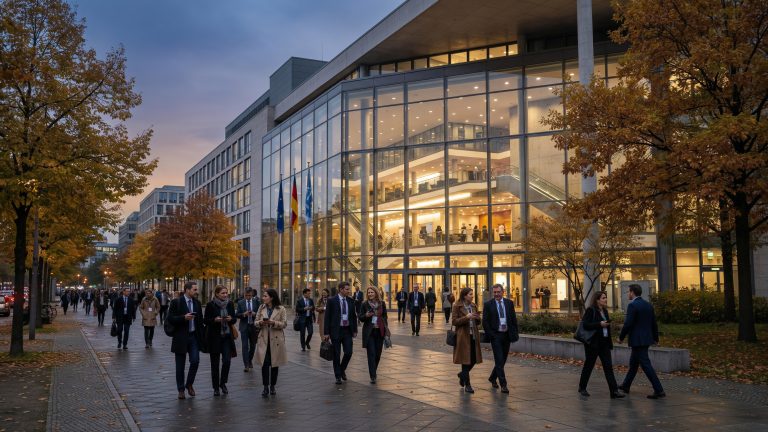
Former European Union foreign policy chief Josep Borrell warned on November 26 that perceived European double standards over Russia and Gaza obstruct the bloc from building durable global partnerships. Speaking during a panel at Chatham House in Berlin, Borrell stated that Europe must demonstrate consistent credibility if it hopes to anchor an international network resistant to major power spheres of influence. His remarks followed the November 19 trilateral summit in Shenzhen between Presidents Donald Trump, Xi Jinping, and Vladimir Putin, where the three leaders pledged to pursue United Nations reform while criticizing the International Criminal Court for overstepping state consent. Borrell described the Shenzhen gathering as far worse than the 1945 Yalta conference because postwar leaders built multilateral institutions, whereas the three current presidents actively attack them.
Credibility Gaps and Competing Views
During the Berlin discussion, Borrell pointed directly to Middle East policy as a recurring political barrier in relations with the Global South. He noted that European capitals strongly condemn Russian aggression in Ukraine yet remain largely silent regarding events in Gaza, convincing foreign governments that European values operate with variable geometry. This concern echoes earlier warnings from both Brussels and New York, as Borrell previously acknowledged growing frustration across developing nations while United Nations Secretary General Antonio Guterres urged European leaders to uphold international law equally in both conflicts. Current European Union diplomats push back against claims of indifference, however, pointing out that High Representative Kaja Kallas reaffirmed European commitment to the United Nations Charter and humanitarian access in Gaza before the Security Council.
Panelist Shada Islam, a journalist and author, broadened the debate by arguing that perceptions of European inconsistency extend beyond Gaza to Venezuela and the conflict involving the United States, Israel, and Iran. She warned that harsh domestic political rhetoric on migration and Islam deepens disenchantment abroad more sharply than foreign policy decisions alone. At the same time, Islam offered a counterpoint to external critics by noting that several governments accusing Europe of hypocrisy are authoritarian regimes that routinely practice double standards themselves. Despite these tensions, she maintained that European citizens and foundational values remain major strategic assets.
Rethinking Alliances and Industrial Policy
Looking toward future diplomacy, Borrell argued that Europe should choose partners based on a shared commitment to international rules rather than geography or ideology. He outlined three distinct circles of cooperation, beginning with democracies lacking imperial ambitions such as Canada, Japan, and the United Kingdom. His framework also includes influential swing states like India, Brazil, and Gulf nations alongside regional blocs such as ASEAN, the African Union, and Mercosur. Brussels has already moved in this direction on trade, as the European Union and Mercosur began applying their interim trade agreement in May 2026 to open commercial ties across South America.
Economic protectionism, however, poses a parallel challenge to European outreach, particularly regarding Turkey. Turkish Deputy Foreign Minister Z. Levent Gümrükçü reminded the Berlin audience that Ankara already forms an essential pillar of European security through NATO, the OECD, and the Council of Europe. He objected to the proposed Industrial Accelerator Act and its domestic manufacturing push, arguing that Europe appears ready to erect walls around its industry instead of cooperating with close neighbors. Analysts at the European Centre for Development Policy Management similarly cautioned that the legislation, while designed to counter Chinese manufacturing dominance, risks sidelining emerging economies, and European automakers recently pressed Brussels to keep Turkish plants inside the framework. Borrell agreed that the European Union has neglected Ankara and called for a more proactive approach, endorsing the idea that future European production should be built alongside trusted partners rather than in isolation.
Original analysis inspired by Chatham House Press Office from Chatham House.
Additional research and verification conducted through multiple sources.