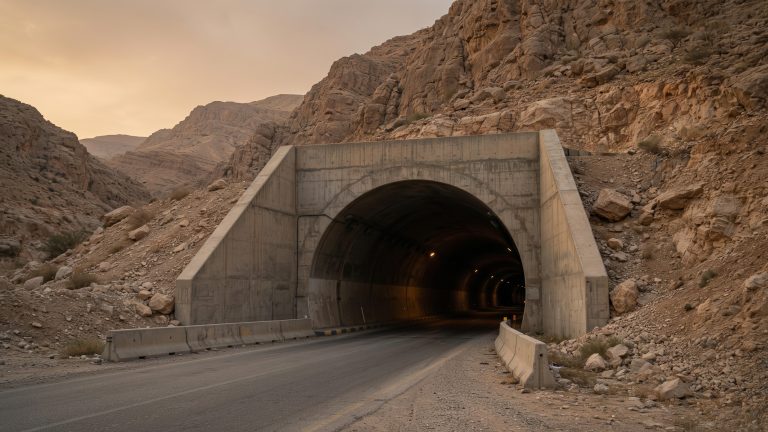
Across Lebanon, Gaza, and Yemen, armed groups aligned with Tehran operate sprawling tunnel complexes and concealed weapons depots that closely resemble Iran’s buried missile cities. Many observers assume the Islamic Republic invented this subterranean doctrine and exported a single blueprint across the region. Middle East Institute senior fellow Alex Vatanka challenges that view, arguing that local geography, historical conflict, and sheer survival drove Hezbollah, Hamas, and the Houthis underground long before Iranian support matured. Other military analysts at the Modern War Institute at West Point have argued that Iranian financial and logistical backing still narrowed the gap between state bunkers and militia tunnels, shifting nonstate forces from tactical hiding toward strategic endurance.
Iran’s Missile Cities and Foreign Inspiration
Iran’s own underground strategy grew out of necessity during the brutal war with Iraq in the 1980s, when Iraqi strikes hit Iranian cities while Tehran lacked retaliatory weapons. According to Ali Bilali, a veteran of the Islamic Revolutionary Guard Corps missile program, early commanders acquired launchers and rockets from Syria, Libya, and North Korea before dispersing units nationwide in the late 1990s to survive future American or Israeli strikes. Former Guard official Nasser Kaveh recounted that aerospace commander Amir Ali Hajizadeh pioneered Iran’s deep missile facilities after observing buried silos during a visit to North Korea. Although Tehran publicly unveiled these underground complexes starting in 2015 to project deterrence, Washington Institute analysts noted in 2026 that American and Israeli strikes damaged most surface missile plants even as Iranian officials claimed buried factories kept operating.
Local Roots in Gaza and Southern Lebanon
Vatanka points to Gaza as the clearest counterexample to claims that Tehran originated regional tunnel warfare. Residents in Rafah dug the earliest passages in the 1980s to reunite divided families and move goods across the Egyptian border, and reporters at The Guardian traced how Palestinian militants later fortified those smuggling routes into combat corridors used to capture an Israeli soldier in 2006. After Israel withdrew in 2005 and tight border restrictions followed Hamas’s 2007 takeover, underground construction became essential for evading Israeli surveillance and preserving command centers. While Tehran transferred funding, training, and rocket manufacturing expertise to Hamas, Vatanka contends the evidence points far more strongly to Iranian weapons aid than to Iranian authorship of Gaza’s tunnel architecture.
In Lebanon, Hezbollah dug defensive bunkers across rugged southern hills during Israel’s occupation from 1982 to 2000, yet scholars detect much deeper Iranian engineering involvement there. Vatanka highlights Revolutionary Guard engineer Hassan Shateri, who oversaw Iranian civilian reconstruction in Lebanon after the 2006 war and faced American Treasury sanctions in 2010 for supporting Hezbollah’s military communications. Researchers at the Alma Research and Education Center assessed that Hezbollah built a vast interregional network linking Beirut, the Bekaa Valley, and southern Lebanon with Iranian funding and North Korean technical support. Even in Lebanon, Vatanka notes that learning flowed both ways, as Iranian commanders closely studied how Hezbollah withstood Israeli airpower in 2006 before refining their own defensive doctrine.
Yemen’s Mountains and a Reciprocal Strategy
Yemen’s Houthi movement followed a third path, relying on northern highland caves and Cold War bunkers built under former president Ali Abdullah Saleh with reported Chinese and Russian involvement. Military analyst Michael Knights has documented how the Houthis adapted existing depots around Sanaa after Saudi Arabia intervened in 2015, while satellite imagery analyst Fabian Hinz observed expanded subterranean sites with vehicle entrances capable of housing ballistic missiles and drones. Analysts at the Combating Terrorism Center at West Point linked this concealment and strategic depth to Houthi resilience under fire, noting that senior fighters received specialized logistics and missile training in Iran and Lebanon. When American stealth bombers struck five fortified Houthi storage sites in late 2024, Washington Institute researchers noted that targeting Yemen’s buried depots also served to signal American capabilities to Tehran.
Viewed together, these four theaters reveal a shared tactical logic born from distinct local histories rather than a centralized Iranian design. Each actor faced enemies with superior airpower and intelligence sensors, making excavation a practical answer to battlefield vulnerability. Tehran amplified that instinct by supplying funds, engineering talent, and munitions expertise, yet its Arab partners retained independent roots and shaped Iranian military thinking in return. Understanding that reciprocal relationship explains why underground warfare persists across the Middle East even when external supply lines face heavy military pressure.
Original analysis inspired by Alex Vatanka from Middle East Institute.
Additional research and verification conducted through multiple sources.