Western governments are accelerating efforts to secure strategic metals outside Chinese supply networks, creating fresh commercial openings for Central Asian miners and refiners. On November 24, China’s Ministry of Commerce extended a temporary suspension of tighter export curbs on gallium, germanium, antimony, and selected graphite products bound for the United States until January 27, 2027. Despite that brief reprieve, European policymakers are moving quickly to reduce vulnerability, as France announced plans to establish national reserves of rare earths and other critical minerals by 2027 alongside potential price guarantees. Meanwhile, the European Commission approved a joint Italian and Dutch pilot reserve backed by 14 million euros to store and distribute strategic metals through Rotterdam and Porto Marghera in Venice.
Price Volatility and Public Financing
Sharp price swings in minor metals illustrate why alternative producers struggle to attract private capital without state backing. A November 10 report by the United States Geological Survey found that average American antimony prices more than doubled from roughly 10 dollars per pound in 2024 to 24 dollars in 2025 before spot prices slid back toward 12 dollars in April 2026 after Beijing paused its export ban. In its annual outlook, the International Energy Agency warned that global investment in critical minerals declined by 9 percent in 2025 even as public financing pledges across advanced economies climbed to 65 billion dollars. Agency Executive Director Fatih Birol described the added expense of diversifying supply chains as a form of economic insurance against severe market disruptions.
Expanding Processing Across the Region
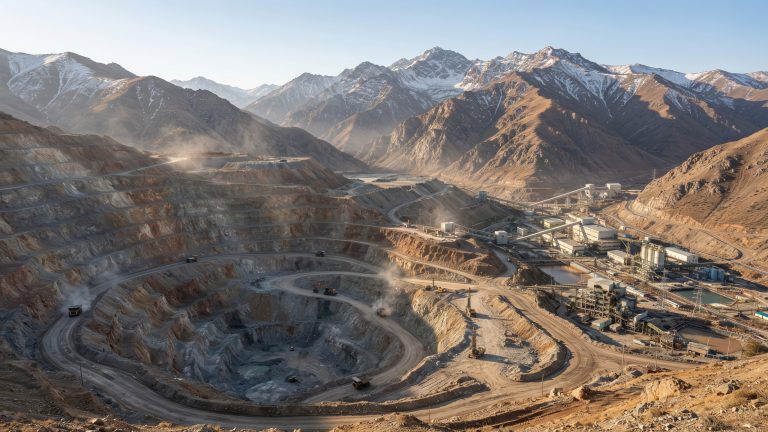
Regional governments now aim to move beyond exporting raw ores and capture greater value through domestic refining. During a November 18 visit to Dushanbe, United States Deputy Secretary of State Christopher Landau discussed mining investment and bilateral cooperation with Tajik President Emomali Rahmon. Tajikistan produced roughly 20 percent of the world’s mined antimony in 2025, and federal trade data show that France absorbed 48 percent of Tajik unwrought antimony powder exports in 2024 while Belgium took another 44 percent. In July, Rahmon opened a new TALCO Gold metallurgical plant in the Ayni district with an annual capacity of up to 5,000 metric tons, while Japanese officials have explored local antimony trioxide production.
Further north, an October 29 policy report by the Organisation for Economic Cooperation and Development identified strong potential to recover gallium, germanium, indium, and rare earth elements from active Central Asian mines and industrial waste. Kazakhstan already produces or refines about 20 of the 34 materials on the European Union critical raw materials list, and Vice Minister of Industry and Construction Olzhas Saparbekov invited Belgian firms in October to transfer processing technologies gradually into the country. Foreign capital is entering the sector unevenly, as the European Bank for Reconstruction and Development lifted its stake in Sarytogan Graphite Limited to 18.4 percent while American developer Cove Kaz Capital Group continues seeking construction financing for its Kazakh tungsten deposits after two federal lenders stepped back. In neighboring Uzbekistan, American Resources Corporation and ReElement Technologies signed an October 19 agreement with the Uzbekistan Technological Metals Complex to demonstrate purified tungsten oxide refining and study domestic processing plants. Company chief executive Mark Jensen stated that the venture seeks to deploy advanced refining technology that builds higher value products for both nations rather than merely shipping raw ore abroad.
Transport Bottlenecks and Market Access
European institutions have paired bilateral mineral partnerships in Kazakhstan and Uzbekistan with a 7.5 million euro regional geological mapping initiative funded alongside Finland. Even Turkmenistan, where mining lags behind hydrocarbons, raised its iodine exports by 51 percent in 2024 to 813 metric tons, sending nearly 30 percent to buyers in the United Kingdom. Moving refined metals reliably to Western factories remains difficult, however, because preliminary OECD findings presented at a November 5 workshop in Tashkent showed that most surveyed Uzbek exporters still ship through Russia along the Northern Corridor. High freight costs, slow transit times, and erratic schedules continue to deter use of the Trans Caspian Transport Corridor, and industry representative Timur Khikmatullayev stressed that stable power, water, and feedstock costs are equally vital for expanding local metallurgy.
Original analysis inspired by Stephen M. Bland from The Times of Central Asia.
Additional research and verification conducted through multiple sources.