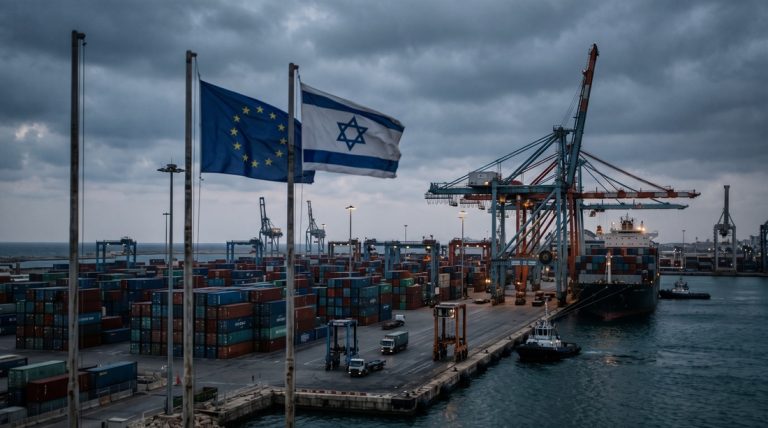
Israel’s relationships with Western governments underpin far more than ceremonial visits and supportive statements. They connect its economy to major export markets and its armed forces to foreign suppliers. Benjamin Netanyahu’s cultivation of sympathetic political leaders has not removed those dependencies. The danger is that diplomatic disputes over Palestinian rights increasingly reach the institutions that sustain trade and military cooperation.
The commercial imbalance is striking. European Commission figures show that the European Union accounted for 31.7 percent of Israel’s goods trade in 2025, while Israel represented less than one percent of the bloc’s external goods trade. Bilateral exchanges reached €43.3 billion. That unequal exposure gives European policy decisions an importance for Israel that friendly relations with individual leaders cannot erase.
Military procurement creates another dependence. SIPRI calculated that the United States supplied 66 percent of Israel’s imported major arms during 2020 to 2024, with Germany supplying another 33 percent. These figures measure major arms transfers, not every weapon Israel possesses or manufactures. They nevertheless show how concentrated its foreign supply relationships have been, making promises of complete strategic independence difficult to reconcile with procurement realities.
Public opinion is moving against the assumption that these relationships enjoy permanent political protection. Pew Research Center found that 60 percent of American adults viewed Israel unfavorably in March 2026, up from 53 percent the previous year. Among Republicans younger than 50, unfavorable views reached 57 percent, although Republicans overall remained more positive than negative. The shift therefore extends beyond a dispute between Netanyahu and Democratic politicians.
European pressure also has a concrete institutional history. In September 2025, the European Commission proposed suspending certain trade concessions, citing Gaza’s humanitarian crisis and settlement expansion among its concerns. The proposal required a Council decision; its announcement was not itself an enacted trade suspension. That distinction matters, but so does the fact that preferential market access became an explicit instrument of political pressure.
The underlying dispute cannot be resolved solely by presenting a different personality abroad. A debate within Israel now connects its diplomatic predicament to settlement policy, violence against Palestinians and the exclusion of Arab citizens from governing partnerships. Those questions concern government conduct and political rights. Replacing Netanyahu could create room for different decisions, but it would not make those decisions automatically.
Nor do declining approval ratings guarantee an arms embargo or a commercial rupture. Governments weigh domestic politics, security commitments and economic interests before acting. Yet treating continued cooperation as unconditional encourages precisely the policies that put it under pressure. The practical test for Israel’s next government will be whether it changes conduct that partners have challenged, rather than merely asking them to accept a more reassuring spokesperson.
By ThinkTanksMonitor Editorial