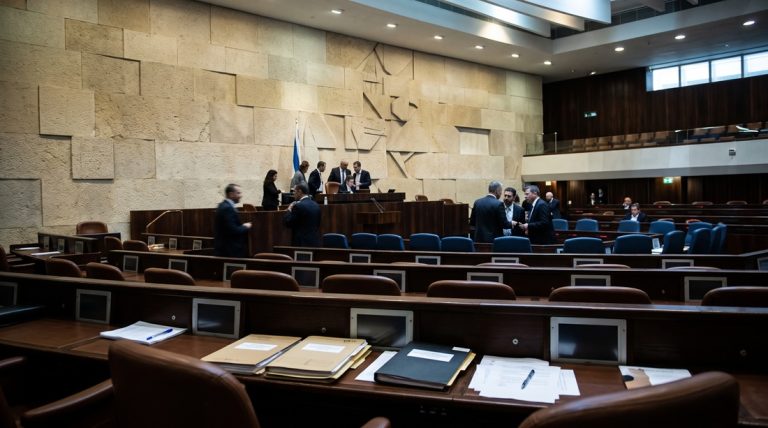
Israel’s coalition talks leave an outgoing government in charge while its rivals try to assemble a parliamentary majority. Reports of possible renewed action against Iran give that interval consequences far beyond the Knesset. The question is who would authorize a strike, what threat would justify it, and how much scrutiny a decision could receive before the country committed itself to another round of fighting.
Israel’s Basic Law keeps an outgoing government in office until a successor takes over. Its provisions on war assign authority to the government and allow delegation to a ministerial committee under specified conditions. They also provide for parliamentary notification and allow military action needed for defense and public security. A change in the parliamentary balance can therefore weaken a prime minister’s political position while leaving the government capable of making consequential security decisions.
Legal capacity and political discretion are separate questions. Reuters reported after the election that experts expected restraint from a caretaker government but saw room for military action in urgent circumstances. That gives the timing of any proposed strike particular weight. A cabinet making the case for imminent action would need to explain why the threat could not be managed through defensive preparations or left to a government with a fresh mandate.
Opposition leaders have already raised the issue in public. Avigdor Liberman warned on November 12 against decisions that could lead to war without parliamentary oversight and support from security chiefs. The Jerusalem Post reported the next day that Benjamin Netanyahu and Gadi Eisenkot had discussed possible renewed action in a security briefing. Consultation can give rival leaders a clearer picture of the options. It leaves the government responsible for explaining the purpose and expected consequences of any decision.
The regional costs can emerge well before coalition negotiations end. Reuters reported on November 13 that Washington was sticking with its blockade of Iranian ports, keeping maritime security central to the confrontation. Another strike would add military uncertainty to a dispute already affecting access to the Strait of Hormuz. Israel’s next government could inherit both the operation and the diplomatic constraints it created, which gives lawmakers a practical reason to demand a clear case for urgency now.
Original analysis inspired by Simon Speakman Cordall from Al Jazeera. Additional research and verification conducted through multiple sources.