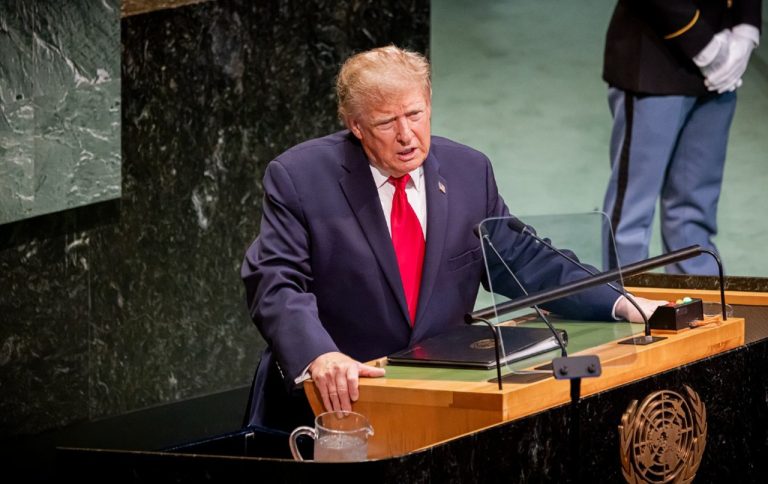
Two speeches in New York this month offered opposite answers to a question Washington can no longer dodge: what security looks like after American primacy. On 22 September, President Donald Trump told the 81st United Nations General Assembly that the United States is stronger than ever and will use that strength to confront enemies, protect interests, and reject global control. The night before, Senator Bernie Sanders argued at Riverside Church, where Martin Luther King Jr. spoke against the Vietnam War, that a country spending ever more on arms and ever less on social needs is approaching a spiritual death, and that the pattern is now global.
Trump’s list of deeds was the policy. He threatened to annihilate Iran if talks fail, claimed credit for a Gaza settlement, and described strikes on boats he calls cartel craft, plus the removal of a Venezuelan gang leader. He repeated that there is no global government and, while he is president, no global taxes. Climate rules and limits on artificial intelligence were dismissed as a hoax. The United States has left the World Health Organization. A military budget he wants raised by about a third, toward $1.5 trillion, and a proposed shield over the continent would add fuel to an arms race already outrunning the old treaties. The International Criminal Court drew a demand that members quit what he called a rogue body. The through line is enforcement of will, not of a charter.
A different list of threats
Sanders treated that record as the problem. He called for an end to the Iran war, a halt to military aid for Israel, and a condemnation of what he termed genocide in Gaza. He urged work with activists to stop Vladimir Putin’s war in Ukraine and criticism of the United Arab Emirates over Sudan. Violence, he said, makes the United Nations more necessary, not less: disagreements belong at a table, not in a slogan that might makes right. The danger he ranked first was oligarchy. The top 1 percent of Americans, he noted, now hold more wealth than the bottom 94 percent, and about 3,400 of the richest people on earth grew $4 trillion richer last year while children die of preventable disease. Artificial intelligence and climate change sat beside that concentration of money as threats no navy can bomb away.
The split is practical, not rhetorical. Trump’s map puts the spoils with the powerful and treats shared rules as a tax on sovereignty. Sanders’s map treats militarism as a drain, oligarchy as the main assault on democracy, and pandemics, climate, and new weapons as jobs for cooperation. Neither speech restores the unipolar habits of the past two decades. One spends the remaining advantage on coercion. The other bets that a citizens’ movement can still build an order, in his phrase, based on justice and decency rather than greed. Nelson Mandela’s line, which Sanders quoted, is the wager: it always seems impossible until it is done.
Original analysis inspired by Katrina vanden Heuvel from The Nation. Additional research and verification conducted through multiple sources.