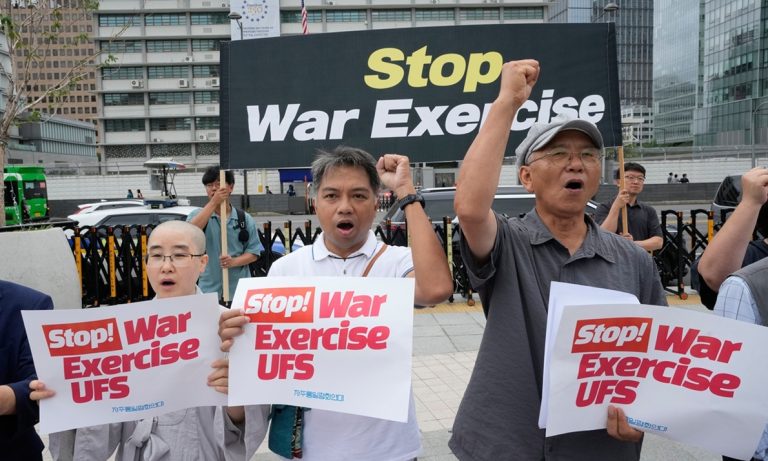
The annual Ulchi Freedom Shield exercise has exposed an unusual tension inside the United States and South Korea alliance. Seoul wants to preserve military readiness against North Korea while gaining greater control over its own defense and reopening political space for dialogue with Pyongyang. Washington, meanwhile, increasingly views the alliance through a broader Indo Pacific lens. President Donald Trump’s order to substantially reduce the exercises adds another complication, showing that differences now exist not only between Seoul and Washington, but also within Washington’s own approach to the Korean Peninsula.
Ulchi Freedom Shield began with around 18,000 South Korean personnel and scenarios involving drones, cyberattacks, electronic warfare, and GPS disruption. These threats reflect lessons from recent conflicts as well as North Korea’s expanding military capabilities. Pyongyang has condemned the exercise and warned that deeper cooperation among Washington, Seoul, and Tokyo will produce a stronger North Korean nuclear response.
Seoul wants deterrence without permanent confrontation
President Lee Jae Myung is trying to combine military preparedness with a markedly different political message toward North Korea. His government has promised to respect the North Korean political system, reject forced unification, reduce hostile actions, and continue pursuing peaceful coexistence. At the same time, Lee has said South Korea must strengthen its independent defense capabilities and complete the planned transfer of wartime operational control during his presidency.
That creates a difficult balancing act. Wartime operational control gives the alliance an integrated command system during conflict, and transferring greater authority to Seoul requires extensive testing of South Korean command capabilities. Joint exercises therefore help South Korea prepare for the very autonomy that could eventually reduce its dependence on American command structures.
Trump has complicated that calculation by again questioning the scale of the exercises. He ordered the Pentagon to substantially reduce them, citing their cost and describing them as unnecessarily hostile toward North Korea. US Forces Korea commander Xavier Brunson subsequently discussed possible reductions with South Korean defense officials even while the current exercise continued.
The alliance is expanding beyond North Korea
A second debate concerns what the alliance is ultimately designed to do. Official American and South Korean defense statements increasingly connect bilateral cooperation to security across the Indo Pacific, not only deterrence on the peninsula. A recent integrated defense dialogue committed both countries to deeper cooperation on shared security goals in Korea and across the wider region.
American military exercises offer practical evidence of that shift. During Freedom Shield earlier this year, the US Eighth Army deployed airborne forces from Alaska to demonstrate rapid combat power projection across the Indo Pacific. US and South Korean military leaders have also stated that their combined deterrence contributes to regional security beyond the Korean Peninsula.
This does not mean Seoul has accepted an automatic military role in a future confrontation involving China or Taiwan. South Korea remains heavily focused on North Korea and has strong economic reasons to avoid unnecessary confrontation with Beijing. Washington, however, increasingly expects allies to contribute to a regional network capable of responding to threats across the Indo Pacific.
The alliance therefore faces a problem of purpose rather than imminent rupture. Seoul wants American deterrence while seeking greater military autonomy and room for engagement with Pyongyang. Washington wants a capable South Korean ally that can contribute beyond the peninsula, while Trump simultaneously questions the costs and political value of some traditional alliance practices. Those goals can coexist, but only if both governments agree on where Korean defense ends and wider regional strategy begins.
Original analysis inspired by Zhan Debin from Global Times. Additional research and verification conducted through multiple sources.