One year after Washington brokered a truce between Israel and Hamas, diplomatic attention has shifted away from halting bloodshed toward managing a ruined enclave. When Israeli and Hamas negotiators signed the Sharm el Sheikh agreement in October 2025 under President Donald Trump’s framework, Western capitals celebrated a diplomatic breakthrough. Yet lethal Israeli military operations have persisted across the Gaza Strip almost daily, even as international scrutiny faded from front pages. Rather than securing safety for civilians, the truce converted urgent demands to stop mass killings into technical debates over aid logistics and governance.
Shifting Focus From Accountability to Administration
Before the October 2025 agreement, two years of relentless bombardment had killed more than 67,000 Palestinians and drawn mounting diplomatic isolation for Israel. Securing the truce allowed Israel to recover captives while easing the reputational damage of an increasingly unsustainable campaign. Once the ink dried, however, Palestinian health officials reported that Israeli forces killed another 1,538 Palestinians and wounded 5,498 more by late October 2026. Global media coverage fell sharply after the signing, leaving those continuing casualties largely invisible to international audiences.
Human rights monitors found that a full year after the announcement, Israeli forces still struck civilians and blocked adequate humanitarian relief across the territory. Instead of confronting who continues to fire on displaced families or restrict access to land, foreign governments narrowed their focus to administrative mechanics. Diplomats now spend their energy debating which bodies should distribute food, who will oversee local policing, and how donor funds should flow. By treating an active military occupation as a technical management challenge, international actors have obscured ongoing violence behind bureaucratic procedure.
Reconstruction Without Justice Risks Another Cycle
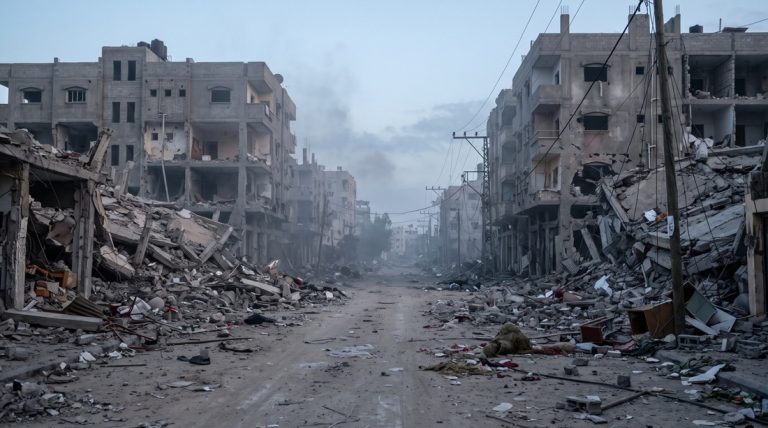
The gap between diplomatic rhetoric and reality on the ground has prompted sharp warnings from international legal bodies. In October 2026, the United Nations Office for Human Rights in the Occupied Palestinian Territory urged third states to halt weapons transfers to Israel and support international accountability mechanisms. Meanwhile, Gaza’s physical and economic ruin has reached historic proportions, with a joint United Nations and European Union assessment estimating that rebuilding the territory will require 71.4 billion dollars over the next decade. That figure dwarfs the roughly 10 billion dollars needed after earlier Israeli assaults in 2008, 2009, 2014, and 2021 combined.
Donor pledges alone cannot break this pattern if rebuilding proceeds without legal consequences for mass destruction. Aid analysts at Oxfam argued in July 2026 that meaningful recovery requires genuine Palestinian ownership and a rights based approach rather than temporary relief that ignores decades of blockade. Until governments measure success by whether Palestinians live free from bombardment and displacement, the ceasefire will remain a diplomatic shield that makes continued violence easier to ignore.
Original analysis inspired by Yousef Munayyer from The New Arab.
Additional research and verification conducted through multiple sources.