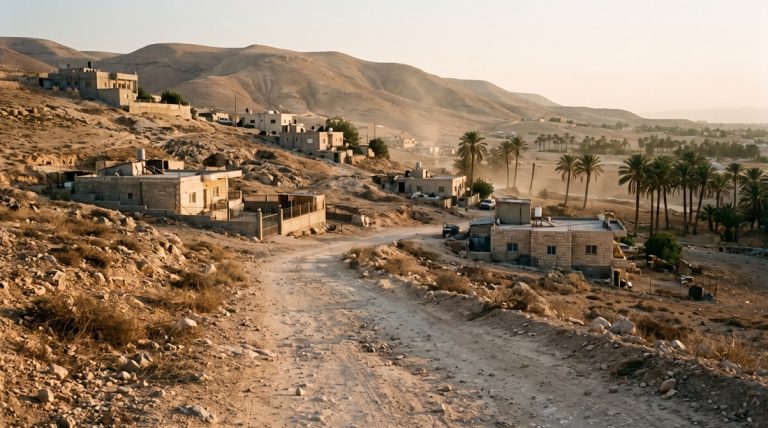
A wave of settler violence on the outskirts of Jericho is threatening to remake one of the West Bank’s most prominent Palestinian cities. On November 17, armed Israeli settlers shot and killed 72 year old Palestinian resident Fida Salem Hajjaj Fahidat during an overnight attack in Duyuk al Tahta, injuring around a dozen others. Two weeks earlier, scores of settlers backed by Israeli soldiers seized eight homes in the same neighborhood, forcing more than a dozen Bedouin families of the Kaabneh tribe into makeshift encampments. Rights monitors now warn that these coordinated raids aim to establish a permanent settler enclave inside Jericho, mirroring the divided reality long imposed on Hebron.
Military Backing Behind Settler Takeovers
The takeover of Duyuk al Tahta followed months of escalating harassment, home demolitions, and livestock theft that intensified after Israel’s October 2026 parliamentary elections. Although army officials initially denied coordinating the November incursion, Israeli media revealed that Central Command chief Major General Avi Bluth knew of the settlers’ plans in advance and instructed them not to alert other commanders. Days after the raid, the Israeli military declined to evict the settlers from the seized properties, leaving the displaced Palestinian owners stranded nearby. Settlers now patrol the boundary between Israeli controlled Area C and Palestinian administered Area A, intimidating families who previously fled Khan al Ahmar in 2007.
Heritage Projects as Tools of Expansion
The confrontation in Jericho is closely tied to an Israeli government drive to turn West Bank antiquities into settlement anchors. In April 2026, Israel’s security cabinet retroactively legalized the nearby Armonot Farm outpost, renaming it Daya alongside 102 other outposts across the occupied territory. One month later, Israeli ministries allocated 250 million shekels to develop West Bank heritage sites, including plans to transform the ancient Hasmonean Palaces near Jericho into a tourist attraction. Because the traditional route to those ruins passes through Palestinian controlled Area A, the army issued a military seizure order over Kaabneh family land to carve out a separate access corridor.
Challenging the Oslo Map in Area A
Archaeological watchdogs compare this strategy to East Jerusalem’s City of David project, where tourism infrastructure and settler outposts reinforce one another to displace local Palestinians. Israeli settlement monitor Peace Now warned that planting a settlement on Jericho’s edge could replicate Hebron’s trajectory, where a small settler presence brought sweeping street closures, military checkpoints, and severe movement restrictions for Palestinians. Under the Oslo Accords, Jericho was designated for Palestinian Authority governance, yet settlers have already seized roughly 14 percent of the West Bank and displaced at least 78 Palestinian communities across Area C. By straddling the line into Area A, the Jericho outpost directly challenges what remains of Palestinian urban autonomy and fragments Palestinian geography even further.
Original analysis inspired by Jessica Buxbaum from The New Arab.
Additional research and verification conducted through multiple sources.