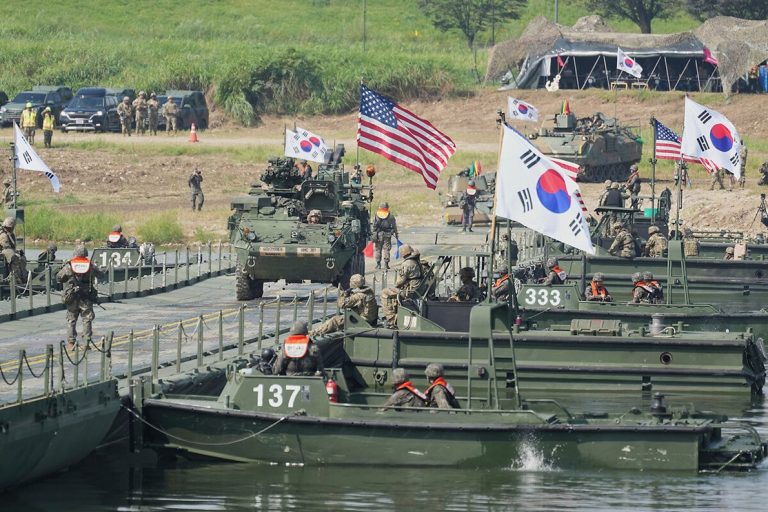
Donald Trump is once again using military exercises as diplomatic leverage on the Korean Peninsula. Just before Ulchi Freedom Shield began, the president ordered the Pentagon to substantially reduce American participation, citing both the financial cost and his relationship with North Korean leader Kim Jong Un. The decision could create an opening for renewed talks with Pyongyang, but it also forces South Korea to reconsider how dependable Washington will be when American diplomatic priorities change. For Seoul, the central question is whether concessions designed to restart negotiations will ultimately strengthen peace or weaken deterrence.
Ulchi Freedom Shield remains one of the alliance’s main readiness exercises. US Forces Korea describes the training as an effort to improve combined operations across military services and strengthen responses to a range of security threats. Around 18,000 South Korean personnel are taking part this year, while more than 28,000 American troops remain stationed on the peninsula as part of the broader defense commitment.
Diplomacy returns to alliance policy
Trump’s reasoning reflects an approach he used during his first presidency, when direct diplomacy with Kim temporarily changed the rhythm of military activity around the peninsula. He met the North Korean leader three times and reduced major exercises while attempting to negotiate denuclearization. Those talks failed to produce a lasting nuclear settlement, but Trump continues to present his personal relationship with Kim as an asset that traditional diplomatic channels cannot reproduce.
That approach may now be producing movement. Trump said that Kim has responded to his latest diplomatic outreach, although he provided no details about the communication or whether a meeting is being prepared. Seoul has reacted cautiously but positively, expressing hope that renewed contact between the two leaders could advance the broader goal of reducing tensions and building a durable peace system. President Lee Jae Myung has already pursued measures intended to reduce confrontation with Pyongyang while rejecting forced unification.
North Korea nevertheless enters any new negotiation from a stronger strategic position than during Trump’s first term. Its nuclear and missile capabilities have continued to grow, while cooperation with Russia has increased its international leverage. Pyongyang has also condemned the current exercises as preparations for war. Reducing drills may therefore remove one recurring North Korean complaint without necessarily convincing Kim to limit his weapons programs.
Seoul pays the strategic price
The more difficult issue is how Trump reached the decision. South Korean officials were surprised by the announcement, which came as the exercise was beginning rather than through a coordinated alliance process. Trump also connected his dissatisfaction with the drills to Seoul’s refusal to participate in American military operations involving Iran. That linkage introduces a transactional element into an alliance traditionally organized around defense of the Korean Peninsula.
South Korea has strong reasons to preserve the relationship. Its forces operate through deeply integrated command structures with the United States, and Washington provides extended deterrence against a nuclear armed North Korea. US defense policy has long defined the alliance as essential both to defending South Korea and to supporting security across the wider Indo Pacific. Abrupt changes to exercises therefore affect more than training schedules because they influence perceptions of military readiness and political commitment.
Yet Seoul also wants greater autonomy. Lee has emphasized stronger independent defense capabilities while continuing dialogue with North Korea. A diplomatic opening created by reduced exercises could support that agenda, particularly if it lowers the risk of escalation. But if Washington changes alliance practices without consultation and receives little in return from Pyongyang, calls inside South Korea for greater strategic independence could grow.
Trump’s decision is therefore a gamble on personal diplomacy. If reducing military pressure produces substantive negotiations with Kim, the move could become an early step toward lowering tensions on the peninsula. If North Korea accepts the concession while continuing its nuclear expansion, Washington may have weakened an important alliance tool without gaining meaningful restraint. For South Korea, the outcome will shape not only relations with Pyongyang but also its judgment about how much of its future security can safely depend on Washington.
Original analysis inspired by Matthew Bell from The Christian Science Monitor. Additional research and verification conducted through multiple sources.