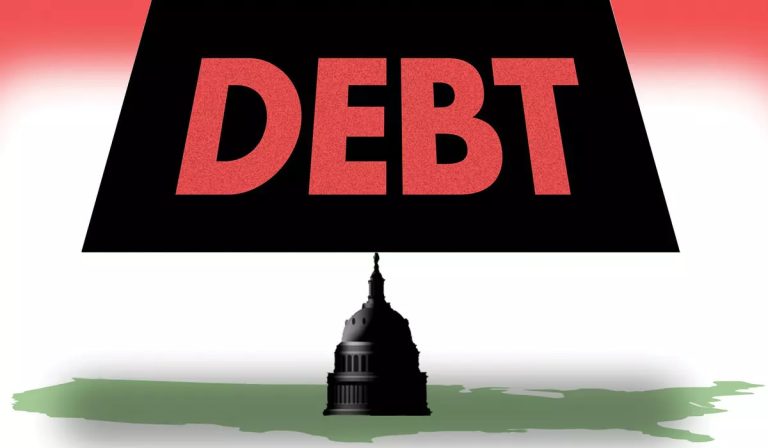
The United States has carried large debts before. It financed World War II by borrowing heavily, then spent the next three decades growing its way out. That playbook no longer works — and the country is not even trying to use it. What is different today is that the debt is rising during a period of low unemployment and sustained wage growth, precisely the conditions under which it historically fell. The rules have changed, and most of Washington has not noticed, or has chosen not to.
The numbers are stark. Federal debt held by the public currently sits at roughly 99 percent of GDP and is projected to reach 187 percent by 2055 under current policy. Net interest payments, which consumed 3.18 percent of GDP in 2025, are on a path to reach 6.17 percent — a level with no peacetime precedent in American history. These are not speculative projections from advocacy groups. They come from the Congressional Budget Office, whose models have historically been considered conservative.
How the Hole Got This Deep
The origin story is bipartisan in its early chapters and firmly partisan by the end. Before the Bush tax cuts of 2001, federal revenue was on track to keep pace with spending indefinitely — even accounting for an aging population and rising healthcare costs. Those cuts broke the baseline. The overwhelming majority were made permanent on a bipartisan basis during the Obama years, which normalized what had previously been treated as temporary. Then came the 2017 Trump tax cuts, and now the recently passed Big Beautiful Bill, which independent analysts estimate will add $5.8 trillion to deficits over the next decade — or $6.6 trillion if its temporary provisions are assumed to be extended, as they almost certainly will be.
The fiscal gap — the sustained reduction in primary deficits needed to stop the debt ratio from rising indefinitely — now stands at roughly 2.6 percent of GDP. In 2026 terms, closing it would require legislation that reduces deficits by approximately $840 billion per year, or $10.5 trillion over ten years. For context, the entire tax-raising component of Build Back Better totaled around $2 trillion after adjusting for economic growth. The gap between where fiscal policy is and where it needs to be has never been wider during peacetime.
Interest rates compound everything. For most of the decade following the 2008 financial crisis, borrowing costs were historically low — low enough that even a rising debt ratio felt manageable, because the economy was growing faster than the government was paying to borrow. That cushion has narrowed significantly. The Federal Reserve’s rate cycle has pushed average interest costs on federal debt back toward levels not seen since before the Great Recession, and the CBO projects that rates will eventually overtake GDP growth within three years. When that happens — when r exceeds g in economists’ notation — debt stabilization requires running a primary surplus, not merely a smaller deficit. The United States is currently running a structural primary deficit of roughly 3 percent of GDP. The direction of travel is precisely wrong.
The AI Mirage
Into this picture has come a politically convenient argument: that artificial intelligence will generate enough productivity growth to solve the problem without anyone having to make hard choices. The appeal is obvious. If AI supercharges the economy, tax revenues rise, the debt-to-GDP ratio falls, and no one has to touch Medicare or raise taxes on anyone. It is a story that sells itself.
The evidence does not yet support it. Workplace AI adoption — defined as firms using it in regular business functions — remains below 20 percent and rising. The productivity gains recorded so far are real but modest. More fundamentally, there is a critical distinction between a level shift and a growth rate shift. If AI makes workers 30 percent more productive as firms adopt it, that is a one-time gain — impressive, but not the kind of sustained acceleration that changes a long-run debt trajectory. For AI to rescue the fiscal outlook, it would need to keep making workers more productive year after year, indefinitely. The internet analogy is instructive and cautionary: the 1990s technology boom produced a genuine spike in productivity growth that peaked around 2000, then faded back toward the pre-internet baseline even as the internet itself became ubiquitous. History suggests that transformative technologies shift the level of output more reliably than the rate at which it grows.
Yale Budget Lab modeling confirms the pattern. Under moderate AI adoption scenarios, debt stabilizes around 105 percent of GDP through the 2030s — an improvement over the baseline, but not a solution. Only under the most optimistic assumptions, productivity growing at 3.2 percent annually for a sustained period, does the debt ratio actually decline. Most mainstream economists put likely AI-driven productivity gains closer to 0.1 to 1.5 percent per year. Betting fiscal policy on the upper bound of that range is not prudence — it is wishful thinking with generational consequences.
What Actually Needs to Happen
The case for fiscal discipline is not simply about abstract debt ratios. CBO modeling suggests that allowing the debt ratio to rise indefinitely will leave average real wages roughly $4,200 lower in 2055 than they would otherwise have been — a permanent drag on living standards that compounds over time. Higher debt also pushes up mortgage rates, reduces housing construction, and raises rents — outcomes felt most acutely by working families who do not own financial assets.
The responsible path is not austerity directed at vulnerable Americans. Cutting Medicaid to close a fiscal gap produced by upper-income tax cuts would be both economically and morally incoherent — the people most likely to lose health coverage are the least likely to benefit from whatever wage growth debt reduction might eventually produce. The correct sequencing starts with the revenue side: unwinding tax cuts that disproportionately benefited the wealthy before touching the programs that lower-income households depend on to survive.
None of this will happen without political will that is currently absent. Congress has effectively stopped responding to deteriorating fiscal projections — passing tax cuts in good times and rescue packages in bad ones, with no mechanism for course correction in between. The debt is larger, more expensive, and more structurally entrenched than it has ever been outside of a world war. AI will not fix that. Only policy will.
By ThinkTanksMonitor Editorial