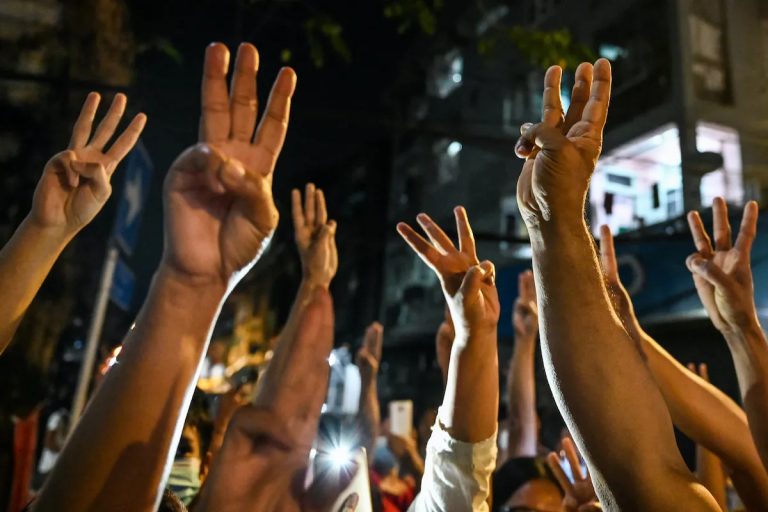
Every revolution eventually faces a test that protest alone cannot pass. Armed resistance can hold territory, disrupt supply chains, and erode an enemy’s legitimacy — but it cannot govern, negotiate, or attract the formal international recognition that translates battlefield momentum into political power. On March 30, 2026, the National Unity Government and four major ethnic revolutionary organizations officially announced the formation of the Steering Council for the Emergence of a Federal Democratic Union. Five years after the coup that ended Myanmar’s fragile democratic experiment, the Spring Revolution has built the kind of institution that foreign capitals said they were waiting for.
The Steering Council represents the most significant formal alliance between legacy ethnic revolutionary organizations and federal democratic and parliamentary entities since the military junta’s February 2021 coup. The founding coalition brought together the NUG, the Committee Representing Pyidaungsu Hluttaw, and four key ethnic armed organizations — the Karen National Union, the Karenni National Progressive Party, the Chin National Front, and the Kachin Independence Organization. What makes this alliance structurally different from earlier attempts at resistance coordination is its explicit commitment to place all armed forces under elected civilian command — a demand the military has spent 60 years insisting was incompatible with national stability.
That stability argument has always been the junta’s core product. For six decades, Myanmar’s generals have marketed themselves as the only institution capable of holding together a country of over 100 ethnic communities. The claim was powerful precisely because it was occasionally validated by a fragmented resistance. Competing visions of federalism, personal rivalries between commanders, and intra-ethnic disputes gave foreign governments a convenient reason to hedge. The Steering Council was constructed to make that hedge intellectually indefensible.
A Charter Built to Govern, Not Just Resist
The Council’s six founding principles are unambiguous: overturn the military’s usurpation of state power, ensure all armed forces operate solely under democratically elected civilian command, abrogate the 2008 Constitution in its entirety, draft a new federal democratic constitution by consensus, build a genuine federal union under that charter, and institute transitional justice mechanisms for conflict-era abuses. These are not aspirational statements — they function as a shared advocacy framework that any diplomat, senator, or civil society organization can use to evaluate whether a proposed agreement advances or dilutes the revolution’s goals.
The Council is built on three formal pillars: representation of states and federal units, representation of ethnic revolutionary organizations and the people’s movement, and representation of women — each tasked with coordinating military, political, federal, and institutional matters. The three-pillar structure institutionalizes inclusion as a founding principle rather than an afterthought, which matters enormously for a movement that has historically struggled to present a unified face to the outside world.
The Bangkok briefing on June 5, at which the Council addressed diplomats from 24 countries and international organizations under a single political framework, marked the first time the resistance had spoken collectively to the international community. The message — that Myanmar is a political transformation problem, not merely a humanitarian emergency — could only be carried credibly by a collective voice. The era of scattered, group-by-group lobbying in foreign capitals, which policymakers routinely ignored, appears to be over.
What the Ground Looks Like
The Council’s political maturation coincides with a military situation that has fundamentally shifted against the junta. A 2026 UN Security Council briefing cited a junta footprint of about 21 percent of the country, while independent mapping projects put it closer to a third, and one field survey credited the resistance with roughly 38 percent of territory by the end of 2025. What every assessment agrees on is the direction of travel — the military is administering less of Myanmar each year.
More than 6,000 civilians have been killed and over 3.3 million people displaced, with more than half the country’s townships involved in active conflict. The junta has responded to its shrinking territorial control by intensifying aerial bombardment. As of early May 2026, the Myanmar Peace Monitor recorded over 3,163 airstrike events across 177 townships. The junta leader also issued emergency ordinances to impose military control across 60 townships spanning Kachin, Kayah, Kayin, Chin, Shan and Rakhine states as well as Sagaing, Magway and Mandalay regions — a move analysts read as a legal mechanism to expand pressure rather than a genuine sign of territorial recovery.
The junta’s sham elections, which even ASEAN refused to recognize as legitimate, produced a parliament with no credibility outside the military’s own ecosystem. The resistance, by contrast, has built interim federal unit governments in Sagaing, Magway, Mandalay, and Tanintharyi that are already administering territory and providing services. Endorsements from these emerging administrative bodies, alongside the Karenni Interim Executive Council and Chin National Defense Force councils, have given the Steering Council a form of bottom-up legitimacy that no declaration alone could generate.
The International Community’s Remaining Obligation
The NUG has described the Steering Council as part of its revolutionary collective leadership, demonstrating an active phase of state building, and has urged the international community to extend effective support to both the people of Myanmar and the Council in efforts to build a federal democratic union.
Three specific actions are now overdue. Washington should formally [suspicious link removed] the Steering Council as the legitimate political interlocutor for Myanmar’s transition, as Myanmar’s UN ambassador has formally requested. The BURMA Act, passed with bipartisan support, should be fully implemented with sequestered junta assets directed toward Council-coordinated programs. And ASEAN’s dialogue partners — the United States, Japan, the European Union, Australia, and the United Kingdom — should make clear that the Five-Point Consensus can no longer serve as a framework for engaging a military that controls less than a quarter of the country it claims to govern.
The resistance has answered, in concrete institutional form, the political question that foreign capitals used for years to justify inaction. Continued hedging is no longer a defensible analytical position. It is simply a choice to let a military dictatorship outlast the patience of the people fighting it.
Original analysis inspired by James Shwe from Asia Times. Additional research and verification conducted through multiple sources.
By ThinkTanksMonitor