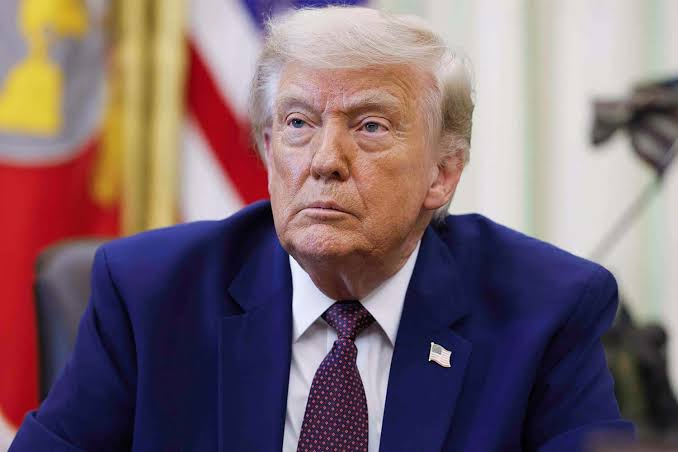
Donald Trump turns 80 this week, making him the second octogenarian president in American history. The first did not finish his term. The comparison raises legitimate questions, but the nature of Trump’s cognitive situation is structurally different from Joe Biden’s 2024 debate collapse. Trump still sounds like himself — combative, digressive, culturally specific in ways that are oddly coherent on their own terms. The concern is not sudden deterioration but something slower and harder to quantify: a mind increasingly governed by the cultural sediment of mid-twentieth-century America rather than the present, making policy from a reference library that was assembled decades ago and has not been meaningfully updated since.
The pattern is visible if you know what to look for. When Trump discusses naval strategy, he routinely invokes Victory at Sea, the 1952 documentary series about World War II battleship operations that was one of television’s first major hits. When he celebrated the Venezuela military operation on Truth Social, he posted a fighter-jet montage soundtracked by “Fortunate Son” — the Creedence Clearwater Revival song that is explicitly and historically an anti-war anthem protesting Vietnam-era draft inequality. The cultural reference was deployed without apparent awareness of its meaning. That gap between the symbol and its actual content recurs throughout his public behavior in ways that have direct policy consequences.
When Pop Culture Becomes Policy
The most analytically significant examples are those where cultural misreading directly produced policy decisions. Trump’s repeated invocations of Hannibal Lecter during the 2024 campaign — connecting the fictional cannibal to immigration — reflected a genuine confusion between the legal concept of asylum-seekers and the institutional concept of asylum as a psychiatric facility. The word was the same; the meanings were entirely different; the policy framing that resulted treated refugees as the equivalent of institutionalized patients. Last spring, Trump announced plans to reopen Alcatraz as a federal penitentiary; a PBS affiliate serving South Florida had aired the 1979 film Escape from Alcatraz twice in the days preceding the announcement. The policy appeared to have been generated by a television schedule.
The broader pattern is of a president who processes the present through a set of cultural templates assembled during the Reagan 1980s — an era of financial speculation, unapologetic wealth display, Warholian excess, and a media landscape in which Trump himself became a celebrity precisely because he embodied its values so completely. The Trump Tower aesthetic, the casino branding, the gold logos, the obsessive coverage by tabloids and entertainment television — these made Trump a recognizable cultural figure, and that figure has not fundamentally changed since. What has changed is the scale of the platform and the consequence of the decisions.
The Media Empire Parallel
The cultural obsessions have a commercial and political dimension that deserves serious attention. The Trump administration has reshaped Paramount from the top down, suing CBS News into a significant settlement, celebrating the cancellation of Stephen Colbert’s show, and approving the Skydance merger only after ideological commitments were extracted from its leadership. The shake-up at 60 Minutes that followed was a direct consequence of that conditional approval. The administration has simultaneously maneuvered to facilitate a Warner Bros. Discovery takeover that would effectively grant ally Larry Ellison control of a substantial media empire — excluding the CNN anchors Trump considers adversaries.
This is not random cultural noise. It is the systematic application of one specific cultural template — the media mogul who controls his image by controlling his platform — to the machinery of state. The Phantom of the Opera cast recordings that reportedly blare through White House rooms, the UFC fight planned for the White House lawn as part of the country’s 250th birthday celebrations, the sculpture garden of midcentury American icons from Elvis to General Patton — these are not affectations. They are expressions of a coherent cultural vision, however internally contradictory, that genuinely shapes what this presidency considers normal, appropriate, and worth celebrating.
The question at 80 is not whether Trump is declining in any dramatic clinical sense. The question is whether a mind formed by mid-twentieth-century American television, entertainment, and financial culture — and increasingly operating through the most superficial interpretations of its reference points — can navigate a 2026 world defined by drone warfare, AI competition, nuclear deterrence failure, and post-dollar geopolitics. The cultural artifacts that shaped him were never designed to provide a roadmap for that world. The concern is not that he knows this. The concern is that he does not.
Original analysis inspired by Nitish Pahwa from Slate. Additional research and verification conducted through multiple sources.