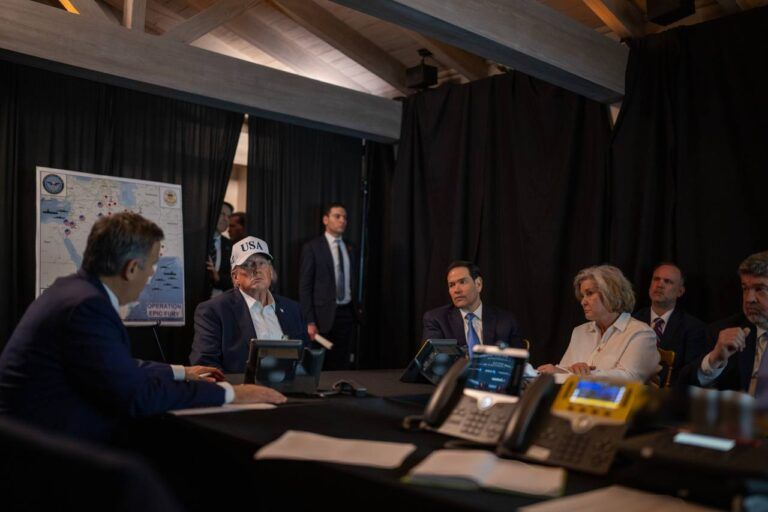
The gravest threat emerging from the US-Iran conflict is not simply military overreach. It is the possibility that a president who helped engineer the crisis could come to see nuclear weapons as the cleanest exit from a war that is no longer going according to plan. That prospect deserves serious institutional scrutiny, not as a theoretical worst-case exercise, but as a live risk pattern that demands action now, before events compress available choices.
The Pentagon has reportedly examined options for a decisive final blow against Iran that would include massive bombing, ground operations, and deep strikes on enrichment facilities buried underground. That is not a description of a targeted raid. It describes an escalatory framework in which military stalemate, mounting troop casualties, and the desire for a politically usable victory could merge into something far more dangerous. The Strait of Hormuz has remained a festering strategic and economic wound throughout the conflict, while Iran’s missile capabilities and underground nuclear infrastructure have survived far more intact than Washington’s early triumphalist statements suggested.
When Humiliation Fuels Escalation
The psychological dimension of this risk is the part most officials are reluctant to discuss openly. Research on crisis decision-making shows that when leaders frame a military objective in absolute reputational terms, the calculus of escalation shifts dramatically. Retreating begins to feel identical to humiliation, and humiliation becomes indistinguishable from personal destruction. Trump has cast the Iran conflict in precisely those terms, openly stating that preventing Tehran from acquiring a nuclear weapon is the only thing that matters to him, explicitly dismissing concerns about the domestic economic toll.
That kind of framing creates a cognitive trap. A leader operating under those conditions stops weighing long-term consequences against short-term relief. Psychic numbing compounds the danger further: a decision-maker can remain acutely sensitive to American casualties while becoming emotionally detached from the vastly larger foreign death toll that nuclear use would produce. Once that asymmetry takes hold inside a war room, nuclear options can start feeling emotionally manageable long before they become strategically or morally defensible.
The Arms Control Association has warned that renewed US military strikes on Iran would be counterproductive and unjustified on nonproliferation grounds, noting that Iran’s nuclear knowledge and determination have outlasted the physical damage to its facilities. The Union of Concerned Scientists documented in March 2026 that the war actively undermines global security and raises the long-term danger of nuclear proliferation beyond the Iran context. Other governments watching Washington’s behavior are already drawing lessons about whether diplomacy or rapid nuclear development offers better security guarantees.
A Broken System Needs Fixing Now
The structural problem is stark. Under current US law, a president holds sole authority to order a nuclear launch and requires neither congressional approval nor military concurrence to do so. Neither branch can formally overrule that decision. This arrangement, inherited from Cold War logic designed for rapid retaliation, was never intended to govern a prolonged conventional war in which escalation creeps incrementally rather than arriving in a sudden attack. House Resolution 317 in the 119th Congress has urged implementing checks and balances on this sole authority, ending the hair-trigger posture that compresses presidential decision time to mere minutes. That resolution deserves urgent action.
Congress has a clear mandate to act. Legislators should publicly establish that no president holds a mandate to use nuclear weapons to rescue a failing conventional campaign. Senior military commanders, though bound by civilian control, can independently demand full-spectrum analysis that includes independent civilian casualty assessments and second-order geopolitical consequences, refusing to let a war defined by political spectacle collapse into the logic of virtuous violence.
A political retreat may embarrass one person. Nuclear escalation threatens entire civilizations. By the time the nuclear option feels genuinely thinkable inside the decision-making apparatus, the failure of oversight will already be complete. The window for preventing that outcome is open. It will not remain so indefinitely.
Original analysis inspired by Paul Slovic and Rose McDermott from Bulletin of the Atomic Scientists. Additional research and verification conducted through multiple sources.
By ThinkTanksMonitor