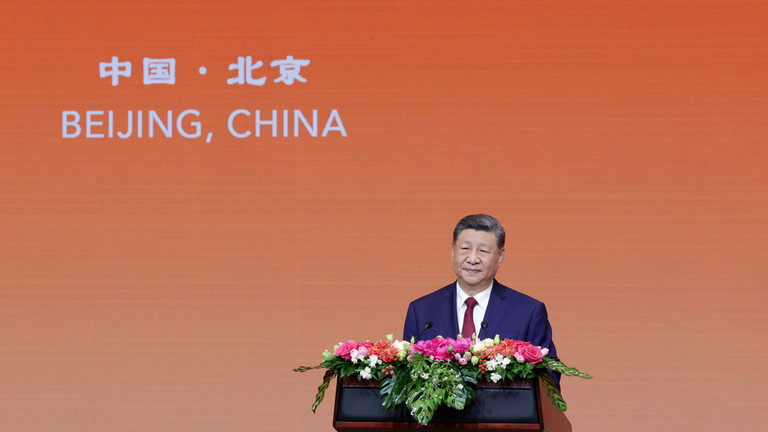
Within the span of a single week, Xi Jinping has hosted both Donald Trump and Vladimir Putin in Beijing — the first time China has received the American and Russian presidents back-to-back outside a multilateral forum. The scheduling alone tells the story. Beijing is no longer just balancing between Washington and Moscow. It is positioning itself at the center of the triangle, a diplomatic gravity well that neither rival can afford to ignore.
The back-to-back visits arrived at a moment loaded with symbolism. Putin’s trip coincides with the 25th anniversary of the Sino-Russian Treaty of Good-Neighborliness and Friendly Cooperation, the foundational accord that formalized the partnership in 2001. Trump’s visit — the first by a sitting U.S. president since 2017 — was delayed weeks by the Iran crisis, creating the unintended but highly visual sequence that Chinese state media seized upon. The Global Times described the pair of summits as proof that Beijing is “fast emerging as the focal point of global diplomacy.”
The Triangle Is Real but Unequal
Analysts have revived the old language of strategic triangularity — a framework that dates back to Henry Kissinger’s Cold War maneuvering between Washington and Moscow via Beijing. But the geometry of 2026 looks nothing like the 1970s. China is no longer the weaker third corner. Its economy dwarfs Russia’s and increasingly rivals America’s. The National Interest put it bluntly this week: China “appears to occupy the center of the triangle itself.”
The asymmetry shows up starkly in trade. China-U.S. commerce reached $414.7 billion in 2025. China-Russia trade, while growing fast, came in at roughly $228 billion — about half the U.S. figure. First-quarter 2026 data shows the Russia-China corridor rebounding nearly 15% year-on-year, driven by surging oil deliveries and a near-doubling of Chinese passenger car exports to Russia. But the imbalance persists: Beijing holds nearly $700 billion in U.S. Treasury bonds, hosts five times more Chinese students in American universities than in Russian ones, and depends on access to Western markets and technology in ways that the Russia relationship cannot replicate.
That gap matters because it shapes what each visitor came to Beijing seeking — and what each can offer in return. Trump arrived with CEOs, secured a 200-plane Boeing order and $17 billion in annual agricultural commitments, and won a September invitation for Xi to visit Washington. Putin arrives with energy. Russia’s oil exports to China grew 35% in the first quarter of 2026, and the long-stalled Power of Siberia 2 gas pipeline is expected to dominate the agenda.
Moscow’s Quiet Anxiety
Putin publicly welcomed the Trump-Xi summit. “We stand only to benefit from stability and constructive engagement between the U.S. and China,” he told reporters. But behind the diplomatic polish sits real concern. Russia’s 2026 GDP growth forecast has been slashed to just 0.4%, Western sanctions continue to bite, and the Ukraine war grinds through its fourth year with no exit visible. China’s economic lifeline is not optional for Moscow — it is existential.
Still, Moscow will have noted something encouraging from the Trump visit. As one analyst told Al Jazeera, “China did not give Trump what he wanted — an end to the Iran war.” Beijing neither abandoned Tehran nor signaled it would squeeze Moscow on Ukraine. For the Kremlin, the fact that Xi held the line matters as much as any gas deal signed this week.
The trust dimension cuts to the heart of the triangle’s dynamics. A Renmin University survey from May 2026 found that within the 18-to-35 age group, 85.5% of Chinese and 87.5% of Russians describe bilateral relations as friendly. The comparable American number tells a different story. A March Pew survey found just 27% of Americans hold a favorable view of China — up from a low of 14% in 2023, but still a long way from mutual warmth. Deep political polarization in the United States and the whiplash of shifting administrations make Washington a fundamentally unpredictable partner for Beijing, in ways that Moscow simply is not.
Not a Zero-Sum Game — but Not Costless Either
The temptation is to read the triangle as a zero-sum contest: every gain for Russia-China comes at America’s expense, and vice versa. The reality is messier. China buying less from the U.S. doesn’t automatically mean it buys more from Russia. A U.S.-China trade deal doesn’t weaken the Sino-Russian partnership, because each relationship runs on a distinct set of drivers. The days of Kissinger-style triangular leverage are gone.
Where the interests do overlap is in avoiding catastrophe. None of the three powers wants a global financial meltdown. None wants the Strait of Hormuz closed indefinitely. And none — despite the rhetoric — wants a direct military collision between nuclear states. That shared floor of restraint gives Beijing room to play host, mediator, and partner all at once.
Yet the balancing act has a cost. NATO has labeled China a “decisive enabler” of Russia’s war in Ukraine. The EU sanctioned Chinese entities this spring for supplying dual-use technology to Moscow. And while Xi can afford to smile through a state dinner with Trump one week and embrace Putin the next, each photo op adds friction to the other relationship. The question is whether Beijing’s diplomatic capital is deep enough to absorb the accumulating strain — or whether, eventually, the center of the triangle buckles under its own weight.
Original analysis inspired by Andrey Kortunov from RT. Additional research and verification conducted through multiple sources.