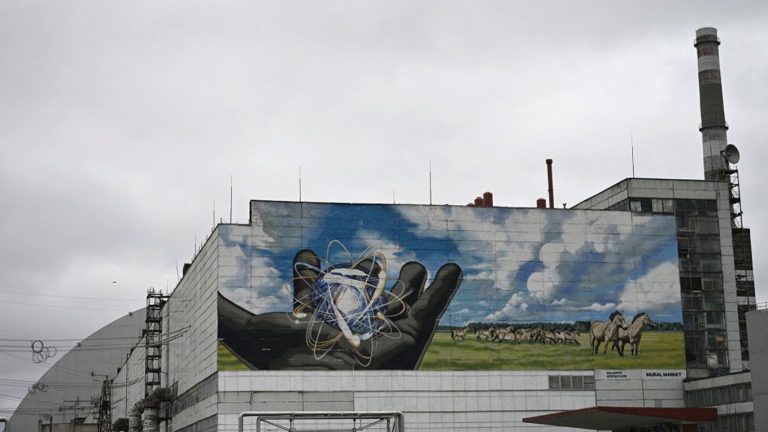
At 1:23 in the morning on April 26, 1986, reactor number four at the Chernobyl nuclear power plant exploded during a botched safety test, sending an enormous plume of radioactive smoke into the atmosphere across Europe. The explosion at the Chernobyl nuclear power plant resulted in the worst civilian nuclear disaster in history. Forty years later, Ukraine marked the anniversary under active bombardment. Strikes across Ukraine, Russian-occupied territory, and Russia killed at least 16 people, as the 40th anniversary prompted fresh warnings about the risks posed by attacks near the plant during Russia’s more than four-year invasion. The terrible symmetry is hard to ignore: a disaster born of Soviet secrecy and recklessness is being commemorated in a country where nuclear sites are, once again, in the crosshairs of war.
The human cost of the original catastrophe remains staggering and contested. Around 350,000 people were displaced in the years that followed, while some 600,000 men put their lives at risk to participate in the containment operations. A UN report from 2005 estimated that the number of deaths due to radiation exposure in the three worst-affected countries stood at 4,000, while a 2006 Greenpeace report put the figure at nearly 100,000. The true toll will never be known. The disaster’s environmental, social, and healthcare cost has been estimated to have exceeded $700 billion, and Soviet leader Mikhail Gorbachev would later say it was “perhaps the real cause of the collapse of the Soviet Union.”
A Monument Under Fire
The story of Chernobyl did not end in 1986. Decades of international effort went into containing the original reactor wreckage — first under a crumbling concrete sarcophagus poured by Soviet liquidators, then beneath the New Safe Confinement, a colossal steel arch completed in 2016. The EU contributed €423 million toward the New Safe Confinement, a massive arch structure placed over the destroyed Unit 4 at Chernobyl to prevent radioactive leakage. The structure — the world’s largest movable object — was designed to house the removal of 200 tonnes of molten nuclear fuel still inside the destroyed reactor, work that was meant to begin in 2026. None of that can proceed now.
Following a Russian drone strike in February 2025, the structure was badly damaged, and the European Commission has dedicated a further €37 million towards restoring it to full functionality by 2030. IAEA Director General Rafael Grossi, during a visit to Kyiv, said repairs to the plant’s damaged outer protective shell must begin immediately, warning that years of inaction could heighten danger to the original sarcophagus beneath it. Ukraine’s President Zelensky was unambiguous about the responsibility: “Russian-Iranian Shaheds regularly fly over the plant, and one of them struck the confinement last year,” he wrote.
The damage to the confinement dome represents more than a repair bill. It is evidence that the international community failed to anticipate — let alone prevent — the deliberate targeting of the world’s most famous radioactive site. When engineers designed the New Safe Confinement in the early 2000s, they built it to withstand natural disasters and structural decay. No one designed it to survive a drone war.
From Chernobyl to Bushehr
What makes Chernobyl’s 40th anniversary particularly grim is that it arrives in the middle of a second, parallel nuclear crisis. Iran’s Foreign Minister Abbas Araghchi claimed the Bushehr facility had been “bombed” four times since the war erupted on February 28, criticising what he described as a lack of concern for its safety. The IAEA confirmed that a structure 350 metres from the Bushehr reactor was hit and destroyed on March 18, and that a security staff member was killed in a subsequent strike on April 4. The IAEA Director General stated unambiguously that a direct hit on Bushehr could result in a very high release of radioactivity to the environment, and that disabling the plant’s power supply could cause a reactor core melt — with protective actions potentially required at distances of several hundred kilometres.
The contrast with the international response to Zaporizhzhia in 2022 is striking. Iran’s Foreign Minister called out Western nations for failing to speak up about the possible dangers of targeting Bushehr in the same way they did over Ukraine’s Zaporizhzhia plant, pointing to the “Western outrage” that followed Russian aggression there. When Russia seized Zaporizhzhia, the UN, US, EU, and NATO all issued immediate condemnations. The European Union has not commented on the attacks on Bushehr. The IAEA issued statements of “deep concern.” The double standard is visible to anyone paying attention — and it is corrosive to the very norms that nuclear safety depends upon.
Beyond Nuclear noted that the IAEA “actively promotes the use and expansion of nuclear power around the world, so the agency must take responsibility for its role in the extreme danger we have found ourselves in, first in Ukraine and now Iran, with nuclear plants embroiled in war.” That critique stings because it is accurate. The IAEA’s mandate equips it to monitor, inspect, and warn — but not to compel, censure, or prevent. Its board of governors includes both Russia and the United States, each of which has been implicated in attacks on nuclear infrastructure during the current cycle of conflicts. The result is institutional paralysis at precisely the moment institutional authority is most needed.
The Governance Gap No One Wants to Fill
Neither national authorities, nor international coalitions, nor even UN bodies such as the IAEA are capable of guaranteeing the effective protection of civilian nuclear facilities during a conflict. That conclusion, drawn by nuclear expert Dmitry Gorchakov, is not alarmist — it is a sober assessment of demonstrated reality. The IAEA’s “Seven Indispensable Pillars” for nuclear safety during conflict are a statement of principle, not a mechanism of enforcement. Critics have noted that these pillars “make an assumption we can now recognize as entirely unreliable — that the world leaders expected to abide by these protocols are sane and rational.”
The calls for a new international framework are growing louder — but they lack a sponsor. The US State Department acknowledged that the Chernobyl catastrophe “compelled us and our partners to create stronger international standards and better safety protocols,” insisting that “nuclear power must remain in responsible hands committed to transparency.” Those words ring hollow in a year when strikes near an operating reactor have become routine news items.
Ukraine is commemorating the 40th anniversary of the Chernobyl nuclear disaster amid lingering fears that Russia’s four-year-old war could spark a repeat of the world’s worst nuclear disaster. That fear is not hypothetical. Any extended loss of power caused by an attack or a direct hit on Bushehr could see the fuel overheat and ignite, potentially leading to explosions and long-lasting radioactive fallout affecting vast areas in Iran, neighbouring countries, and beyond — contaminating agricultural land and seawater in a region that relies on desalination.
Forty years after Chernobyl, the lesson the world drew was that nuclear disasters are catastrophic, irreversible, and demand the highest standards of care and international oversight. The lesson currently being written in Ukraine and Iran is different: that those standards dissolve the moment geopolitical interests are at stake. Chernobyl became a synonym for catastrophe. The question now is whether 2026 will add new entries to that grim lexicon — and whether the world will wait until it does to build the governance architecture that should have been ready before the first drone ever flew over a reactor dome.
Original analysis inspired by Charles Digges from The Moscow Times. Additional research and verification conducted through multiple sources.