Four weeks into the war on Iran, Europe is staring down its second energy crisis in four years — and this one may be worse. The International Energy Agency has called the disruption caused by the Strait of Hormuz closure the “largest supply disruption in the history of the global oil market.” The OECD slashed its eurozone growth forecast by 0.4 percentage points to just 0.8%, while raising its inflation projection by 0.7 points to 2.6%. The European Central Bank has warned that a prolonged conflict will likely trigger stagflation and push energy-dependent economies including Germany and Italy into technical recession by year’s end. A new analysis from CSIS argues that the EU needs a fiscal response on the scale of its pandemic recovery — and that decarbonization is no longer just a climate goal but a matter of hard security.
Storage Tanks Empty, Prices Climbing
Europe entered this crisis in the worst possible position. Gas storage stood at just 46 billion cubic meters at the end of February, compared to 60 bcm in 2025 and 77 bcm in 2024. Under EU regulations, storage must reach 90% capacity by December — meaning the bloc needs to inject nearly 60 bcm during the upcoming refill season just to meet its target. That was already a tall order before Iranian drones struck QatarEnergy’s Ras Laffan facilities on March 2, forcing an immediate production shutdown and a force majeure declaration that has thrown LNG contracts into chaos.
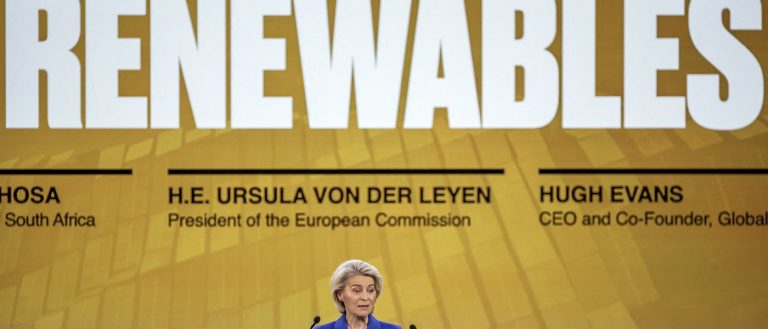
The numbers tell the story. The conflict pushed Brent crude from around €60 to more than €100 per barrel in days, while European natural gas prices jumped 60% since February 28. Commission President Ursula von der Leyen told a nuclear energy summit in Paris that the war cost European taxpayers $3.5 billion in just its first ten days — what she called “the price of our dependency.” Oil executives and analysts now warn that the economic fallout could escalate sharply if the Strait of Hormuz isn’t reopened within the next one to three weeks.
Unlike 2022, when Europe scrambled to replace Russian pipeline gas with LNG from the United States and Qatar, the current shock hits the very supply chain Europe built as its lifeline. Even if a ceasefire were agreed today, the continent is likely already heading toward an energy crisis. Repairs to Qatar’s damaged LNG infrastructure could take three to five years. And the political temptation to crawl back toward Russian gas is already surfacing: Belgium’s Prime Minister Bart De Wever shocked fellow leaders by calling for normalization of relations with Moscow to regain cheap energy, claiming that “in private European leaders tell me I am right.”
From Climate Ambition to Security Imperative
The CSIS analysis makes a pointed argument: Europe’s energy transition, long framed as environmental policy, must now be understood as a security strategy. Wind and solar grew from 20% to 30% of the bloc’s electricity mix between 2022 and 2025, overtaking fossil fuels as the largest source of power generation. But electrification of the broader economy — heating, transport, industry — has barely budged. Electricity makes up only 20% of energy usage, while heating and transport account for 80%, and as one Oxford researcher put it, “we’ve done very little on that 80%.”
The policy prescription is ambitious. CSIS calls for a new fiscal package — on the scale of the €750 billion NextGenerationEU pandemic fund — to subsidize electric vehicles, heat pumps, and grid modernization across the bloc. Spain has already moved, approving a €5 billion crisis package that slashes VAT on energy from 21% to 10%. France’s Macron has announced plans for a military coalition to protect maritime shipping through the Strait of Hormuz, the Suez Canal, and the Red Sea.
But the analysis goes beyond short-term relief. It argues Europe must issue joint Eurobonds to fund Ukraine’s defense — because the Iran war is a Russian windfall. Moscow’s oil revenues have doubled since the conflict began, and the munitions Washington is burning through in the Gulf are the same ones Kyiv desperately needs. The OECD has warned the conflict poses “a real risk of a stagflationary shock,” potentially cutting 0.6 percentage points off EU GDP in 2026 and 2027 in a prolonged scenario.
There is a harder truth embedded in the data. Europe does not escape dependency by electrifying — it changes the form of dependency and, if it is not careful, simply relocates vulnerability from molecules to materials. China controls 60 to 85% of production capacity across EV batteries, solar panels, and critical mineral supply chains. Trading one bottleneck for another is not a strategy.
Still, the direction is clear. As Columbia University’s Jason Bordoff noted, the largest reduction in fossil fuel use came in the decade after the Arab oil embargo, not after the Paris Agreement — because national security concerns can be a more powerful driver of policy than environmental ones. Europe proved resilient in 2022. Whether it can do so again depends on whether leaders treat this crisis as a reason to accelerate the transition or, once the immediate pain fades, slip back into the same fossil fuel dependency that left them exposed in the first place. As that same Oxford researcher warned: “During a crisis, lots of bold ideas are discussed. Once a crisis is over, it’s back to normal. Worse, we have this backtracking.”
Original analysis inspired by Max Bergmann and Federico Steinberg from Center for Strategic and International Studies. Additional research and verification conducted through multiple sources.