Every great standoff comes down to one question: who blinks first? That question is now hanging over the Strait of Hormuz, where a US naval blockade — announced by President Trump on April 13 in the wake of the failed Islamabad talks — has turned an already fragile ceasefire into a slow-burning test of wills. Both Washington and Tehran have compelling reasons to hold firm. Both also have powerful reasons to fold. The outcome will shape not just this war, but the credibility of American power for a generation.
The mechanics of the blockade are less sweeping than Trump’s initial announcement implied. Joint Chiefs of Staff Chairman Dan Caine clarified that the action is a blockade of Iran’s ports and coastline, not a blockade of the Strait of Hormuz itself — a significant distinction, since Trump had initially declared the strait would be sealed entirely. In the first 24 hours, CENTCOM reported over 10,000 personnel, supported by more than a dozen warships and dozens of aircraft, enforcing the operation — with no vessels attempting to breach it. By April 16, the US Navy had turned back 13 ships since the blockade began. On paper, the early signs favour Washington.
Iran’s Vulnerability Is Real — But Not Absolute
Tehran entered this confrontation already badly wounded. As of early 2026, Iran was experiencing its deepest and longest economic crisis in modern history, with international sanctions severely limiting oil exports and access to global markets, compounded by domestic mismanagement and corruption — pushing inflation past 48% in late 2025. The war made everything worse. Residents of Tehran reported prices shooting up around 40% since the war began, with insiders close to the Iranian establishment viewing the economy as the country’s Achilles’ heel, amid fears of renewed unrest.
The blockade adds a third layer of pressure on top of this. The blockade costs Iran an estimated $400 million a day in lost revenue. Failure to reach a ceasefire deal dashed hopes for sanctions relief or the release of frozen assets, and without an influx of funds, authorities face difficulty making payroll — eventually threatening the regime’s ability to govern. There is also a hard time limit on Iran’s options: according to one US analyst, Iran has only 13 days of oil storage capacity, after which it would be forced to shut down its oil fields, potentially causing permanent damage.
And yet Iran has a history of absorbing economic pain that would topple other governments. Even before the war, Iran was losing roughly 20% of its potential oil export revenues trying to bypass sanctions, with Tehran continuing to sell oil through indirect routes despite the costs. The regime has survived forty-plus years of isolation, the 2018 reimposition of maximum pressure, and near-constant currency collapse. Resilience is a survival skill in Tehran.
Washington’s Domestic Clock Is Ticking
The United States has the military capacity to maintain this blockade indefinitely. What it may not have is the political stamina. Traffic through the Strait of Hormuz — through which a fifth of the world’s crude oil and liquefied natural gas supplies once transited — has been almost completely blocked since the war began, sending energy prices spiking globally, with the International Energy Agency warning that Europe may have only weeks of jet fuel reserves left. The IEA has characterized the closure as the largest supply disruption in the history of the global oil market, with economists drawing comparisons to the 1970s energy crisis.
Those comparisons matter to voters. Rising gas prices at home, a war that polls show is increasingly unpopular, and midterm elections approaching on the calendar create a political timetable that Iran’s negotiators can read just as well as anyone in Washington. Trump’s public contradiction of his own vice president’s 20-year enrichment moratorium proposal — reportedly rejecting it after JD Vance had already floated it in Islamabad — has further complicated matters. Shifting goalposts give Tehran reason to believe the US position is less solid than its military posture suggests.
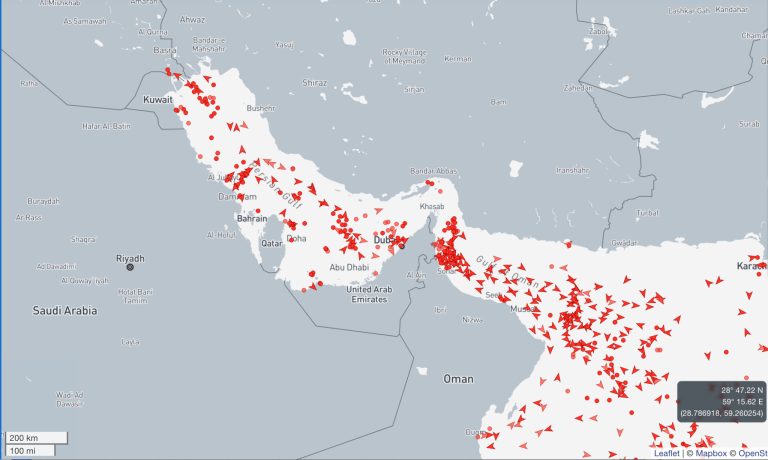
The blockade also has an enforcement problem that technology can only partially solve. Key questions remain about how a large-scale blockade operation of this kind can be sustained over time, given that history shows such measures are difficult to enforce and their results are often unpredictable. Lloyd’s List Intelligence said the US action has plunged shipowners into fresh uncertainty around enforcement. There is also the China dimension: at least four ships related to Iran crossed the Strait on the first full day of the blockade, according to public transponder data, though those vessels later stopped or turned around according to shipping data firms. Whether Washington will risk confronting Chinese-linked tankers as Trump prepares to meet Xi Jinping next month is a question without a comfortable answer.
The Shadow Fleet Problem
One of the less-discussed complications is the shadow fleet — the network of opaque tankers that Iran, Russia, and Venezuela have used to circumvent sanctions for years. CENTCOM confirmed the blockade applies to all ships regardless of nationality heading into or from Iranian ports, with US forces also actively pursuing Iranian-flagged vessels and ships attempting to provide material support to Iran, including dark fleet vessels. But identifying those ships before they transit, rather than after, is exactly where tracking and interdiction becomes complicated. Russia’s shadow fleet experience after Ukraine sanctions is a useful reference: hundreds of tankers continued moving Russian oil for months before countermeasures caught up.
Pressure, Not Collapse
The current standoff is best understood not as a prelude to Iranian capitulation, but as a pressure-building exercise ahead of a second round of talks. Trump announced the blockade after complaining that Tehran had not reopened the Strait of Hormuz as required by the ceasefire agreement, with the move designed to ratchet up pressure after the first round of peace talks failed. Both sides are reportedly preparing for a second round. US Defence Secretary Pete Hegseth insisted the blockade will last as long as it takes, but the real deadline is the ceasefire expiration on April 22 — and what happens if no new framework is in place by then.
Iran’s economy is badly damaged but not broken. America’s military is dominant but its political system is impatient. That asymmetry — between Tehran’s capacity to endure and Washington’s compulsion to resolve — is the real story of the Strait of Hormuz standoff. Roughly 20% of the world’s oil and natural gas normally passes through the strait, and analysts warn prices could reach $100 per barrel or higher if disruptions persist. The longer this drags on, the more the costs accrue on both sides — and the more urgent the question becomes: who actually holds the stronger hand?
Original analysis inspired by Lawrence J. Haas from The National Interest. Additional research and verification conducted through multiple sources.