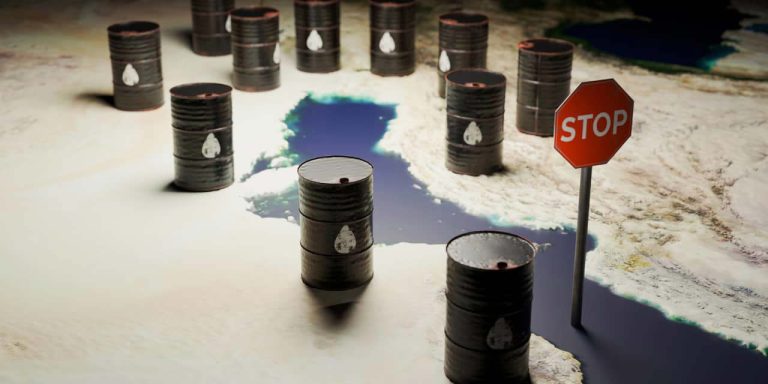
Two months into the conflict between the United States and Iran, the closure of a vital shipping route has triggered the most severe disruption to global oil flows in modern history. Brent crude currently trades between $108 and $115 per barrel, a level that feels almost stable after the initial surge. Yet the real pressure builds out of sight, as usable commercial stocks drain at an alarming rate and major buyers scramble for alternatives.
What looks like ample global reserves on paper quickly shrinks when examined closely. Total oil and product inventories stood at roughly 8.4 billion barrels at the start of the year. According to detailed modeling, however, only about 800 million barrels count as readily accessible without causing physical damage to pipelines, terminals, and refineries. A significant share of that flexible buffer had already disappeared by late April, with daily draws reportedly reaching 11 million barrels or more.
The International Energy Agency has labeled this supply loss the largest ever recorded, exceeding previous Gulf crises by a wide margin. Goldman Sachs analysts note that global inventories have fallen to levels equivalent to just 101 days of forward demand, approaching an eight-year low, and could drop further by the end of May. With roughly 14 million barrels per day of Middle East production effectively offline, the market faces an unprecedented test.
Asia Experiences the Frontline Impact
Buyers across Asia, which normally absorb nearly 85 percent of crude passing through the blocked route, have already exhausted their immediate supplies and moved into emergency mode. China, India, Japan, and South Korea accounted for the overwhelming majority of those flows in recent years. Factory curtailments, government-mandated fuel rationing, flight cancellations exceeding 150,000, and power shortages now mark daily life in several economies.
Pakistan relies on the Gulf for virtually all its liquefied natural gas, while Vietnam sourced around 80 percent of its crude from Kuwait before the route closed. Bangladesh has shuttered universities and commercial sites early to save energy, and the Philippines declared a national emergency in March. Indian authorities responded by imposing export duties on diesel and jet fuel while accelerating domestic gas connections. These measures offer a preview of the demand destruction required worldwide, estimated at 11 million barrels per day to balance the market. For comparison, the COVID-19 lockdowns reduced global oil use by about 9 million barrels daily at their peak.
Traders and banks have modeled extreme scenarios. Macquarie Group assigns a 40 percent chance of oil reaching $200 per barrel if the standoff continues through June, with even higher theoretical peaks possible if additional infrastructure suffers damage. These projections are not forecasts but stress tests that reveal how thin the margin for error has become.
The United States has so far weathered the storm better than most, thanks to its position as the world’s top producer and exporter. American crude shipments have climbed to record highs near 6.5 million barrels per day as buyers hunt for non-Gulf barrels. Domestic gasoline prices have risen more than a dollar per gallon, yet they remain manageable relative to the spikes seen elsewhere. That relative insulation will erode if diesel shortages materialize, since diesel powers much of the global movement of goods.
Europe entered the crisis with unusually low natural gas inventories after a cold winter and faces compounded risks from its dependence on liquefied natural gas routes affected by the same tensions. The European Central Bank has already revised down growth forecasts, with some internal modeling suggesting that sustained high crude prices could halve eurozone expansion. Both sides of the Atlantic will soon feel secondary effects as higher transport and manufacturing costs ripple through supply chains.
A Mutual Economic Chokehold
At its core, the situation represents a mutual economic chokehold. Washington has signaled its determination to sustain naval pressure on Iranian ports for months as leverage, while Tehran’s leadership has vowed to maintain its position on the waterway and key military capabilities. A fragile ceasefire announced earlier has done little to restore tanker traffic. Previous Gulf disruptions typically removed 2 to 5 million barrels per day and unfolded over years rather than weeks. The current shock, involving physical damage to facilities and the loss of 10 to 15 million barrels daily, compresses the adjustment timeline dramatically.
The weeks ahead will demonstrate whether price signals alone can force the necessary reduction in consumption fast enough to prevent broader economic damage. Past experience with oil shocks suggests recessions often follow such sustained price spikes, though the speed of this episode leaves less room for gradual adaptation. Longer term, the crisis may accelerate efforts to diversify energy sources and reduce dependence on concentrated chokepoints, yet the immediate test remains whether the system can absorb a blow of this magnitude without fracturing.