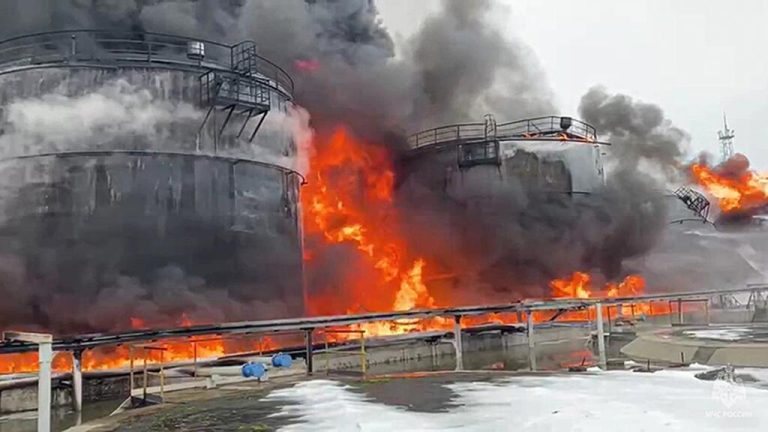
A new chapter in economic warfare is unfolding across the globe, from the plains of Ukraine to the shipping lanes of the Persian Gulf. The recent conflicts have demonstrated with brutal clarity that the age of drone warfare is turning the world’s most vital commodity into its greatest vulnerability. For decades, a nation’s oil infrastructure—its sprawling refineries, massive tankers, and critical terminals—was a symbol of economic might. Today, these centralized assets represent a glaring Achilles’ heel, easily targeted by cheap, precise, and plentiful unmanned systems.
This new reality has been starkly illustrated by Ukraine’s sophisticated drone campaign against Russia. Ukrainian forces have systematically crippled Russia’s oil refining capacity, launching strikes on facilities over 2,500 kilometers from the border. These attacks have exposed the inherent fragility of the fossil fuel supply chain. Refineries are incredibly complex and specialized, making them difficult and time-consuming to repair, especially under sanctions. By targeting these single points of failure, Ukraine is not just damaging military logistics; it is striking at the economic heart of the Russian state.
The Vulnerable Supply Chain
The vulnerability extends across the entire energy supply chain. The recent war in the Middle East showed how easily supertankers, the slow-moving giants of global trade, can be targeted in strategic chokepoints like the Strait of Hormuz. Ukraine has replicated this tactic, successfully attacking Russian vessels in the Sea of Azov. These incidents reveal that there is effectively no foolproof defense for a floating vessel carrying millions of barrels of flammable liquid against a determined adversary with low-cost drones.
This asymmetric threat dynamic fundamentally alters the calculus of energy security. The cost of a single advanced air defense missile can be hundreds or even thousands of times greater than the drone it is meant to intercept. This economic imbalance means that a defensive strategy is unsustainable over the long term. For petrostates like Russia, which rely on a “shadow fleet” to evade sanctions and keep revenue flowing, the risk is now existential. Their economic lifeline is exposed at every point, from the refinery to the terminal to the open sea.
The Strategic Dividend of Decentralization
In stark contrast, the war has also highlighted a path toward a more resilient energy future. As Russia has targeted its power grid, Ukraine has been aggressively rebuilding with decentralized renewable energy sources. A single missile can devastate a centralized gas-fired power plant, but destroying a wind or solar farm requires dozens of strikes for a comparable impact. The modular and distributed nature of renewables makes them inherently more secure and harder to disrupt.
This shift toward decentralization mirrors a broader evolution in modern military thought. The Pentagon itself is moving away from large, fixed bases toward a more distributed and agile posture to reduce vulnerability. The lesson is clear: in an era of precision-guided munitions and low-cost drones, concentration is a liability.
The implications are profound. The pursuit of “energy dominance” through fossil fuels, as championed by leaders like Donald Trump, now looks like a strategic dead end. The very infrastructure that underpins this model has become a source of weakness. The move toward clean energy is no longer just an environmental imperative; it is a national security necessity. A world powered by decentralized sun, wind, and batteries is not only cleaner but also fundamentally more secure and less susceptible to the disruptions of war.
By ThinkTanksMonitor Editorial