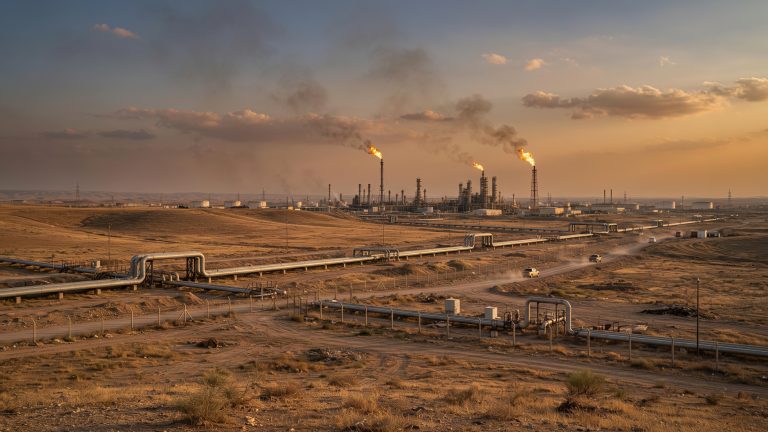
A prolonged governance deadlock inside Iraq’s Kurdistan Regional Government has collided with a decisive federal push from Baghdad, reshaping constitutional tensions across northern Iraq. On November 24, Iraqi Prime Minister Ali Al Zaidi ordered federal authorities to assume control over all regional border crossings, require federal Oil Ministry approval for crude exports, and manage disputed oil fields guarded by Kurdish forces in Kirkuk, Nineveh, Diyala, and Salah Al Din. Federal officials frame the directives as an urgent crackdown on oil smuggling, while Kurdistan Democratic Party and Patriotic Union of Kurdistan leaders condemn them as an unconstitutional infringement on regional autonomy. Iraq’s Federal Supreme Court backed Baghdad’s position on November 25, affirming federal authority over international borders and natural resource oversight while limiting regional jurisdiction to areas administered in March 2003.
Internal Deadlock Weakens Kurdish Leverage
Baghdad’s federal expansion arrives during the deepest internal rupture between the KDP and the PUK in decades. Following the October 2024 parliamentary elections, which awarded the KDP 39 seats, the PUK 23 seats, and the New Generation Movement 15 seats, both ruling parties failed to form a cabinet for two years. KDP officials argue that government posts should reflect electoral seat shares, whereas PUK leaders insist on equal power sharing under their 2006 strategic agreement. Tensions erupted on November 4 when the KDP convened parliament without PUK participation, prompting PUK leader Bafel Talabani to withdraw from the cabinet and threaten a rival administration in Sulaymaniyah.
Party officials and independent observers remain sharply divided over who bears responsibility for the institutional breakdown. KDP leaders, including Prime Minister Masrour Barzani, maintain that reactivating parliament protects regional institutions and reject any administrative partition of Kurdistan. Conversely, PUK spokesman Karwan Gaznai demanded the dissolution of parliament as a precondition for renewed talks, while independent analysts warn that persistent distrust undermines Kurdish bargaining power in Baghdad. Although the two rivals issued a joint statement calling violations of regional rights a red line and later agreed to attend December 1 national talks in Baghdad with a united position, researchers note that this tactical alignment leaves their core governance dispute unresolved.
Federal Enforcement Meets Constitutional Resistance
Federal authorities moved swiftly from legal decrees to physical enforcement along Iraq’s northern frontiers. One day after the supreme court ruling, Iraqi border forces closed the Al Walid crossing with Syria and the Bashta crossing with Iran, both previously administered by the KRG. Prime ministerial adviser Abdul Amir Taiban cited Articles 110 and 112 of the Iraqi constitution to justify federal intervention against alleged smuggling at the North Oil Company, where federal auditors estimated massive revenue losses since 2004. Erbil’s cabinet rejected those orders as unconstitutional, while Iraqi constitutional expert Maytham Handhal and PUK officials contend that the absence of a federal oil and gas law fuels recurring clashes over budgets, customs, and civil servant salaries.
Energy Vulnerabilities and Turkey’s Strategic Calculus
Geographic divisions across the region’s energy grid compound the political standoff between Erbil, Sulaymaniyah, and Baghdad. Most oil fields sit in KDP territory, whereas critical gas infrastructure lies in PUK areas that face acute security threats. On November 8, a drone strike halted production at the Khor Mor gas field in Sulaymaniyah, cutting roughly 2.8 gigawatts of electricity generation and exposing the region’s fragile power supply. Political analyst Lawk Ghafuri cautions that imposing federal authority over contested energy assets without a negotiated agreement with Erbil could escalate into a wider security confrontation.
Meanwhile, shifting export routes have altered Ankara’s strategic position regarding northern Iraq. On November 17, Iraqi Oil Minister Basim Mohammed Khudair announced the resumption of crude pumping through the federal Kirkuk to Ceyhan pipeline to Turkey, providing Baghdad an alternative northern export outlet while regional conflict disrupts Strait of Hormuz shipping. Although federal pipeline flows reduce Turkey’s sole reliance on KRG export channels, Ankara still depends on Kurdish political stability and border security after working throughout 2026 to repair ties with both Erbil and Sulaymaniyah. As Iraqi leaders prepare for the December 1 national dialogue and a December 14 court hearing on the KRG’s caretaker status, whether Kurdish factions convert tactical unity into durable compromise will determine their leverage with both Baghdad and Ankara.
Original analysis inspired by Shaho El Qaradaghi from Anadolu Agency.
Additional research and verification conducted through multiple sources.