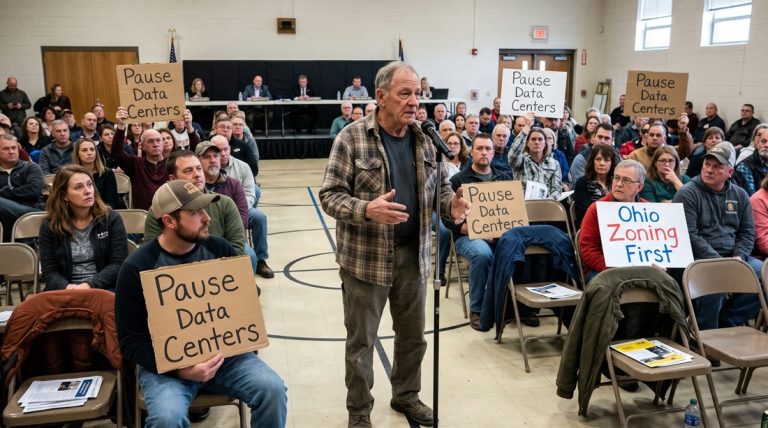
Ahead of the November 2026 United States midterm elections, commentators warned that generative artificial intelligence would flood campaigns with deepfakes and deceive millions of voters. Just as in 2024, however, those apocalyptic predictions of algorithmic election interference failed to materialize. While technology firms operated monitoring rooms and platforms deployed community notes, voters proved discerning enough that synthetic disinformation had minimal impact on election outcomes. Instead, the real electoral collision over artificial intelligence centered on physical data center infrastructure and local land use.
Local Ballot Battles Over Computing Infrastructure
Across the country, voters weighed in directly on the physical footprint of the artificial intelligence boom through dozens of municipal and county ballot measures targeting data centers. In Ohio alone, twenty one local measures passed to restrict or pause server farm construction through zoning rules and moratoriums. Although national Gallup and exit polls showed that household inflation and economic anxieties towered over technology policy as primary voting drivers, regional polling indicated that more than half of voters in Ohio, Texas, and Mississippi viewed data centers and artificial intelligence as major factors in their congressional choices.
Over fifty five percent of surveyed voters in those three states expressed concern that artificial intelligence could harm society, and those skeptical voters disproportionately backed Democratic candidates. While local communities have valid reasons to debate zoning and utility strain, calls by figures like Senator Bernie Sanders for a nationwide federal moratorium risk choking off domestic innovation. Restrictive local and federal policies are already prompting companies like Google to invest fifteen billion dollars in Malaysian data centers while Elon Musk floats orbital computing concepts, potentially depriving smaller American businesses of domestic cloud capacity.
Divided Government and State Regulatory Patchworks
With Democrats taking control of both the House and Senate alongside a Republican White House that favors light touch regulation, sweeping federal artificial intelligence legislation remains unlikely over the next two years. Narrow bipartisan compromises could still emerge around federal data privacy standards, government surveillance limits, or military autonomous weapon guardrails following recent disputes between the Pentagon and Anthropic. However, hasty bipartisan efforts to restrict chatbots in the name of youth online safety could inadvertently infringe upon free expression and user privacy.
Federal gridlock will likely accelerate legislative activity across state capitals, where lawmakers have already introduced more than one thousand artificial intelligence bills over the past two sessions. When state legislatures in California, New York, or Texas regulate model development and algorithmic design, their rules effectively create a fragmented national standard that burdens interstate commerce. Policymakers can better serve constituents by protecting civil liberties against government abuse of surveillance tools and modernizing outdated occupational licensing laws rather than restricting emerging software.
Original analysis inspired by Jennifer Huddleston and Christopher Gardner from Cato Institute. Additional research and verification conducted through multiple sources.