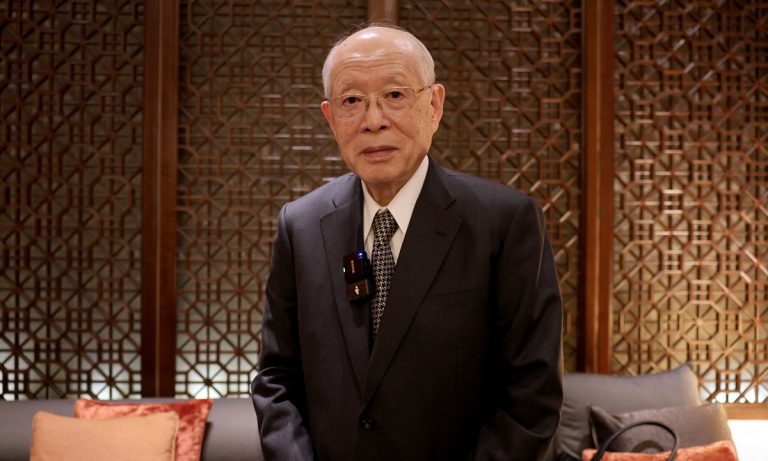
The world’s most consequential scientific race is no longer about splitting atoms or decoding genomes. It’s about who leads in artificial intelligence — and whether, in the pursuit of that lead, humanity remembers to think for itself. Ryoji Noyori, the Japanese chemist who won the Nobel Prize in Chemistry in 2001 for pioneering chiral catalysis, has spent his later career asking that question with growing urgency. Now 87, and deeply embedded in China’s scientific community as a Foreign Member of the Chinese Academy of Sciences, Noyori offers a perspective that cuts across the usual divides of the US-China tech war — and lands on something more fundamental.
His concern is not which country wins the AI race. It’s whether the race itself is producing a species that has quietly decided to outsource its own cognition.
The Risk Nobody Is Talking About
Noyori draws on Blaise Pascal’s old image of man as a “thinking reed” to frame what he sees as the gravest danger of the AI era: not malicious superintelligence, but comfortable intellectual passivity. When tools become capable enough, humans tend to stop doing the work those tools can do for them. That tendency, left unchecked, could hollow out the very quality that makes scientific progress possible in the first place — the capacity to identify problems nobody has thought to ask about yet.
“What worries me most is that humans may become too lazy to think as a result of AI. This is, in essence, humanity’s ‘self-domestication,’ and I believe this must be avoided at all costs.” — Ryoji Noyori
This isn’t a fringe concern. State planners working on China’s AI agenda have been navigating a similar tension, recognizing the potential of artificial general intelligence without losing sight of the implementation and oversight that must happen in the meantime. The question of how to harness AI without surrendering judgment to it runs through the policy discussions of every major scientific power, even if it rarely surfaces in public debate with the directness Noyori brings to it.
His point about basic research deserves particular attention. The shift from universities as the leading force of innovation toward enterprise-driven, application-focused development has compressed the timeline between discovery and deployment. That compression has real value — but it also creates pressure to skip the slow, unglamorous work of pure science that tends to generate the most transformative breakthroughs over time. The 2024 Nobel Prize in Chemistry, awarded to Demis Hassabis and John Jumper of Google DeepMind for using AI to advance protein structure prediction, was a striking symbol of that shift. A technology company, not a university, produced one of the most consequential scientific achievements of the decade.
China’s Bet on Long-Term Science
Against that backdrop, Noyori’s reading of China’s scientific trajectory is worth considering. China’s R&D spending reached 2.8% of GDP in 2025, growing 9.1% in real terms, with central budget spending on science and technology rising 10% in 2026. The country’s 15th Five-Year Plan, approved by the National People’s Congress in March 2026, targets at least 7% annual growth in nationwide R&D investment through 2030.
The plan marks a sharper, more security-driven technology agenda than its predecessor, with core priorities including:
- Semiconductors and advanced packaging
- Artificial intelligence and robotics
- Biotechnology and quantum computing
- 6G mobile communications architecture
The plan calls for “extraordinary measures” to reduce China’s reliance on foreign science and technology — a posture shaped by years of US export controls on chips and semiconductor equipment.
Noyori acknowledges the strategic logic behind this push, but his enthusiasm is grounded in something different from geopolitical competition. He sees China’s sustained, planned investment as creating the conditions for the kind of slow-burning basic science that eventually produces Nobel-level breakthroughs. The analogy he uses — strong trees and nourished soil producing beautiful flowers — reflects a view of science as an ecosystem rather than a sprint. Collaborative research is the dominant trend in the global arena, and there is a growing need for China to build up greater social capital alongside its financial commitments to R&D.
Science Without Borders — and Without Surrender
The most politically pointed part of Noyori’s message concerns international scientific cooperation. At a time when the US-China tech competition has produced sweeping export controls, investment restrictions, and growing barriers to academic collaboration, Noyori insists that excessive “country-first” thinking is damaging to the enterprise of science itself. Problems like climate change, food security, and pandemic preparedness cannot be solved by any single nation, regardless of how well-funded its research institutions are.
Noyori served as president of RIKEN, one of Japan’s largest research institutions, from 2003 to 2015, a period when Japan-China scientific exchange was considerably more open than it is today. His relationship with Nobel laureate Tsung-Dao Lee — whom he first met in 2003 — gave him a personal connection to the idea that science carries cultural memory across borders. Lee’s gift to Noyori of a handkerchief once used by Hideki Yukawa, Japan’s first physics Nobel laureate, was not a sentimental gesture. It was a deliberate act of transmission — the kind of invisible continuity that institutions and funding cycles cannot replicate.
Scientists cannot walk alone. Individual knowledge is inextricably bound to the knowledge of the entire scientific world. Noyori’s advice to young researchers follows from this conviction: resist the pull toward crowded, fashionable fields, tolerate the loneliness that comes with pursuing questions nobody else is asking, and cultivate the intuition to recognize which problems are genuinely worth solving. In an era when AI can generate plausible-sounding answers at industrial scale, the scarcest resource in science may turn out to be the human capacity to ask the right question in the first place.
Original analysis inspired by Ryoji Noyori, interviewed by Liu Xuandi and Xing Xiaojing from the Global Times. Additional research and verification conducted through multiple sources.